


EVA Foam for Beginners
Discover what EVA foam is and how to use it! This versatile material is ideal for cosplay, sports equipment, decorations, or even flooring.

What do you find in the article?
We are a cosplay couple from Slovakia, Rys and Tor’Kaya, and we have been making costumes for over 5 years. Our favorite material is EVA foam, as we love crafting large armor and weapons. Rys wants to focus on creating large props and gear in the future, whether from foam or other materials. His biggest dream is to build a motorcycle. Tor’Kaya would like to improve her pattern-making skills and learn how to work with casting techniques and electronics.

What is EVA foam and what is it used for?
- Ethylene Vinyl Acetate
- foam
Beyond making props and cosplay, EVA foam is primarily used for decorative elements, sports equipment, or various floorings and cushioned surfaces. It is used in a wide range of densities and thicknesses.
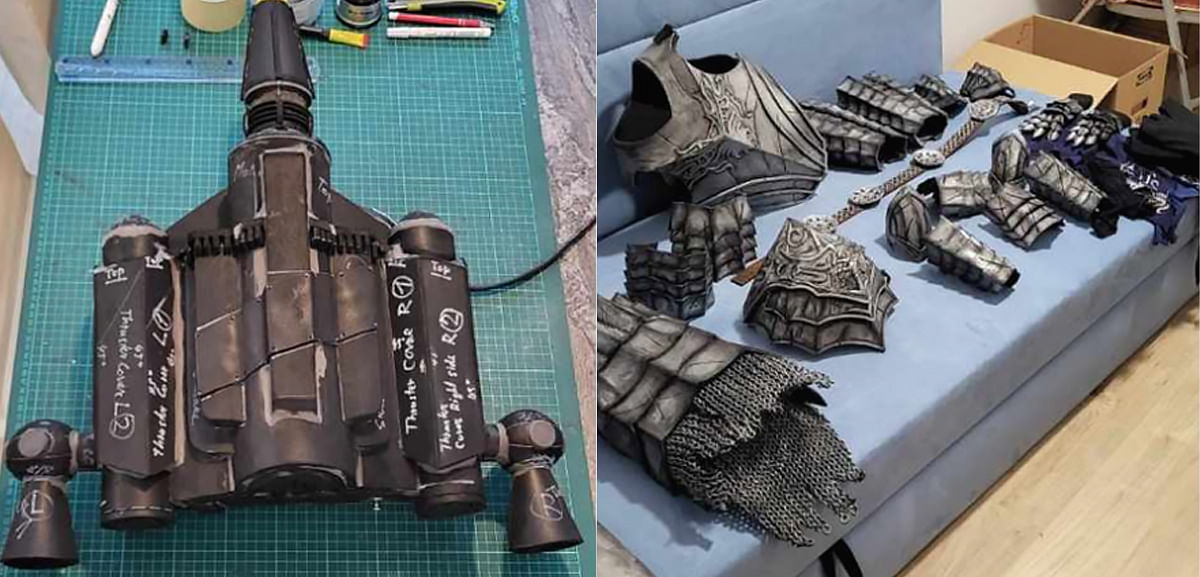
At the same time, EVA foam is an excellent material for making the aforementioned cosplays and various props – from armor and weapons (like swords or pistols) to boots and more.
You can also use it to reinforce soft parts (dresses, trousers, shirts, jackets, and other "sewn clothing") or wigs.
What types and variants are there?
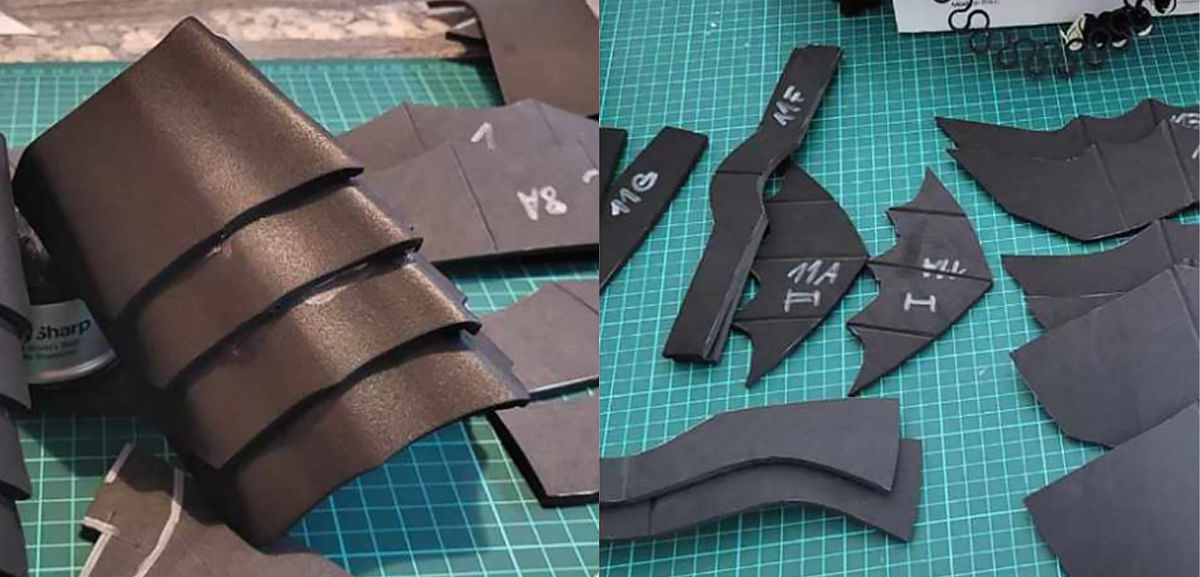
EVA foam comes in various forms, and all of them are great for making cosplay. These include classic sheets and rolls, foam clay, and foam that is pre-cut into various shapes, such as scales, circles, and other patterns, including edges and trims.
For beginners, standard rolled sheets are the most accessible and practical to use.
Foam density and thickness
The basic characteristics of EVA foam that are important for costume makers are density and thickness. Both have their own categories, and it is necessary for a potential costume maker to think ahead about what kind of foam they will need for their planned project.
Regarding density, EVA foam has several variants, each suiting different purposes, and costume makers choose based on the properties their props require. You cannot see the density with the naked eye, but you can feel it; even so, information from the seller is important. A simple explanation of how density affects the final product: the denser the foam, the less flexible the result. The opposite is also true – the lower the density, the more flexible the product. If you want to make a prop that is rigid and won't bend, like a sword, use high-density foam.
Based on common characteristics and usage, they can be divided as follows:
1. EVA foam sheet (100 kg/m3) - Characterized by high density (HD). It is perfect for rigid costume parts, such as armor and weapons. 90% of costumes with rigid parts are made from high-density foam. Generally recommended for: helmets, breastplates, weapons, etc.
2. EVA foam sheet (50 kg/m3) - Characterized by low density (LD). It is suitable for costume parts that need to bend frequently. Good examples include foam calf guards, thigh pieces, and similar items. Generally not recommended for: helmets, breastplates, weapons, etc.
3. LED foam - This type of foam usually has medium/moderate density. Its main feature is translucency, making it perfect for prop elements that need to let light through (for example, using LED lighting).
4. EVA foam sheet (150+ kg/m3) - This type of foam has the highest density (UHD). It is ideal for static props like weapons – large swords, rifles, cannons, etc. Not recommended for complicated or small details.
Furthermore, it is important to mention foam thickness. Unlike density, you can see the thickness with the naked eye. Foams of different densities come in different thicknesses – it is important to correctly identify the sheet you need for your project. Because you can easily estimate thickness by eye, the properties associated with it are easier to explain – the thicker the foam, the larger it is. Foam thickness is measured in millimeters. Based on usage and availability, it can be divided as follows:
1. 3 mm - Used mostly for edges, decorations, patterns, and small details.
2. 5 mm - The most commonly used thickness overall. Elements most often made from it: armor, breastplates, helmets, larger decorative parts, etc. It is also suitable for large pieces that need to bend.
3. 10 mm - Used mostly for shields, swords, etc. Generally suitable for large pieces that do not bend.
Foam clay
Another separate product that falls into the EVA foam category is foam clay. The material comes in a soft form – in airtight plastic containers. In appearance, foam clay is similar to modeling clay or plasticine. In the world of prop and costume makers, foam clay serves two main purposes: modeling elements and smoothing uneven joints.
By modeling elements, we mean imitating jewelry, fittings (buckles and clasps), or even more complicated structures like various remains (trophies, imitation bones, and skulls). Activating foam clay is similar to working with the aforementioned modeling clay – it works on a water/air basis. To activate this material, you need to apply moisture using hot water, after which the foam clay can be shaped. Once the desired shape is achieved, the foam clay begins a passive air-drying hardening process. Unlike modeling clay, it is not recommended to speed up the hardening process of foam clay with heat – the material is often ruined.
In a dry environment at room temperature (approx. 22 degrees Celsius), foam clay hardens over several days, so for an ideal result, it is recommended to work with this material without rushing. Once fully cured, the material can be worked with rotary tools and sandpaper.
As for painting this material, you can use the same paints used for standard foam. For a perfect finish, it is recommended to use a primer or sealer to seal the surface; otherwise, there is a risk of cracking.
Contact cement
The basic and main adhesive that costume and prop makers use when creating all possible foam joints is contact cement. It is a neoprene adhesive that works on the principle of contact between two surfaces. It differs from traditional paper (or other surface) glues – you must apply contact cement to both surfaces you want to join, then wait a certain amount of time – usually 10-20 minutes, depending on how much glue is used. Once the glue dries to the point where it is no longer sticky to the touch, press both surfaces together and hold. Only this correct procedure guarantees a truly strong bond, which is necessary for the proper use (and shaping) of the foam.
For easy use, a small applicator (tube) is recommended. If you need to spread this glue over larger areas, a brush with a plastic tip is better than one with bristles.
Joints created by the correct application of this glue are very resistant to bending, temperature, and friction. If they get damaged, repairing them is also simple – a fact that foam as a material shares.
Other tools
Other essential tools you won't be able to do without when working with foam include:
- thin white marker
- utility knife
- special cutting mat
- heat gun
- rotary tool
These basic tools are enough to process foam and subsequently make costumes. The white marker and utility knife are needed to trace templates onto individual pieces, and the mat protects the table while cutting. It is very important to mention that the mat you cut foam on must not be wooden (like a kitchen cutting board). While you could use it, it would only last a few times before being destroyed. For these purposes, use a special cutting mat (the high-quality ones boast self-healing properties). These mats have built-in scales and rulers that can help with cutting.
An essential part of every kit is, of course, a heat gun. It is a tool that, when plugged in, blows a strong stream of hot air. Today, you can buy one at any hardware or home improvement store. Their price reflects their features, but for basic foam processing for costume making, models with at least 2 heat settings are sufficient (and in a way, essential). One of the basic properties of EVA foam, which also determines its importance in the world of costumes, is its flexibility and ability to hold a bent shape even after cooling.
This article will cover other foam properties, including the ability to create a very smooth surface using heat, later on, but this is another reason why it is important to have a heat gun.
A rotary tool also plays a very important role, although it is not considered strictly necessary. You can mount several different attachments into a rotary tool to sand, smooth, or carve shapes into the foam.
EVA foam is an indispensable material for a wide range of creative and practical projects. Its versatility, availability in various variants, and ease of processing make it an ideal choice for cosplay, sports equipment, decorations, and many other applications. Thanks to EVA foam, you can easily bring your ideas to reality.
authors: Rys and Tor’Kaya
Tor’Kaya
Autor článků na imago.cz


You might also like

Star Wars lightsabers and their replicas
The lightsaber, the legendary weapon from the Star Wars film series. Many consider it one of the main reasons for the popularity of this universe. Want one too? We'll help you choose the right lightsaber. full article...
Non-fiction journalism 27. 7. 2026 Karel Krajča 4 min
Vampire: Step-by-Step to an Immortal Look
A quick guide on how to transform into an elegant vampire in twenty minutes—makeup, colors, details, and fangs for the perfect Halloween look. full article...
Tips and guides 27. 10. 2025 Eva Lassler 4 min
Fantastická Ostrava 2025 Festival: A World Beyond Reality
The biggest fantasy event in North Moravia celebrates its sixth edition! Thousands of fans, international stars, and a program packed to the brim. full article...
Non-fiction journalism 3. 6. 2025 Karel Krajča 4 min