


How to write a gamebook without losing your mind (Part 1)
A gamebook is an interactive story where the reader/player decides, to some extent, how the adventure turns out. Understanding a gamebook is easier than it seems…
What do you find in the article?
Gamebooks, a game and a book in one. An unconventional creative endeavor that is loved by many, hated by others, and often misunderstood. A gamebook is an interactive story where the reader/player decides, to some extent, how the adventure turns out. Understanding a gamebook is easier than it seems. And from that knowledge, it's just a short step to creating one yourself.
Before I dive deeper into how to write gamebooks, I recommend reading The Glory and Misery of Gamebooks (Part 1) and The Glory and Misery of Gamebooks (Part 2), which cover their history from the beginning to the present. I won't be dwelling on the past in this article. I will focus on how to actually write a gamebook. What you can pack into it, and how not to go crazy from all the constant branching.
I should warn you in advance that my approach isn't some highly polished, years-tested know-how. As with everything, there are recommended steps, apps, or programs, but not all of them will suit you as an author. If you are interested in writing gamebooks, find your own style, mechanics, and tools that work for you personally. And if someone tells you your choices are wrong, send them to the appropriate link and keep doing it your way.
The Plot of a Gamebook
If you've already had an epiphany, a vision, a drunken or even sober fit of courage, or some other kind of fantastical delusion that drove you to write a gamebook, congratulations! You've taken the first step. Now let's think about what your gamebook will be about.

If we look back at works like Lone Wolf or the Fighting Fantasy books—gamebooks that shaped the form of interactive literature for decades to come—we find that the plot is often extremely primitive. It is precisely this possibility of choice that creates the feeling of a complex work.
Let's take an example - Lone Wolf, Book 1: Flight from the Dark. What is the plot? You are a young initiate of an ancient knightly order. One day, the temple where you train is attacked by enemies, and after a brutal battle, you become the last living member of this once-renowned order. You must reach the capital city and bear witness to what happened.
That's it. Really. No complicated plot, no turning points, no narrative twists, no cliffhangers. The story is completely simple—go from point A to point B. The experiences you have as a player in between are not drivers of the plot, but rather mechanics of chance and reward. Yes, you can meet characters who make your life much easier. You can get items that make you stronger. You can also die. But none of that changes the fact that you have a very simple task.

The same mechanics apply to books like The Warlock of Firetop Mountain, City of Thieves, or Citadel of Chaos. In these cases, you are summoned or voluntarily become a hero determined to destroy an evil villain. Nothing more, nothing less.
Do you already have an idea of what your gamebook could look like?
For me, as a writer of standard fiction, I can't work with this total simplicity. My writing follows almost cinematic rules. In the opening scenes, I introduce you to the main character, establish their personality, and create basic motivation. Drama is conflict, so it's often about some inconvenience that sends the hero out into the world. Subsequently, I create hooks—little things that slightly turn the plot in a different direction—these can be people, objects, or situations. Climaxes and conclusions also belong in my books and short stories.

TIP: Joseph Campbell explains in his studies that the basis of every narrative is the fact that we place the main hero in a non-standard situation. We take away their stable place on the ground. We kick them out of their comfort zone. The hero is thrown into an unknown environment that they must deal with. And I'm not just talking about physical locations. An unknown environment can also be, for example, previously unexperienced feelings or newly discovered abilities that the hero cannot control.

So, if you have your main hero and their motivation, you're one step further. Now comes the (in my opinion) harder part. The actual storytelling and mechanics.
"You are a hero on the road to the city"
Gamebooks are written from the second-person perspective and in the present tense. This means everything happens at the very moment the player is reading about it.

Example:
You enter the tavern. A charming waitress greets you with a nod from a table. The young woman has a flower behind her ear and her long, chestnut hair braided into a neat plait.
"The gods be with you," she smiles at you, and you have to admit that the brunette is a true gem of this otherwise poor-looking establishment. "I am Yani. How can I serve you, noble sir?"
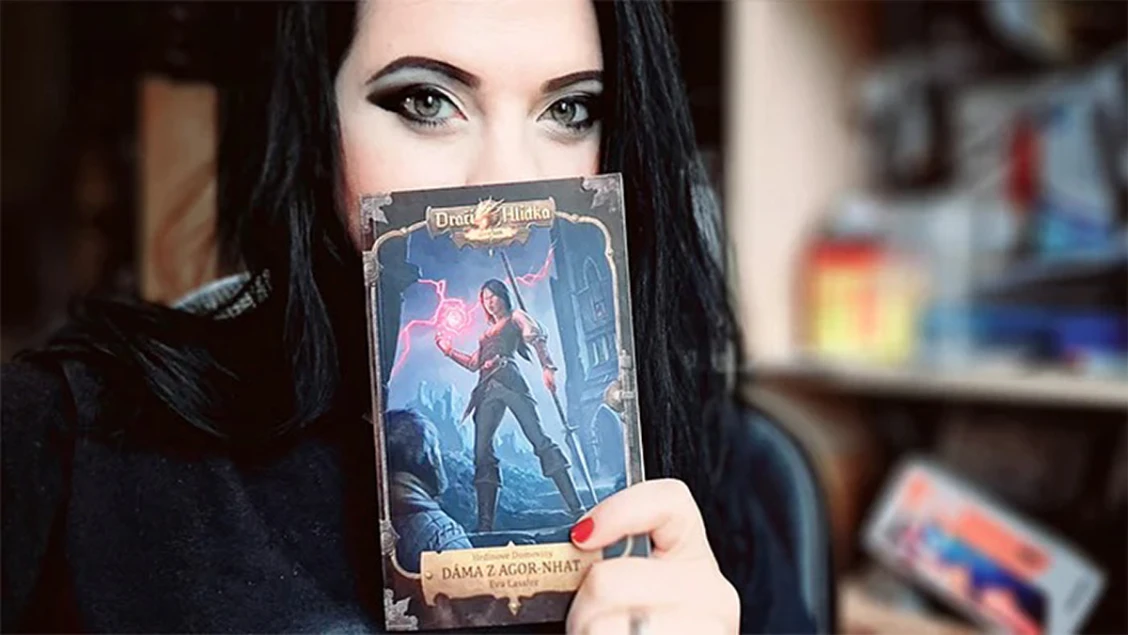
LASSLER, E. Hrdinové Domoviny: Dáma z Agor-Nhat. 1st ed. BlackTower Entertainment, 2022. ISBN 978-80-908162-4-4
Writing a gamebook is much easier once you get used to writing in the present tense (if you aren't already). I wrote my first gamebook in 8 weeks! That's a time worthy of an Olympic winner. Usually, I give myself about 8-12 months to write a classic book.

Paragraphs should be short and punchy—unless you need to explain something in more detail. You rarely find long-winded passages with "Tolkien syndrome," describing every blade of grass. Yes, more extensive descriptions appear in modern gamebooks (Za Jitřní štíty or Měsíční oheň), but it's also about what you enjoy more as an author or as a reader.
One magical rule for writers says: "Write what you would enjoy reading."
In my gamebook, you'll find both—longer descriptions where it's necessary to explain the logic of the plot or history. But also extra short descriptions, because I don't enjoy reading about how many haystacks are lying in a field. Especially if it's not essential to the story. I have full trust in the reader's imagination and don't need to hold their hand.
In gamebooks from the 70s to the 90s, you will encounter direct speech spoken by your character somewhat less often. I think it's easier to identify with them that way. The text is also shortened by simply writing that something was said.

Example:
Subsequently, you tell the duchess everything you have experienced so far. Jusmina listens attentively to everything.
LASSLER, E. Hrdinové Domoviny: Dáma z Agor-Nhat. 1st ed. BlackTower Entertainment, 2022. ISBN 978-80-908162-4-4
You as the player have experienced it, so you know what the character tells the duchess. It's quite logical. But—again, you can use this, or you don't have to.
Currently, I am working on a new gamebook that is primarily sci-fi. I think of it as a computer game in a book. I am a huge fan of the MMORPG Star Wars: The Old Republic. The fact that the characters I play speak in the game and I see them react to stimuli is priceless! Therefore, the main hero in my upcoming gamebook Second Earth not only speaks—and often—but also has their own opinions. They express them, they stand by them, even if it doesn't necessarily match the reader's personal views. Let's be honest, it doesn't match mine either, but that's why we are authors. 🙂 We know how to speak for others.

To old-school gamebook players, this might seem unusual, but I believe the entertainment industry has moved so far that it's actually natural for us to play as characters without imagining that we are them. We perceive and accept emotions happening on monitors and TVs as if they were our own. Even if the player is, for example, a woman and the main hero is a man, or even an animal.
Personally, as a gamer (RPG or PC/console) and author, I prefer male characters. Again, I take to heart the rule that I write what I would enjoy reading. In my work, you will find a female lead only once, in my debut—the young adult western Old-West Story: Na straně zákona (available only as an ebook).
Furthermore, regarding gender, gamebooks in English have the luxury of a language that allows them not to specify gender if the authors don't want to. We Czech authors don't have it so easy.
Before I end the first part of this recipe for writing gamebooks, I will also mention illustrations. Gamebooks may or may not contain illustrations. In the vast majority, however, you will find them in the books. Primarily in the form of maps or page dividers, for proper layout or the visual style of the book. Sometimes illustrations are useful if you want to set the atmosphere or imprint a specific thing or person into the reader's visual memory.

If you want to enrich your future gamebook with illustrations, you can draw them yourself (like author Michael Reilly in the gamebook Za Jitřní štíty), or reach out to a professional artist. Be very specific about what they should draw, but also trust their talent and have constructive conversations.
In the next part, we will look at the content of the narrative, good advice from professionals (Reilly, Green, Lloyd), and think about the actual game mechanics of your future work.
author Eva Lassler
List of parts:
How to write a gamebook without losing your mind (Part 1)
How to write a gamebook without losing your mind (Part 2)
How to write a gamebook without losing your mind (Part 3)

Eva Lassler
Eva „Ronne“ Lassler je autorka a výtvarnice z Ostravy. Je spisovatelkou zaměřující se na gamebooky, překladatelkou a organizátorkou festivalu Fantastická Ostrava.
You might also like
Book Review: Sladký příběh – A Dark Fairy Tale of Bizarro Fiction
Do you dream of reaching the end of the rainbow? In Sladký příběh, a childhood dream turns into a dark reality. Find out in our review why this slim book will consume you. full article...
25. 8. 2026 Tereza Nesvadbová 3 min
Mytago Publishing Newsletter #37
Discover the latest from Mytago Publishing! We're releasing an expansion for The Witcher RPG, a campaign for Pirate Borg, and another installment of Fighting Fantasy. Find out what's in store for you this year. full article...
20. 8. 2026 Jiří Reiter 5 min
What is a gamebook? History and the most famous series
Half game, half story – that is how you could briefly describe the phenomenon called a gamebook. And what are the most famous gamebook series? full article...
Non-fiction journalism 4. 8. 2026 Jiří Reiter, Karel Krajča 7 min