


The Glory and Misery of Gamebooks (Part One)
You might have seen them in elementary school, with classmates secretly rolling dice under their desks during class and flipping through pages like crazy. Your friend or older brother probably had them, and they might have even been an integral part of your early literary life.

What do you find in the article?
If you have ever dabbled in fantasy or sci-fi literature, games, movies, or the fandom in general, you have likely heard the term "gamebook".
If you grew up in the 90s, gamebooks were everywhere. You might have seen classmates secretly rolling dice under their desks during class, flipping through pages like crazy. Your friend or older brother probably had them, and they might have even been an integral part of your early literary life.
For those of you who have only (not) heard the term and never took part in this amazing literary adventure, I have prepared a series of articles. This series is also dedicated to current young readers or seasoned gamer-readers who want to reminisce about the gamebooks they have played.
If you tell someone you collect gamebooks, you will probably be seen as a bit of a weirdo. Most people will just stare at you blankly, and only a handful will know what you are talking about. No wonder. Gamebooks have seen their heyday, and today there are few attempts to revive this forgotten phenomenon. If you do get your hands on one, I believe you will enjoy the adventure just as much as in the golden age of gamebooks.
Every gamebook is a little different, but they all have one thing in common. Only you decide what the next step in your story will be. You control the hero, and only you decide their fate. Besides the gamebook itself, the gamer-reader's equipment usually includes a pencil with an eraser and a die, but that is just a minor detail.
Equipped like this, you navigate the story using numbered links, tensely moving your character closer to the desired goal. It is up to you to decide whether to "investigate the strange noise behind the door on the left" and turn to link no. 64, or conversely, "ignore the noise and keep creeping through the hallway in the shadows to keep your position hidden for a while longer" and turn to link 155.
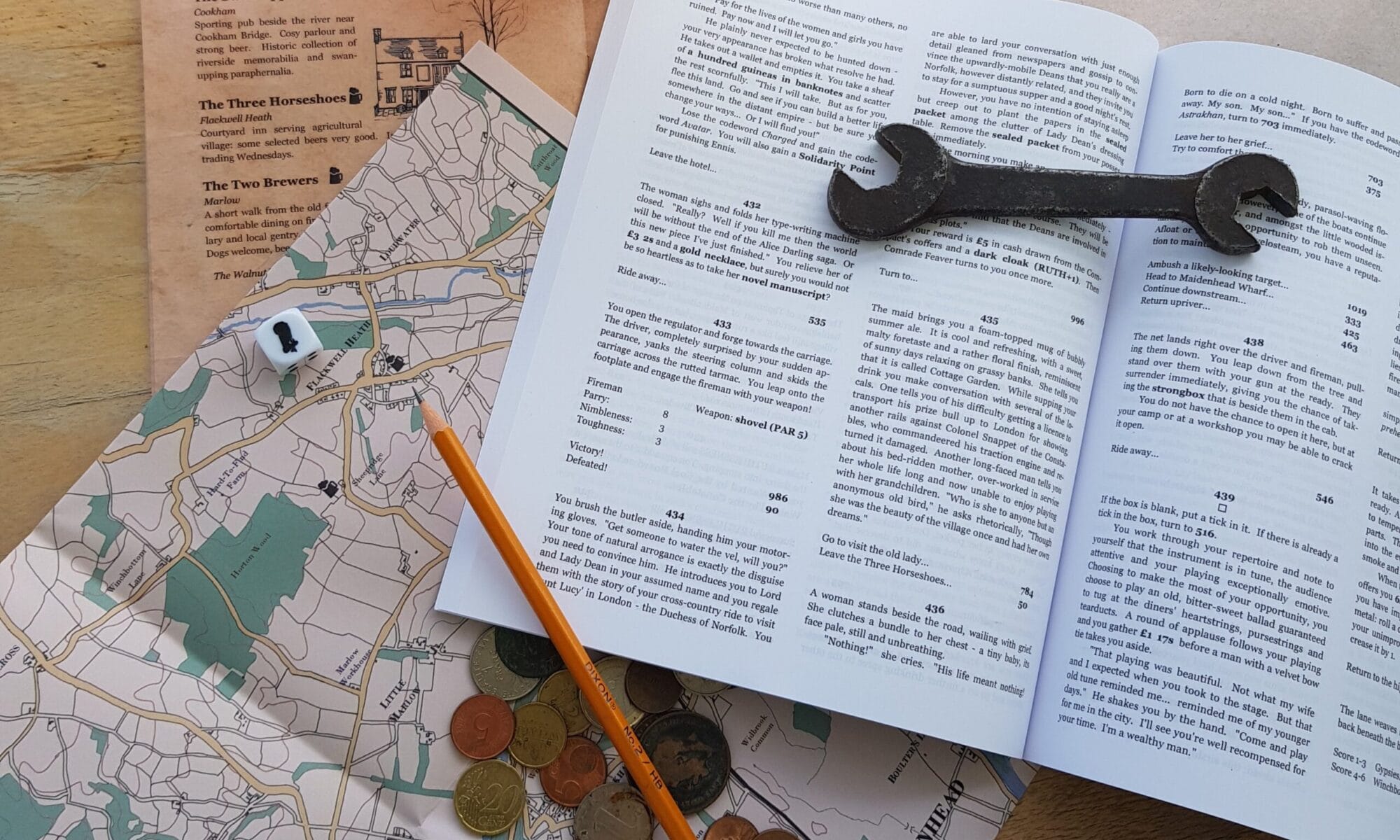
You will be turning pages, making decisions, or rolling dice almost constantly, eventually reaching the final boss, a magnificent treasure, or your bleak demise. That is it… That is the whole trick, which surprisingly works perfectly.
Beginnings, middles, and ends…
In the Czech Republic, a solid collection of gamebooks has been published since the revolution, but their history goes back a bit further. Aristotle once stated that a traditional story always has a beginning, a middle, and an end. A story in a gamebook has one beginning, many middles, and several ends. Literary theorists call this type of story "branching narrative paths". The excellent Argentine fantasist Jorge Luis Borges was playing with the idea of branching stories in some of his short stories as early as 1940.
In 1950, American behavioral psychologist B. F. Skinner developed so-called Programmed Instruction, which defines the programmed structure of curriculum in books (or computers today) so that a student can answer simple questions derived from the material themselves, thus directly determining the direction of their own learning. In the 1960s, the French avant-garde group OuLiPo (Ouvroir de Littérature Potentielle, or Workshop of Potential Literature) invented what is called "tree literature", a story influenced by an uninvolved person – the reader or viewer.
However, the very first pioneers of game-reading are considered to be Edward Packard (*1931) and R. A. Montgomery (*1936 – †2014) in the late 1970s. Packard came up with the idea of branching story paths while telling bedtime stories to his children.
"I had a character named Pete, and I usually described his adventures on an isolated island somewhere in the middle of the ocean," Packard said in a 1981 interview. "But one day I ran out of ideas, so I asked my kids what Pete should do." When his daughters came up with different plots and sequels, Packard simply invented a different ending for each one. "What really got me? The natural enthusiasm and delight the girls found in it. So I thought: 'Shouldn't I write this down?'"
And Edward Packard, of course, wrote the story down and published it in 1976 under the title Sugarcane Island with the help of the publishing house Vermont Crossroads Press, owned by the couple Constance Cappel and R. A. Montgomery. Enthusiastic about the originality of Packard's book, Montgomery himself wrote a sequel titled Journey Under the Sea, which was to become the second volume in the newly created The Adventures of You series.
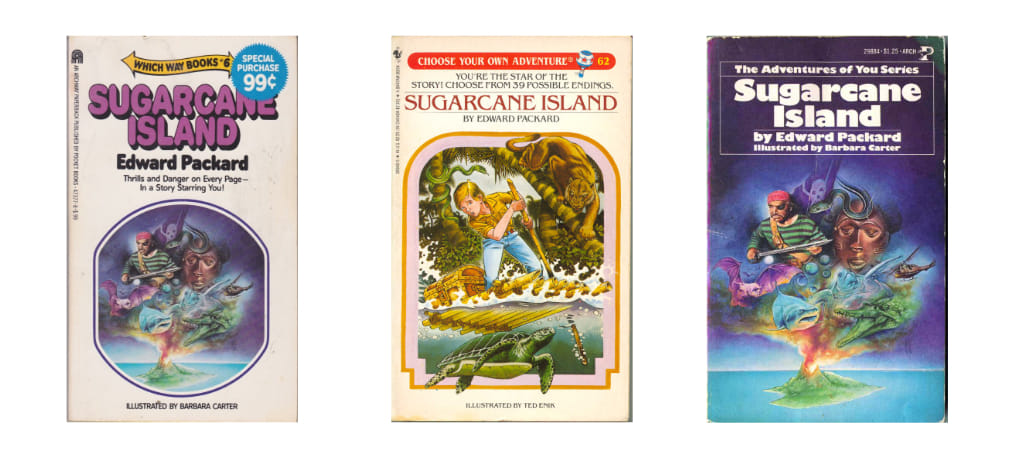
Unfortunately, a sudden divorce forced Montgomery to sell the family business, and the first gamebook series moved to a new publisher – Bantam Books. Fortunately, Bantam agreed to continue, and they hired Montgomery and Packard to write another five adventures, the first of which was called The Cave of Time.
Against all odds, the rebooted series, now renamed Choose Your Own Adventure, was a huge success. The series was published between 1979 and 1998, included over 184 titles, and sold more than 250 million copies worldwide. Packard and Montgomery together wrote over 60 titles in total.
American vs. British Gamebooks
Choose Your Own Adventure was the first successful series of gamebooks as we know them today. This series defined the style we call the "American type (tradition) of gamebooks", as opposed to the slightly younger "British type (tradition) of gamebooks" that appeared a few years later.
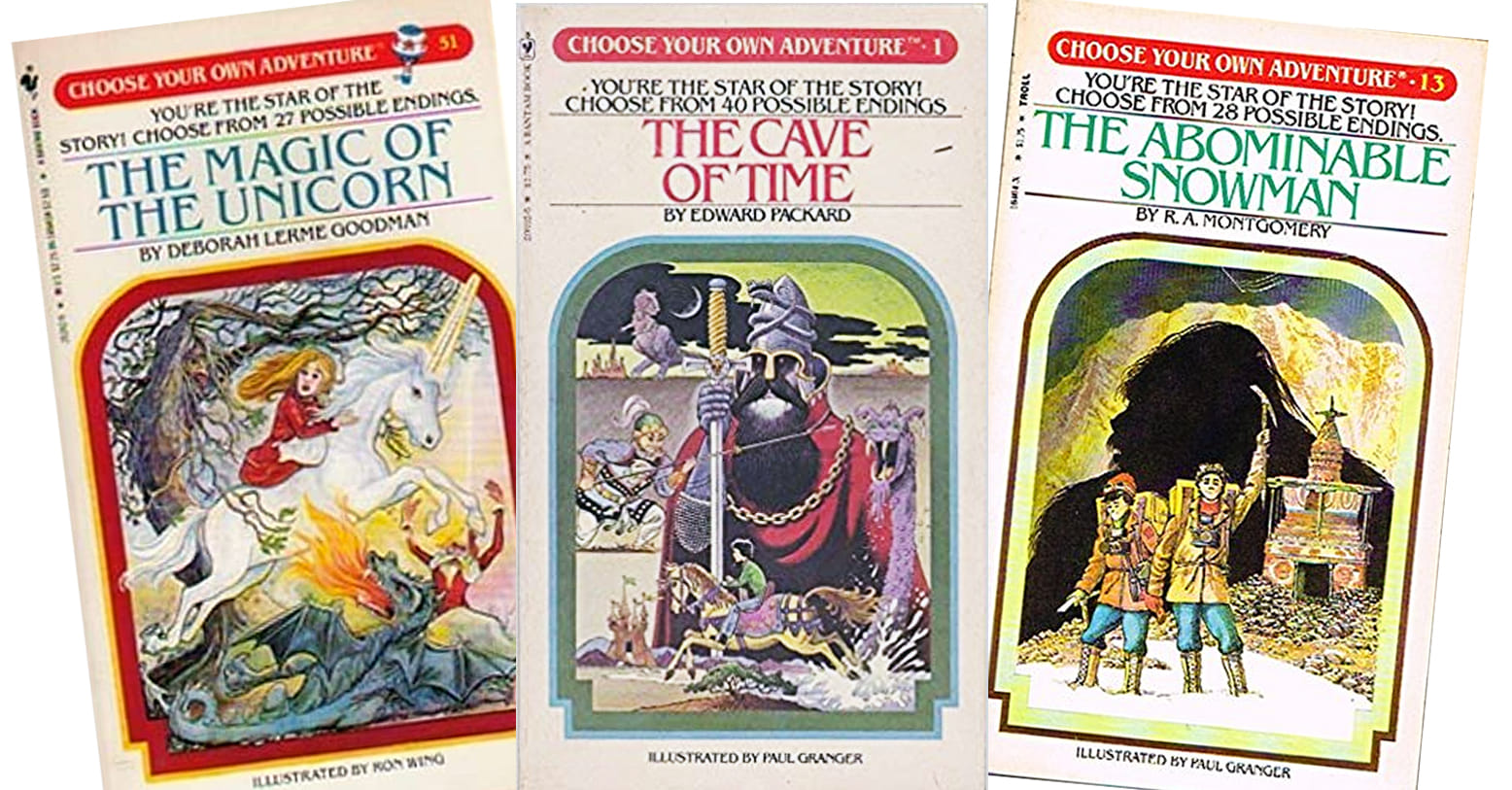
The American type originated as gamebooks for children and young adults. It contained a wide spectrum of genres, from westerns to romance to sci-fi, and used a random "game" mechanism built directly into the pages of the story by the author. The main difference could be paraphrased by Einstein's famous quote: "The American gamebook does not play with dice", meaning you do not need dice to play a traditional American gamebook.
The British type of gamebooks was kicked off in 1982 by the now-legendary and, in the Czech Republic, well-known title The Warlock of Firetop Mountain (Čaroděj z Ohňové Hory) from the Fighting Fantasy series, which began the era of the European gamebook. The publisher Puffin Books released a total of 59 books in the series between 1982 and 1995.
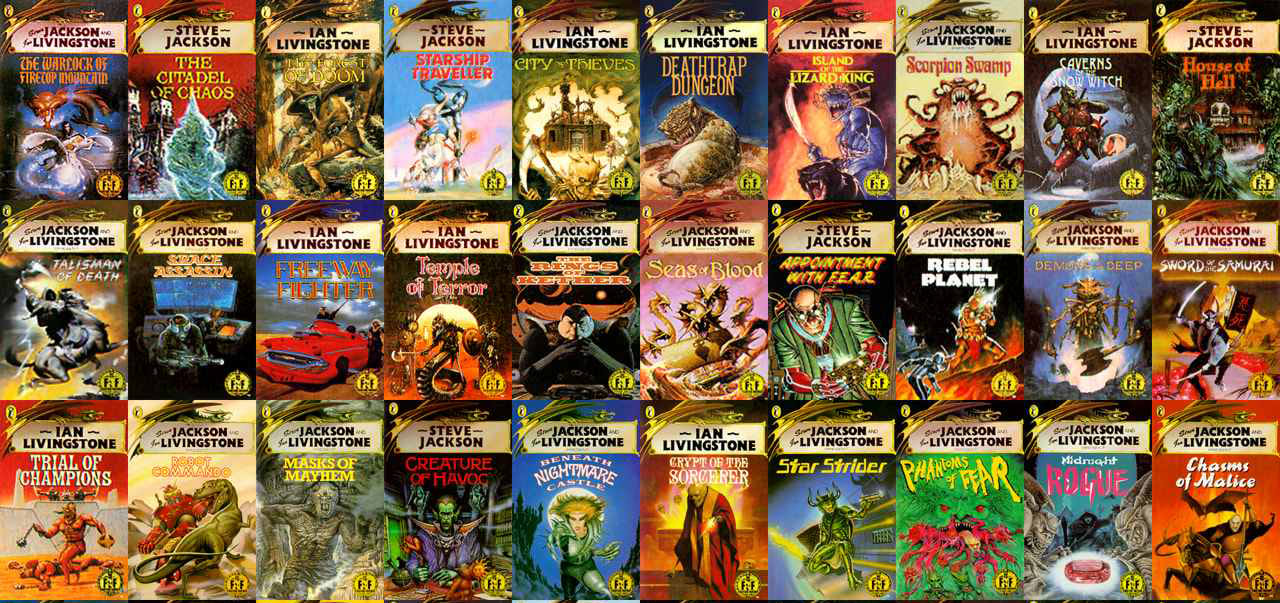
Similar to the Choose Your Own Adventure series, Fighting Fantasy was the work of two authors – Steve Jackson (*1951) and Ian Livingstone (*1949). However, in this case, it is a true co-authorship, as both authors knew each other very well (they even lived together for a few years) and worked on the series and individual stories simultaneously. In 1975, they co-founded the famous company Games Workshop (which brought the famous Warhammer miniature game to the world).
Fighting Fantasy also first introduced a regulated element of chance in the form of dice. As the famous blurb of any title says: "Two dice, a pencil, and an eraser are all you need for this adventure. You yourself will decide which path to choose, which dangers to risk, and which monsters to fight." Erasing a worn-out adventure sheet for the umpteenth time was hell, and to this day, any original copy without a single mark is quite a rarity.
The American type also differs from the British one in that the gamebooks contain a significantly more developed story background, and the choice often comes only after several pages of text. In British gamebooks, the story was sometimes divided into several hundred short paragraphs, so choices came more frequently.
Fighting Fantasy, with some exceptions, almost always had 400 references, of which number 1 was always the beginning of the story and number 400 the only successful ending. The remaining 398 references always contained several endings, though they mostly contained the hero's death or a morally bad conclusion to the story. Fighting Fantasy, however, focused on the genre only within the fandom, so the stories revolved only around sci-fi, fantasy, and horror.
Besides Fighting Fantasy, the world was shaken by the more mature Lone Wolf series (Beaver Books/Berkley, 1984-1998), written by Joe Dever. The series was the first to bring a continuous adventure. Individual titles followed each other, creating one truly long and cohesive epic, divided into four periods based on how well the hero Lone Wolf was trained in his arts (Kai, Magnakai, Grandmaster Kai, New Order Kai). The total count of titles stopped at 31.
A dark story in a fictional world, the battle between good and evil, and plenty of moral decisions brought Lone Wolf fame, and to this day, it is considered by many (including me) to be the best gamebook series ever.
Also famous in the British Isles was the collection full of martial arts – The Way of the Tiger (Knight Mark Smith/Jamie Thompson, Books/Berkley, 1985-87) or the Python-esque Arthurian farce Grailquest by J.H. Brennan (Armada/Dell, 1984-87).
And what about gamebooks in our country and what is their present? You will find out in the second half of the article.
author Honza Kohoutek
List of parts:
The Glory and Misery of Gamebooks (Part One)
The Glory and Misery of Gamebooks (Part Two)

Honza Kohoutek
Deskovky jsou pro něj laboratoř příběhů, videohry paralelní realita a knihy i seriály nekonečný zdroj světů k objevování. Spoluzakládal Vlčí boudu a vášeň pro popkulturu ho drží dodnes.
You might also like

Book Review: Sladký příběh – A Dark Fairy Tale of Bizarro Fiction
Do you dream of reaching the end of the rainbow? In Sladký příběh, a childhood dream turns into a dark reality. Find out in our review why this slim book will consume you. full article...
25. 8. 2026 Tereza Nesvadbová 3 min
Mytago Publishing Newsletter #37
Discover the latest from Mytago Publishing! We're releasing an expansion for The Witcher RPG, a campaign for Pirate Borg, and another installment of Fighting Fantasy. Find out what's in store for you this year. full article...
20. 8. 2026 Jiří Reiter 5 min
What is a gamebook? History and the most famous series
Half game, half story – that is how you could briefly describe the phenomenon called a gamebook. And what are the most famous gamebook series? full article...
Non-fiction journalism 4. 8. 2026 Jiří Reiter, Karel Krajča 7 min