


War of the Ring Card Game Review
Find out why the War of the Ring Card Game is a great game (not just) for Lord of the Rings fans, and how it differs from the War of the Ring board game, in our review.

What do you find in the article?
The Lord of the Rings and other Tolkien's Middle-earth tales defined the fantasy genre nearly a century ago and remain among the best and most beloved works of fantasy ever written. Tolkien's stories of the struggle between good and evil, heroic peoples, fantastic races, gigantic battles, mysterious wizards, and dark lords have been passed down from generation to generation and still represent the purest form of fantasy. The Lord of the Rings is also a powerful brand, and over the last 30 years, it has brought us many great thematic expansions, merch, a brilliant set of six films, video games, and, last but not least, a plethora of excellent board and card games.
Top 3 Board Games Set in Middle-earth
Frodo's journey through Middle-earth has inspired many titles, with the following three currently reigning supreme:
The Lord of the Rings: Journeys in Middle-earth is a cooperative campaign strategy board game from Fantasy Flight Games that lets you play as iconic Middle-earth characters, explore fascinating locations, fight enemies, and gain treasures, information, and, most importantly, experience to progress through many alternative Middle-earth stories. The game is controlled by an app, similar to the well-known Mansions of Madness.
Also worth mentioning is the cooperative The Lord of the Rings: The Card Game (LCG), which works with familiar stories and focuses on difficulty and deck-building from a massive pool of cards across many expansions.
The biggest and most epic game from the world of The Lord of the Rings is definitely the gargantuan War of the Ring, published in Czech by REXhry.
The Big Sister
The classic War of the Ring is more than just a massive tactical-strategic wargame. It brilliantly captures the theme of The Lord of the Rings, with most game situations mirroring the events of the trilogy. And even though the results of battles often don't match the known story, the deeply rooted game system delivers a similarly epic experience. The game takes place on a map of Middle-earth, where two sides fight each other - the Free Peoples and the Shadow Armies. At first glance, the game looks like a classic area-control game about fighting for territory, moving piles of plastic across the map, and gaining victory points. However, the game system is asymmetrical.
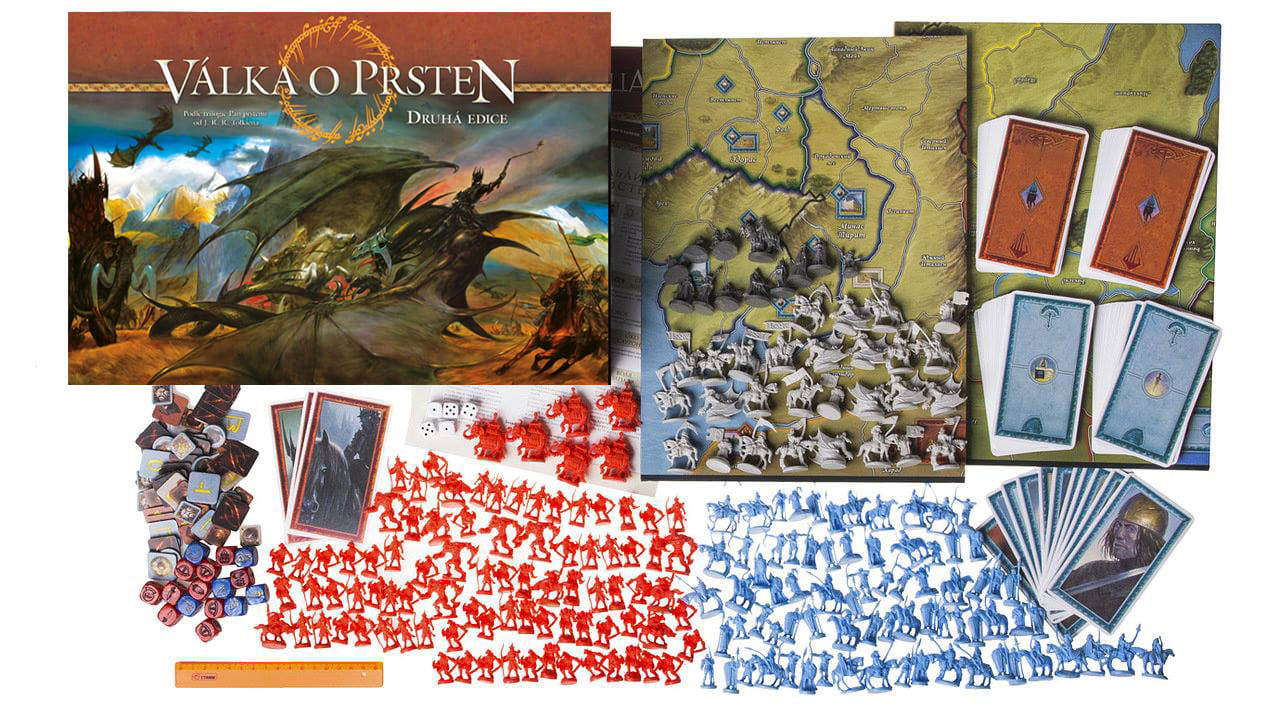
While the Shadow armies churn out endless hordes from Mordor, Isengard, the East, or the South for their war of conquest, the Free Peoples of Middle-earth proudly stand their ground, heroically defending their lands, settlements, and fortresses to slow the Shadow's advance as much as possible. Because under the cover of war, the Fellowship of the Ring is secretly moving across Middle-earth, accompanying Frodo and Sam to Mount Doom, where they must destroy the One Ring. This mix of game systems—area control, tower defense, and hidden movement—works perfectly here, and most games I've had the pleasure of playing ended in a very close victory for one side or the other. Moreover, the game works for two to four players, with more players adding better strategy, tactical decisions, and control over the board.
War in Cards
War of the Ring: The Card Game offers a similar, albeit simplified, experience. The classic War of the Ring is quite difficult to learn and contains many rules for specific situations. The card version is more accessible; it eliminates the tactical battlefield and map, instead bringing powerful game events based on pre-constructed decks and the strategic use of cards on two different types of locations – Battleground cards and Path cards, which grant victory points when conquered. The game also introduces a fresh game system, allowing you to make tactical moves, wait, control, or aggressively influence current events, and it offers several game variants for different player counts. At the same time, setting up the card version is much faster, the game doesn't require as much space, and you can easily play it at the pub.
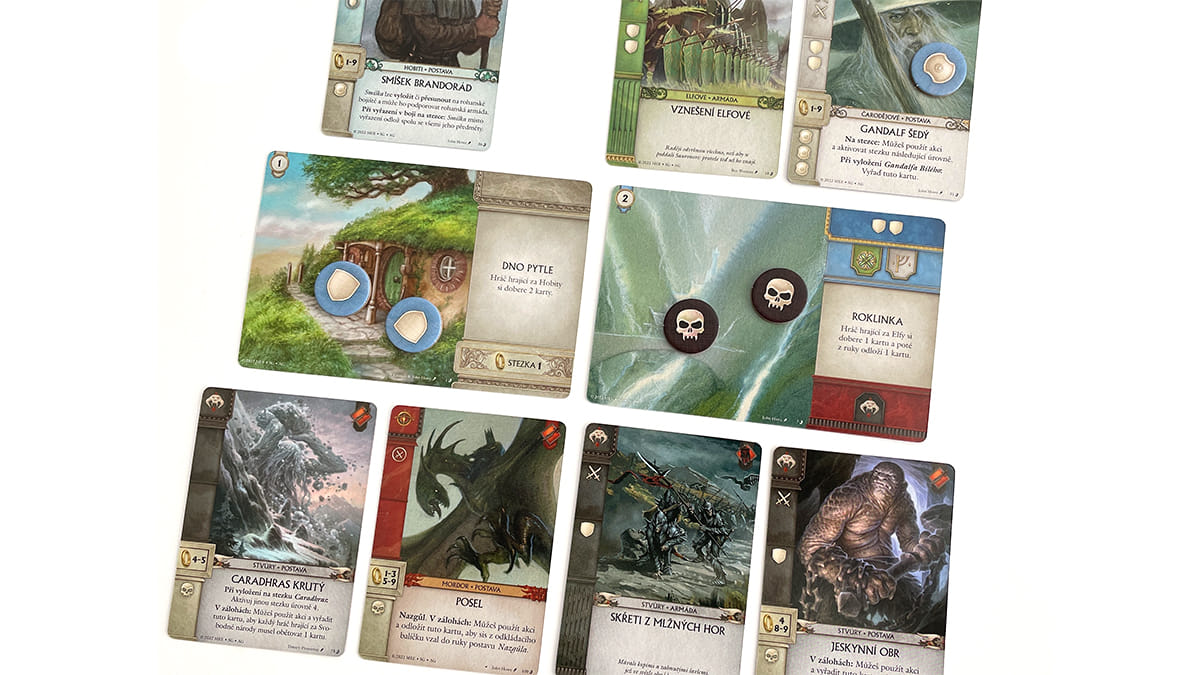
Asymmetrical Game System
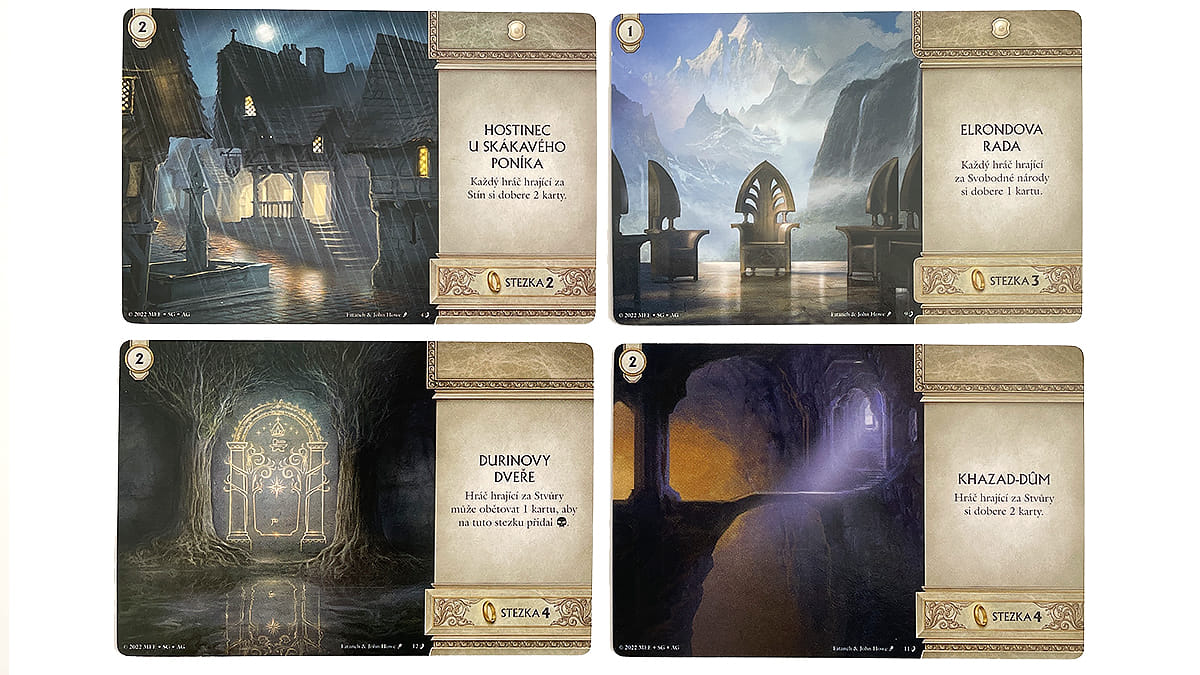
Again, the Shadow fights against the Free Peoples. The game includes four pre-constructed decks for four players. Players for the Free Peoples play as the Dúnedain (together with Elves) and Wizards (together with Hobbits, Rohan, and Dwarves). The Shadow divides its forces between Saruman of Isengard (together with Southerners and Easterlings) and Sauron, containing only Mordor cards full of nasty Nazgûl.
Players choose sides and sit around the table so that both sides alternate turns (Free Peoples - Shadow - Free Peoples - Shadow). The game is played over a maximum of 9 rounds. The Hobbit player starts and draws the first battleground of their color and the first path card, one of three available. Then they perform one of their actions, and it's the next player's turn, which makes for snappy game rounds.
There are several actions a player can perform:
- 1. Play a card – A player can play a card by paying for it by discarding another card to the discard pile. This influences which cards will be played sooner and which ones you keep for later stages of the game. There are four types of cards in the decks - Armies can be used on battlegrounds, Characters on paths and battlegrounds, Items must be owned by their bearers, and Events are instant powerful actions, usually bringing a twist to the game or a significant advantage. The event is then removed from the game. Players place army or character cards on battlegrounds, paths, or their reserves, which often brings various advantages, from drawing cards to checking opponents' hands. Item cards are placed on their bearers, who must be in play, and events are simply performed instantly.
- 2. Move from reserves to a battleground / path.
- 3. Use an action on a card.
- 4. Discard a card to the discard pile.
- 5. Remove two cards from your hand and draw one.
- 6. Use the Ring and draw two cards (only once per game).
- 7. Pass (only possible under certain rules).
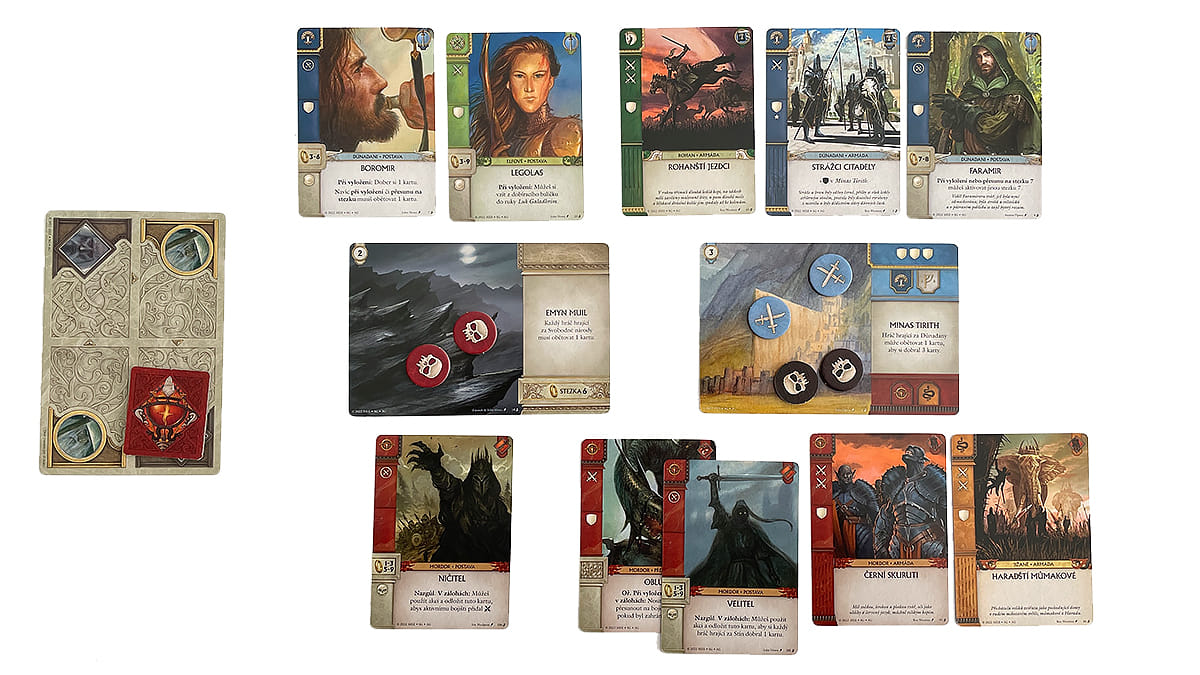
Once all players pass in succession, battles on battlegrounds and conflicts on paths are evaluated. The number of attack symbols is compared against defense symbols, and the winner gains victory points. Attackers are always removed from the game, and defenders only if their defense symbol was used; otherwise, they return to the discard piles. This system of discarding and removing cards is the alpha and omega of the whole game. Removed cards can never return to the game under any circumstances, which leaves room for strategic decisions like: "Sacrifice a strong character who would be more useful in a later stage of the game, or give points to the opponent?"
At the end of the round, it is checked whether one side or the other has gained 10 more points than the opponent, which would end the game. If not, players draw new cards and a new round begins; new battlegrounds and a new higher-level path are drawn, again selectable from three cards. At the end of the 9th round, the player with more points wins. In the case of paths, the point gain is determined by slightly different rules for the Shadow player, but essentially it's just a strategic element that also enhances the atmosphere.
Atmosphere and Graphic Design
The game is fast-paced, accessible, and has a beautiful atmosphere. The graphic design is top-notch, with beautiful illustrations of locations like Bag End, Osgiliath, or Minas Tirith; heroic warriors of Gondor; hungry hobbits, beautiful elves, etc. Playing cards usually adds interestingly connected effects and elements that tie into the story. Although there are many army cards in the decks, the abilities of individual characters primarily dominate the game.
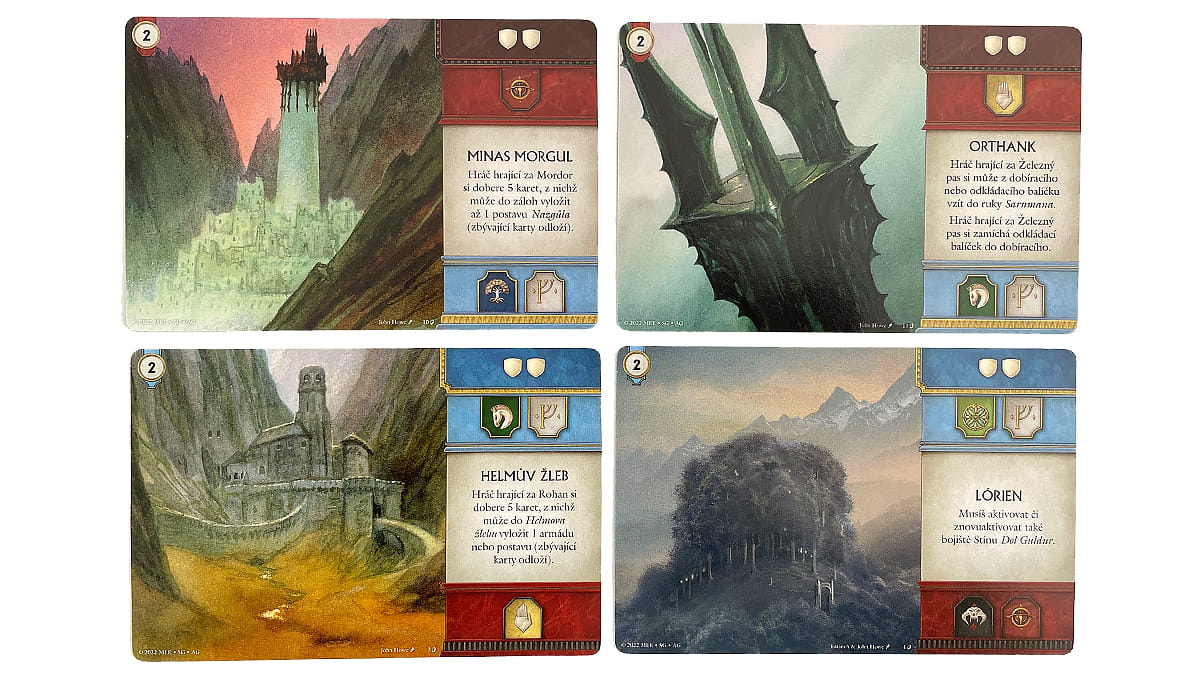
Gandalf on a path shouts, "You shall not pass," allowing you to activate the next path, which speeds up the game by a round, and then he dies on the path without issue. Because Gandalf 2.0 rises, and his Shadowfax allows him to defend Minas Tirith by insanely increasing attack and defense values.
Or take the little hobbits, who can defend paths without the possibility of dying. Éowyn can even search for hobbits in the decks, or you can send her to kill a Nazgûl (even though she still can't cook). Denethor can summon one of his sons (though it will probably always be Boromir). Legolas can search his deck for his bow, and Galadriel can give Frodo or Sam her phial for defense on their journey to Mount Doom.
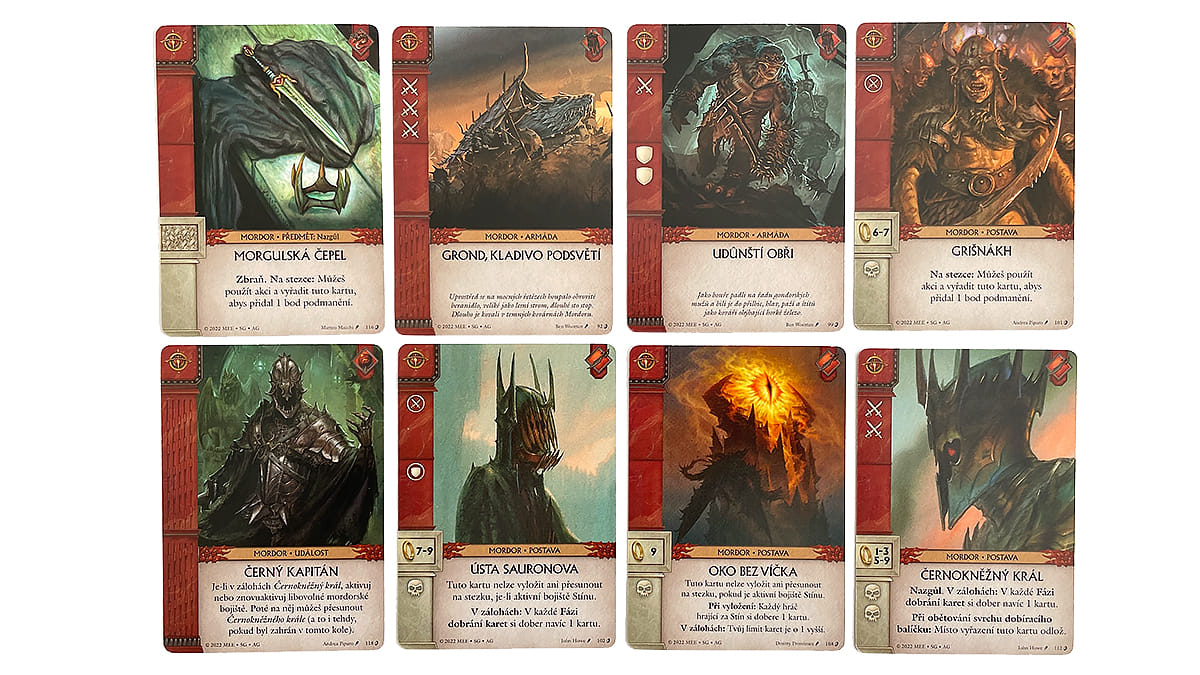
There are nine Nazgûl in Sauron's deck, and their placement in reserves can disrupt the Free Peoples players' strategy, search for other cards, or cause hell on a path. The Witch-king himself gives many advantages to the player, and if he is removed from the deck, he is just discarded. Gríma Wormtongue can summon Saruman or kill Théoden. And Saruman himself has his Palantír, which gives him the ability to prepare the perfect hand for every round. The game features Shelob, the Balrog, and Gollum, all of whom have many advantages when in the right place.
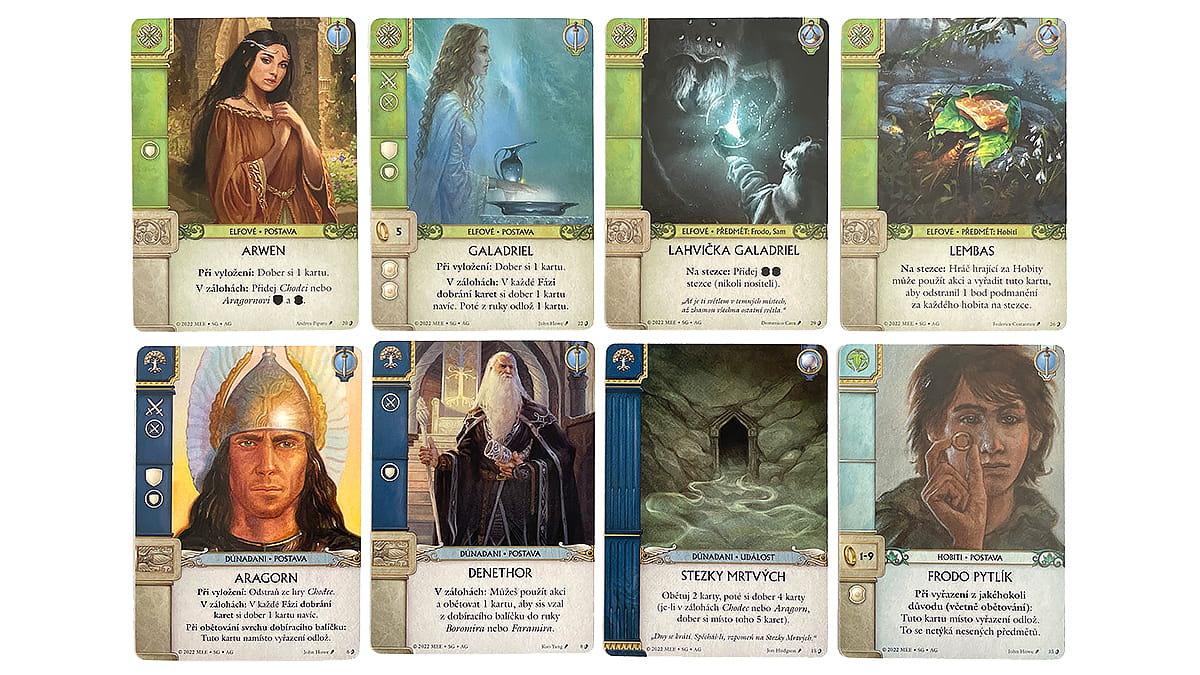
The game is fully asymmetrical and gives plenty of room to learn what to play sooner and what later. What to remove and what not to. Moreover, you won't get to see every battleground and path. Thanks to all this, the game has great replayability. Above, I described the main game mode called Trilogy. However, the game contains other variants, such as the straightforward Duel or a shortened version of the Trilogy called The Fellowship of the Ring. It can be played by two to four players.
Very Positive Impressions
My impressions of the game were great; the game maintains its atmosphere, and individual turns are quick and snappy. The only criticism I found is a slightly inconsistent storyline on the battlegrounds. If we were to play exactly by the rules, it could happen that you fight over Minas Tirith at the very beginning of the game because battlegrounds are drawn randomly. While there are ways in the game to reactivate an already scored battleground, which might bother some Lord of the Rings lovers, it is possible to prepare the battleground decks a bit to preserve the story.
War of the Ring: The Card Game is a great game for everyone, not just fans of The Lord of the Rings. The game is fast, beautifully crafted, and uses an interesting game system that forces you to think strategically and tactically. Plus, it is much more accessible than its heavy-weight brother. It fits on a table practically anywhere, and setup is quick and easy. I wish all thematic games worked with their stories like both War of the Ring games.
author Honza Kohoutek

Honza Kohoutek
Deskovky jsou pro něj laboratoř příběhů, videohry paralelní realita a knihy i seriály nekonečný zdroj světů k objevování. Spoluzakládal Vlčí boudu a vášeň pro popkulturu ho drží dodnes.


You might also like
Magic: The Gathering 2027 Sets Revealed: Complete Overview
Find out which Magic: The Gathering sets are coming in 2027. We have three lore-based sets, an epic return to Kamigawa, and new fantasy crossovers ahead. full article...
27. 8. 2026 Karel Krajča 3 min
Ascension Card Game: A Guide to the World of Deckbuilding
Find out how the Ascension card game and the deckbuilding genre work. We’ll cover the rules, expansions, and the new Lord of the Rings edition. Get to know a genre legend! full article...
15. 7. 2026 Karel Krajča 12 min
Pokémon Card Collecting: The Magic of Booster Boxes, Rarities, and PSA Grading
Want to know how to spot rare Pokémon cards and what determines a PSA 10? Check out these collecting tips from the guys at the Dvě vajca YouTube channel. full article...
4. 6. 2026 Dvě Vajca 6 min