


How to create a character in Dungeons and Dragons 2024?
What changes did the Dungeons and Dragons 2024 edition bring to character creation? DM Honza Havelka tells us.

The new Player's Handbook for DnD 2024 has been on the shelves for a while now. We've had enough time to read through it, gather the party, create characters using the new process, and let it all sink in. So, what's the verdict? More races, more subclasses, more backgrounds, more options, and yet less time needed for character creation! Sounds suspiciously good, right? There must be a catch. Well, yes, but more on that below.
I apologize in advance to the English-speaking terminology purists, but so many RPG newcomers have started taking an interest in the new Dungeons and Dragons 2024 edition that I will use common, accessible equivalents for the sake of clarity. You wouldn't believe it, but the sentence “A Warlock with a Sage background has the Magical Initiative feat, so they take two cantrips from the Wizard spell list” doesn't make much sense to beginners and certainly won't get them excited about playing.
Clarity and unification: A beginner's savior
The new rulebook approaches character creation by improving text navigation and unifying differences. These are often small details that have a big impact. Constant flipping between chapters is gone, which is most noticeable when choosing spells. They are now clearly listed under each class. I also appreciate that every character ability now includes the required level in its name. Players no longer have to read through an entire paragraph to find out if they get an ability at level two or level four. Remember the quick-build suggestions from the old manual? The creators now trust the structure of the class descriptions so much that they are gone.
As a DM, I definitely appreciate that all characters now get their subclass choice at level three. The whole party makes these choices at the same time. You don't have to wait for that one Druid or Cleric who made their choice at level two. Plus, a historical injustice has been corrected: every class in the new manual has exactly four subclasses, which will especially please Barbarian players.
The improved clarity is evident right from the start when you open the character creation chapter. A full-page overview of classes, including subclasses described in a single sentence, is a great help for beginners. It definitely does a better job than the old table with its mechanical list of spellcasting abilities, hit dice, proficiencies, and starting equipment.
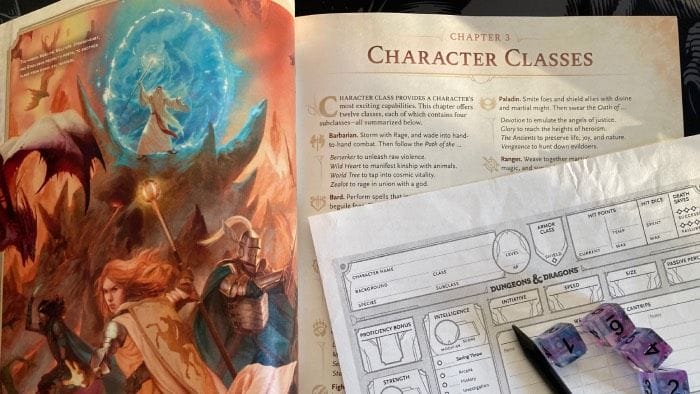
The quick class overview was logically moved to the beginning of the character creation chapter, as choosing a class is now the number one priority. They removed the fluff and instead used a single word to capture what a given class likes (literally) and what level of complexity you can expect from it.
According to the authors, a Fighter likes weapons and has low complexity, while a Cleric likes gods and is moderately complex, and a Warlock likes the occult and is highly complex. It's an amusing simplification, but it actually works quite well, and adding information about how difficult a class is to play in terms of rules is a welcome touch. Many a beginner has struggled with the Sorcerer and their metamagic, calculating spell slots from sorcery points. They rightly felt that instead of an epic RPG, they were holding a math textbook and would rather use a slide rule than dice. Sure, they didn't simplify the class, but at least you were warned.
The right process is half the success
The creators of the new manual weren't afraid to properly overhaul the book's structure, which (positively, in my opinion) had the biggest impact on character creation.
The original process was: choosing a race that added bonuses to certain stats, choosing a class, and rolling or (for math fans) buying ability scores with points. Then there was the Personality and Background section, which dealt with alignment and background, providing skill proficiencies, tool proficiencies, languages, and one unique ability. And finally, the equipment chapter.
In the new manual, you start with the class, as it's the most important player choice. This is followed by the Origin chapter with sections on Species (race), which now has a much smaller mechanical impact, and Background, which has gained importance in terms of rules but lost personality traits. The next steps are choosing one of the three ways to determine starting ability scores. A small detail like recommended standard ability scores for each class, placed on par with the two previous methods, eliminates decision paralysis even for seasoned players and cuts character creation time by a good fifteen minutes. It's ideal for beginners or if you're creating a quick character for a one-shot.
Dependent on the stats are new random tables with adjectives describing appearance and personality resulting from extremely low or high ability scores. In the next section, you choose alignment and newly derived personality traits. Finally, the manual guides us through filling in details like passive ability scores and asking some questions about the character's past. More could have been done here, much more, as proven by the compatible manual A Life Well Lived. It's funny that considering the character's gender is almost the last thing on the list.
We don't say 'races' anymore
As for races, now called species, they added the Aasimar and Goliath, which were already included in Volo's Guide to Monsters from 2016. The Aasimar is a mortal with a celestial spark and, from level three, has an attractive ability to reveal their wings and fly for a minute once per long rest. DMs never really liked permanently flying races (see the bird-folk known as Aarakocra – we could see one in the Honor Among Thieves movie) because they could instantly bypass carefully planned traps. With the limitation the Aasimar has, they probably won't be losing sleep over it. And the Goliath is an eight-foot-tall giant with abilities based on their giant ancestor. Something like Stone's Endurance, reducing damage taken by 1d12 plus Constitution modifier, would be useful for classes with lower hit points. We might soon see nothing but Goliath Wizards and Sorcerers.
The Tiefling gained two bloodline legacies, so fire is no longer the only element they will command. Resistance to necrotic damage along with the legacy spell False Life, adding 1d4 + 4 temporary hit points, is perfect for crawling through dungeons filled with hordes of the undead. The Half-Orc has become an Orc, and the Half-Elf has left us for good – anyone expecting rules for creating mixed races will have to look elsewhere. Species, in general, have lost a lot of descriptive text, whether it's their lifespan, culture, or typical names. This is likely an effort to make them more universal for less stereotypical worlds.
When two do the same thing, it's not the same thing
The classes are the same, they just received new subclasses, as mentioned. There are a few completely new ones, i.e., not published in other expansion manuals. The Barbarian's Path of the World Tree, the Bard's College of Dance, and the Druid's Circle of the Sea. None of them fundamentally change the usual feel of playing that class. The Barbarian simply connects to the cosmic Yggdrasil in their rage and can teleport, the Bard attacks unarmed for Bardic Inspiration and dances between enemies, and the Druid gets thematic spells and casts a local tsunami via Wrath of the Sea. It's worth noting that each of the 48 subclasses has its own large illustration in the book, and they look so good and thematically faithful that you could choose based on them alone.
They added a section for multiclassing directly into character creation and for each class separately, which used to be in the sixth chapter, Customization Options. At the same time, they streamlined the rules so that you now only need a score of 13 in each primary stat of the combined classes. Simple, functional. Because the player encounters this information here, they won't be unpleasantly surprised in the future that their dream Bard mixed with a Fighter won't work.
The more feats you know, the more of an adventurer you are
There are now 16 backgrounds, which is 3 more than before. However, they work fundamentally differently. Each provides 3 stats that you can increase at the beginning. Either by one point for each stat (1,1,1) or by two points for one stat and one point for another (2,0,1). If I were to be nitpicky, I'd criticize the authors for not having 20. Then there would be all combinations for all six stats. Now, backgrounds that would allow increasing combinations like Strength-Constitution-Intelligence, Strength-Constitution-Charisma, Strength-Wisdom-Charisma, and Dexterity-Intelligence-Charisma are missing. However, they say that a player can take a background from other expansion manuals or older rules and determine the trio of stats as they wish.
Feats used to be something a player could only take instead of increasing ability scores, i.e., first at level four. However, the way the game is set up, it rarely paid off not to invest at least the first increase into a primary stat. Often, the player, or rather their character, benefited from this several times because the frequency of abilities and spell attack bonuses depended on the primary stat modifier. Some DMs therefore gave players one extra feat from the start. Feats have great potential to distinguish a character from characters of the same class at the same level.
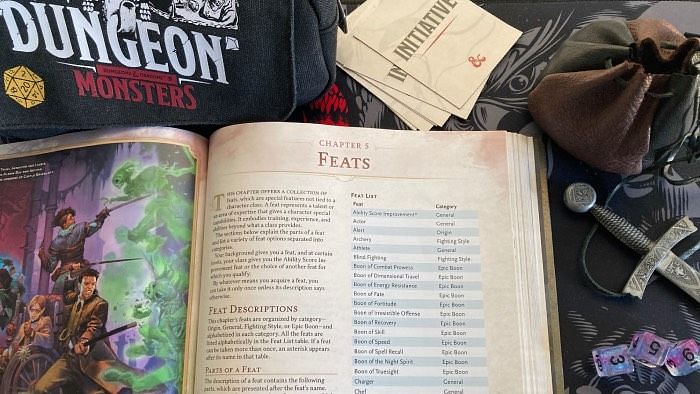
The publishers of the new manual were aware of this and adjusted the system. Today, the manual has 75 feats divided into groups. When initially creating a character, Origin Feats are important. The player character gets one specific one for their chosen background. If you play as a Human, your species gives you one additional Origin Feat of your choice. In this case, the recommended feat is one that allows you to add your proficiency bonus to three skills of your choice.
When you reach level four, you choose a feat for which you meet the stated requirements. One of these feats is the one that says you can increase the value of any one stat by two or both stats by one. So we didn't lose anything, we just got more options to choose from. It must be added that abilities previously reserved only for specific classes have made it into the list of feats. It is thus possible to take spells from another class or learn some combat maneuvers.
What's sadder is that there has been a trimming of accompanying texts for races and inspiration tables for personality traits for backgrounds. Backgrounds used to have random tables for four personality traits: personality trait, ideal, bond, and flaw. Not that I've seen anyone actually roll on them randomly in years of playing, but they worked well as a source of inspiration. From a whole long sentence describing a possible ideal, bond, or flaw of a character with a given alignment, it has now shrunk to two adjectives derived from the alignment on the good-evil and chaotic-lawful axes.
Something extra
Equipment has undergone an interesting change. These are the rules for crafting specific items directly with kits, utensils, and tools. Previously, some starting equipment items were difficult to use in a normal game, and their potential uses were unclear. Now, every such kit has clearly written what useful things can be made with it, what mechanical advantages or effects such an item gives its wearer, and how much it can be sold for. In addition, proficiency with an item (e.g., thieves' tools) and proficiency in a skill (e.g., sleight of hand) no longer duplicate, but if both can be used in a given situation, the second one gives advantage to the roll.
In conclusion, I'll mention one more small thing. We got a new character sheet. Ornamental elements are a matter of personal taste; it didn't thrill me, nor did it offend me. This also applies to the layout of elements, where saving throws and skills are no longer below each other but grouped in a block together with the given stat. What I think didn't hurt is the more organized section for weapons and attack tricks. For spells, a checkbox has appeared to remind you whether casting requires concentration or a material component and whether it can be cast as a ritual. Spell slots also have their own counter. In any case, whoever doesn't like the sheet will find dozens of other unofficial variations on the internet, even specifically adapted for their class.
Overall, the way the authors approached character creation in the new player's manual is a step forward. Dungeons and Dragons remains a rule-heavy role-playing game, however, it is certainly more accessible for new players now. Thanks to better organization of information, more meaningful tables, and summaries, the new book is clearer. And if I compare character creation in the Player's Handbook 2024 with the manual that came out ten years ago, it ensures a faster process and a more interesting result.
author Honza Havelka
Honza Havelka
Autor článků na imago.cz


You might also like
Mytago Publishing Newsletter #37
Discover the latest from Mytago Publishing! We're releasing an expansion for The Witcher RPG, a campaign for Pirate Borg, and another installment of Fighting Fantasy. Find out what's in store for you this year. full article...
20. 8. 2026 Jiří Reiter 5 min
A Brief History of Dice
Did you know that dice have accompanied humanity for over 5,000 years? Take a look at their history from the first throwsticks to modern collector sets. full article...
13. 8. 2026 Karel Krajča 6 min
An Overview of Mark of the Odd RPGs
Are you drawn to minimalist RPGs? We've prepared a comprehensive overview of games built on the Into the Odd system. Find your favorite genre! full article...
10. 7. 2026 Jiří Reiter 21 min