


A Brief History of OSR
The second part of an article about how the term OSR originated in RPGs, what it originally meant, and how its understanding has gradually evolved over the roughly 15 years since its inception.

What do you find in the article?
- The generation of retroclones and the birth of the Old-School Renaissance (OSR)
- Lamentations splits the old school
- The man standing aside: DCC does what it wants
- Minimalism and improvisation arrive, D&D leaves – "new old school" (nu-OSR or nuSR)
- "What the hell am I supposed to take away from this" or the old-school scene of today
- Wait, it's more complicated! A few more words about games "inspired by old school"
- How to start with old school?
- And what should I read?
or why it's such a mess
The second part of the article about how the term OSR originated, what it originally meant, and how its understanding has gradually evolved over the roughly 15 years since its inception.From old D&D to longing for old D&D
We will look primarily at the old editions of D&D, i.e., Original D&D (1974), AD&D first edition (1978), and Basic D&D (1977 or 1981). There are minor differences between them – in their rules, in the "philosophy" with which they were played back then, and in the style of their adventure modules – but those are beyond our current scope. At their inception, all these games were played with an emphasis on simulation, exploration of adventure sites, and free interaction with an open world.
This changed sometime in the first half of the eighties, when first other games and, in reaction to them, D&D began to transition to "story-driven" play. In this style, the referee turns into a Narrator, whose main concern is to invent and coordinate a satisfying story. Open locations from pre-prepared adventures practically disappeared and were replaced by sequences of plot events.* The term "adventure" ceased to mean "a place to explore" and began to mean "a pre-written story." Concurrently, the prevailing philosophy of play turned away from concentrated challenge-overcoming and began to focus more on things like character acting, atmospheric experience, learning about the rich "lore" of increasingly elaborate fictional worlds, and – yes – the effort to achieve a high-quality story built according to literary or film conventions. AD&D 2nd Edition (1989) – and its famous worlds – is already written entirely in this "story-driven" spirit.
- Interestingly, in D&D, this change occurred as early as the AD&D first edition – yes, the game that most popularized the old-school sandbox. The rules remained the same, but the editorial line of adventures changed beyond recognition. Rules are truly only a partial part of the whole.
Somewhat paradoxically, RPGs simultaneously became more complex, so the emphasis on story often went hand in hand with very "crunchy" rules full of "gamey" elements. The resulting combination of complex rules and a story steered by a referee-screenwriter-director (sometimes called "trad games" or "traditional gaming") became the dominant stream that overwhelmingly prevailed on the RPG scene from the 80s at least until around 2005 (?), when it began to be undermined from one side by the rise of looser "narrative" games (dramatic games, story games, indies… terminology is not exactly unified) and from the other by the old-school renaissance itself.
When the internet spread more massively in the late 90s, it turned out that fans of the older playstyle hadn't gone anywhere. Although no new games or adventures were being published for them, a smaller community remained loyal to the old D&D editions. Now, old-schoolers could start gathering on internet forums. However, they encountered practical problems: old D&D editions were long out of print (and digital distribution didn't exist yet), so the games couldn't be bought. Likewise, it was impossible to legally publish adventures for them. While "old-style" fans created homebrew adventures and shared them among themselves in the form of amateur Word files, the inability to establish a publishing house and release products for standard distribution essentially made it impossible for old-school gaming to spread significantly. It is somewhere around here that the term "old school," or "old-school gaming," first appears, still without the "renaissance" suffix.
The turning point was the arrival of D&D 3rd Edition (2000). While old-schoolers unanimously hated it for its complicated rules and superhero aesthetic, the game was released under the now-infamous Open Gaming License (OGL), which made its complete rules freely and legally available to anyone who wanted to create derivatives or game supplements. This phenomenal novelty transformed the entire RPG market in the subsequent "d20 bubble" – but that is another story…
Old-schoolers immediately began using the OGL license to publish "new products in the old spirit." First came the adventures – newly founded publishing houses Necromancer Games (2000+) and Goodman Games (2001+) began releasing adventures for D&D 3e that stylistically returned to the old tradition of "non-story" locations intended for free exploration. Troll Lord Games (2000+) did the same, and they could even boast that the founding father Gary Gygax wrote for them. Shortly thereafter, the first games built on the OGL license appeared, which, while using rules derived from D&D 3e, attempted to emulate the "feeling" of older editions: HackMaster (2001), Castles & Crusades (2004), and Basic Fantasy Role-Playing Game (2006).
- Hackmaster is technically based on AD&D 2e and does not use the OGL license, but that is an irrelevant detail for now.
But that wasn't enough for everyone. Adventures and games in the old style, but still based on D&D 3e, were simply not the same as playing old D&D and being able to publish adventures directly for it. And then someone had an idea…
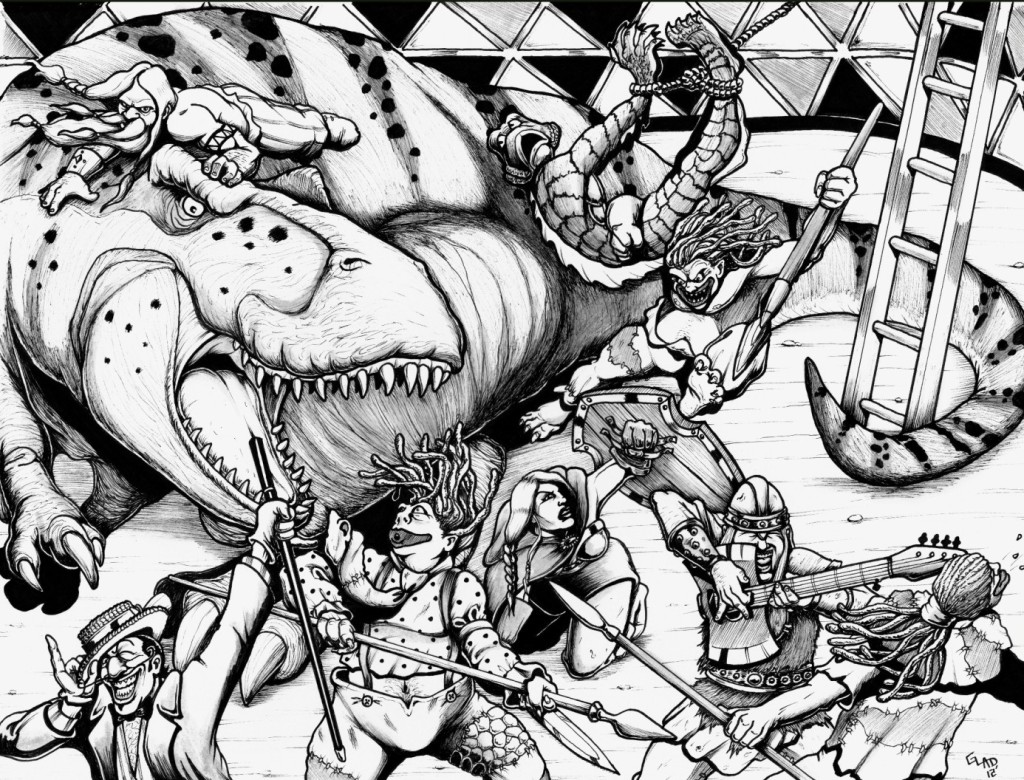
The generation of retroclones and the birth of the Old-School Renaissance (OSR)
The idea went something like this: since the complete rules of D&D 3e are freely available and contain all the key game terms (names of attributes, spells, monsters…), can't we just copy the rules of the old editions but pretend we "derived" them from D&D 3e? It won't be true, but from the perspective of the license and legality, it should be kosher, right?
Thus was born OSRIC (2006), the first true "retroclone," i.e., a rewrite of one of the old D&D editions (in this case AD&D 1e) with the same rules. Not a new game in the old spirit, but truly the same game, just written in different words. It wasn't intended for playing, though! OSRIC was intended as a publishing platform, a legal cover. People who played AD&D 1e could use it to write and commercially publish adventures for AD&D 1e, with identical rules and the same game terminology, only they wrote "Designed for OSRIC" on the cover.
The authors were sure a lawsuit awaited them, but it never came. Their trick of copying an old game by "deriving" it from the freely available D&D 3e worked. Or at least no one challenged it, which is essentially the same thing. OSRIC paved the way, and in the same spirit, copies of other old D&D editions were released: Labyrinth Lord (2007) (a clone of Basic D&D in the B/X variant) and Swords & Wizardry (2008) (a clone of Original D&D).
The peculiar circumstances of these games' creation have peculiar consequences. For one, this trio of the first retroclones is not a truly identical copy of the old games – to avoid being easily accused of plagiarism, they contain various minor deviations, for example in some numerical values or partial tables. (The authors were indeed preparing for a lawsuit.) And since they were meant to serve more as a legal cover and publishing platform, the authors didn't bother much with explaining that old, half-forgotten style of play. Retroclones are primarily reference documents of "hard" rules. It was assumed that players either had the "soft" know-how from personal historical experience or would absorb it osmotically from "community sources" – various discussion forums and blogs. The absence of any available "old-school textbook" would later become the cause of all today's confusion.
Nevertheless, retroclones achieved huge success! The time was ripe – the rise of digital promotion and distribution helped, thanks to which even small "independent" publishing houses could now operate, and a fresh wave of disgust with the "boardgamey" D&D 4th Edition (2008) also contributed. The old-school community flourished: hundreds of adventures, game worlds, and other supplements were released for the three main retroclones. The center of gravity of the community shifted from internet forums to dozens of blogs that chirped with excitement, theoretical breakdowns, design analyses, and new tips and tricks for the game. In this era, the understanding of what makes games in the old "exploratory" style fun shifted significantly. Players took apart every rules aspect of old D&D, from hex map travel to encumbrance counting, and came up with detailed analyses of its significance. The understanding of adventure design improved dramatically, and a whole series of timeless modules were released that often surpassed the old classics. For the first time since 1974, when the first D&D presented the idea of the megadungeon to the public, some playable megadungeons were actually published! New authors "rediscovered" other genre forms of D&D than just heroic medieval fantasy, such as pulp fantasy, sword & sorcery (and sword & sandals, sword & planet…), or mash-up science-fantasy. And finally, the term "Old School Renaissance" (OSR) appeared, provided with an iconic blue-and-white logo. Because now it was truly about a renaissance – not just reviving something old, but also its reinterpretation and further development.
- Sometimes the variant "old school revival" is mentioned, but it didn't really catch on.
All creations from the retroclone era share essentially the same (above-mentioned) game principles. The generally accepted idea of the game was playing in "infinite" sandbox campaigns, in which the referee gradually places adventure locations on the game world map and lets the players dictate the direction of the game. Emphasis was placed on creating truly modular adventure modules – that is, ones that were open and could easily be slapped onto the map of any "infinite" campaign. Mutual compatibility of all creations helped with this. Older editions (and their clones) do have minor differences, but these are negligible in terms of compatibility. It is possible to take an adventure written for any of them and play it in any other old edition or clone without conversion, or perhaps with minor adjustments on the fly.
The retroclone period experienced its biggest boom roughly between 2008–2012. In this era, the term OSR has its most compact, unambiguous meaning – it is playing old D&D or its clones with everything that goes with it. And everything is mutually compatible.
(Although even here, the first ambiguities appear, for example, whether older games derived from D&D 3e, such as Castles & Crusades, count as OSR. And what about adventures written "in the old style" but intended for the third edition? Shouldn't there be some terminological distinction between them and retroclone OSR? Eventually, these turn out to be more rhetorical questions, because the popularity of retroclone OSR steamrolls the others almost to insignificance, and the term "old school" becomes a synonym for "D&D retroclone.")
The trio of main retroclones was quickly followed by dozens and dozens of others, although they never matched them in terms of reach and significance. Eventually, every variant and sub-variant of old D&D editions was cloned. Immediately, games began to be released that were not satisfied with merely copying old rules but began to rework, improve, and push them elsewhere. For example, Astonishing Swordsmen & Sorcerers of Hyperborea (2012) clones AD&D 1e but pushes it into the genre of Conan-esque sword & sorcery and weird fantasy. Adventurer Conqueror King System (ACKS) (2012) is a clone of Basic D&D and significantly develops the simulation of a pseudo-medieval world, its economy, and domain management. Seven Voyages of Zylarthen (2014) is a clone of Original D&D but changes it into the genre of oriental, Sinbad-esque sword & sorcery. And so on.
All these games continued to be called "retroclones," even though they are not pure clones. But since they all stem from old editions, they are easily compatible with each other and share the same ideas about the game, so it didn't cause any terminological mess.
(Just don't ask how Stars Without Number (2010), a clone of Basic D&D remade into a sci-fi game in the style of Traveller (!!!), and other clones by the same author, like the post-apocalyptic Other Dust (2012), fit into D&D. They were probably waved off as just "D&D a bit differently.")
And then came one clone that changed everything.
Lamentations splits the old school
Lamentations of the Flame Princess (2010) is, on the surface, essentially a traditional clone of Basic D&D with a few rule innovations (e.g., a simple skill system) and an unusual stylization into weird horror, but otherwise nothing that would deviate from the standard set by other clones. However, its editorial line of adventures and other supplements quickly began to deviate.
Early adventures for Lamentations are on one hand firmly old-school (non-story-driven, open environment, overcoming challenges, high difficulty), but on the other hand, they turn some principles on their head. In particular, the "reward vs. risk" dynamic collapses in them – Lamentations won't reward you for conscientious exploration and interaction with the environment, but will usually kill you. And that is supposed to be part of the fun! Adventures are often impossible to survive; adventurers end up dead or insane, much like in Call of Cthulhu, and if they happen to survive, they cause an apocalypse. (This nihilistic approach to the game earned the label "negadungeon.") Individual scenarios are highly thematic and stylized, each representing a unique closed situation. You will have a hard time assembling a continuous sandbox campaign from them. Under the baton of Lamentations, adventure modules turn into adventure scenarios or episodes.
Under the banner of Lamentations, people gathered who had the desire to experiment with the format of pre-prepared adventures. They often incorporated art into their work – striking visuals, poetic text, but also innovative layout. Retroclone adventures were rather Spartan until then – essentially standard text in Word aligned into brief paragraphs, an occasional picture, no shenanigans. Lamentations brought an emphasis on graphic layout, information design on the page, and stark, even minimalist text built on a few evocative words meant to do the work of several sentences. The label "artpunk" became common for this direction, and especially in later years, it would be criticized for actually hiding products whose level design and game side are shallow under the poeticism, slick graphics, and striking stylization.
Sometime around 2012, the gaming scene is clearly split. Fans of old D&D and retroclones condemn "would-be artists who didn't understand the old school." And the art-experimental wing… well, actually, it mostly ignores the previous generation, because it doesn't have much interest in old D&D and its creations.
The man standing aside: DCC does what it wants
Among the prominent titles, Dungeon Crawl Classics (DCC) (2012) also deserves mention, a game that never belonged to any stream of the old-school renaissance and always stood self-sufficiently aside. Its originator, the publishing house Goodman Games, was founded back in 2001 in the era of longing for old D&D, when new products "in the old spirit" intended for the third edition of D&D were being created. The Goodman folks always did things their own way and built a successful professional publishing house on adventures for D&D 3e. The community wave of retroclones missed them, until in 2012 they came up with a game of their own – it is carried in a similar spirit as retroclones, but evolutionarily it is unrelated to them and their renaissance-rediscovered principles.
DCC does many things similarly to retroclones, but also many things differently. It shares with them the traditional principles of "non-story-driven" play, high difficulty, and character mortality; it loves traditional dungeon crawling and revels in the "old" aesthetic of pulp fantasy, sword & sorcery, and mash-up science-fantasy. Conversely, it shows very little interest in the simulation component of the game – travel, survival, encumbrance, hiring and morale of henchmen, random encounters, or any other traditional subsystems; you won't find any of that in the game! DCC hasn't seen an old-school sandbox even from a distance; it offers practically no campaign rules, and its published adventures are almost without exception brief, episodic, and mostly linear. Rather than openness, it focuses on unforgettable unique situations.
What it does offer a lot of, however, are exactly the things that the wave of newcomers appreciated: fresh themes, striking stylization (in this case into a wacky "seventies" fantasy), and also a lot of random elements and funny effects. DCC is a return somewhere into the depths of RPG history, even before the serious simulationist AD&D 1e, to the days when games were primarily lighthearted fun.
Minimalism and improvisation arrive, D&D leaves – "new old school" (nu-OSR or nuSR)
The explosion of new games and, above all, thematically diverse and striking adventures attracted a lot of new (and also younger) players to the old-school scene who had no lived experience with old D&D. Many of them came from the second prominent gaming stream that was defining itself against the mainstream at the same time as OSR – namely from the "indie" scene (narrative games / story games / insert your own term). These people brought different experiences and gaming preferences; unlike the old-schoolers, their primary motivation was not to revive the beloved old D&D. In the past, they did not participate in discussions where the principles of old-school gaming were being rediscovered, and since there was no "old-school textbook," they often interpreted them quite idiosyncratically. Often, they also had no interest in long sandbox campaigns built over tens, if not hundreds, of sessions, and the patient acquisition of "player skill" across many sessions did not appeal to them. They wanted to experience similar adventures, but not necessarily within the confines of old D&D and its retroclones – and also on a smaller scale, concentrated into briefer episodes or shorter mini-campaigns.
By roughly the middle of the tens, there were already two de facto separate old-school communities, of course with plenty of mutual contact and overlaps, but still clearly separable:
- Players of old D&D and its retroclones, who gathered on traditional forums.
- A numerically increasingly dominant wave of newcomers who gathered on the newly founded social network Google+ (yes, that existed).
Between them stood blogs that ensured at least some, albeit limited, contact and exchange of ideas between the two streams.
The definition of old school in recent years has expanded significantly, and it was becoming clear that the original explanation "old school = old D&D and its clones" was ceasing to suffice. Among the new players, the idea was born of whether old-school principles could be generalized, extracted, and isolated from old D&D. This segment of the old-school scene thus focused its efforts on generalizing old-school principles. The most famous document that summarizes the results of their efforts is Principia Apocrypha (2017).
In the greatest and most significant misunderstanding in the history of OSR, the new wave of players chose simplicity as the main principle of everything.
It is true that the emphasis on simplicity was present in old-school games from the beginning. It is embodied by the motto "Rulings not Rules," introduced already by the author of the retroclone Swords & Wizardry (2008), which in its original meaning means that the rules do not account for various exceptions or rare situations and instead let the referee account for them improvisationally, here by adding a bonus or penalty, there perhaps by a random roll. In reality, however, all versions of old D&D – and especially the most significant one, i.e., AD&D 1e – do not belong to the simplest games; they contain a number of partial simulation subsystems and are very particular about being used consistently. And when simplicity was talked about in the context of old D&D, it was relative simplicity – compared to the then-mainstream editions D&D 3e and later D&D 4e.
The new generation of players, however, took simplicity literally. In their view, we can make the game snappier and more action-packed by dropping all partial subsystems and rules for rarer situations. For all rules, we evaluate whether we really need them and, if necessary, replace them with something simpler. We keep only the most necessary core of the game and leave all exceptions to the situational judgment of the referee, who will solve any non-standard situations however they happen to think of – there is no need to have fixed rules for that. Minimalist games, boasting the ability to cram the whole game onto as few pages as possible, such as Into the Odd (2013), Maze Rats (2015), or the later Knave (2018), thus trim D&D beyond recognition. If you squint hard and look a bit sideways, you can still see D&D in them, but otherwise, they are actually different games. They often don't even have such basic features of D&D as the six basic attributes, they don't have a fixed list of spells, or perhaps they don't have classes at all! Other games, such as the dreamlike Troika! (2016), the horror sci-fi Mothership (2018), the mouse-like Mausritter (2019), or the doom-metal Mörk Borg (2019), then don't even try to pretend they have much in common with D&D – they are truly distinct games based on "generalized old school." Thinking about mutual compatibility makes no sense.
In such a wide range of games, it is hard to find common elements, but we can observe at least common tendencies. Usually, fixed simulation subsystems disappear from them or are at least simplified to the bone. "Unnecessary" campaign rules like travel and wilderness survival, magical research, resource management… are also cut. What remains of the game is truly only the most necessary skeleton, and if any unusual question arises during play – which will inevitably happen ("How can I make a healing potion and what do I need for it?") – it is necessary to solve it by the principle of "The referee will figure it out somehow." A game stripped of rules thus becomes more dependent on improvisation on the part of the referee.
That is the biggest difference between traditional old school and the new one. While old D&D and its retroclones are particular about a simulationist approach with fixed subsystems that are supposed to generate emergent results, newer mutations of old school and newer games lean more toward improvisation and free storytelling.
Usually, the emphasis on carrying out treasure and the associated "risk vs. reward" dynamic also disappears. Minimalist games are then less about trying to outsmart the environment, choosing suitable tools to overcome difficult challenges, "winning," and grabbing the reward – and more about relaxed, free interaction with the environment.
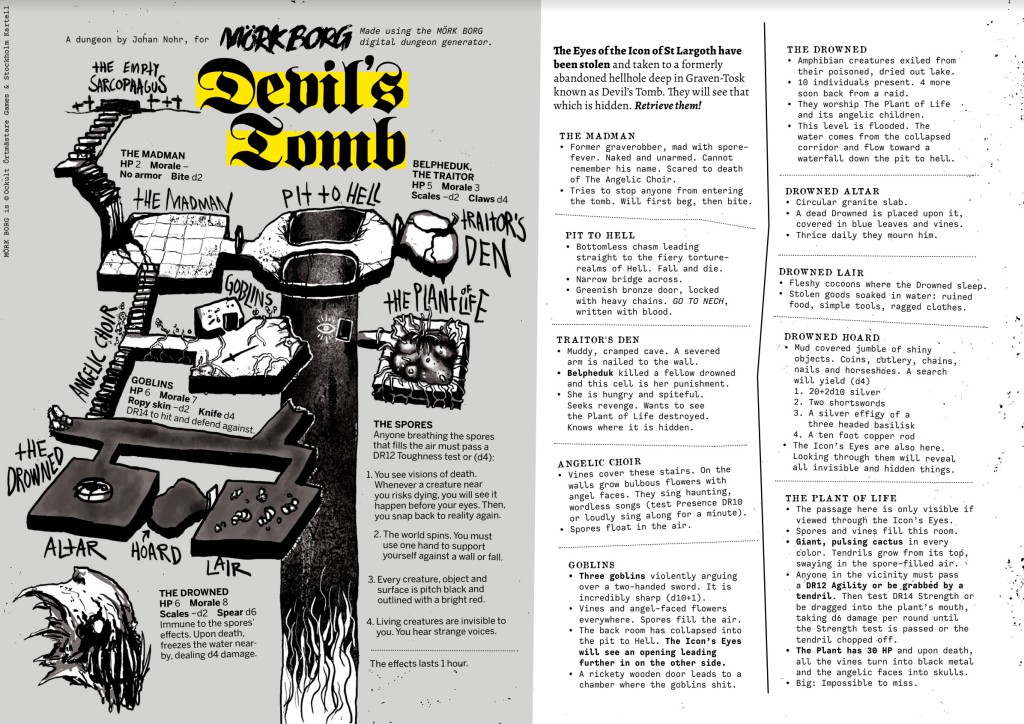
Simultaneously, the process of simplification also affected the form of pre-prepared adventures. While retroclone old school has a fondness for extensive open environments, complex level design, and a large number of challenges ("twenty or thirty"), so that exploration takes you several sessions and still won't be finished, minimalist games subject adventures to the same trimming and try to cram the entire location into as few words and onto as few pages as possible. One-page dungeons or double-sided printed "pamphlets" are popular. This brings with it a dramatic change in style – on the scale of ten starkly described rooms, you can hardly play out a tangled situation with several hostile factions; players don't have many opportunities to sneak around unnoticed, hide from guards in side rooms, or find secret shortcuts – and even the complexity of individual obstacles is limited by the number of lines. The space for inventing "creative solutions" is thus limited.
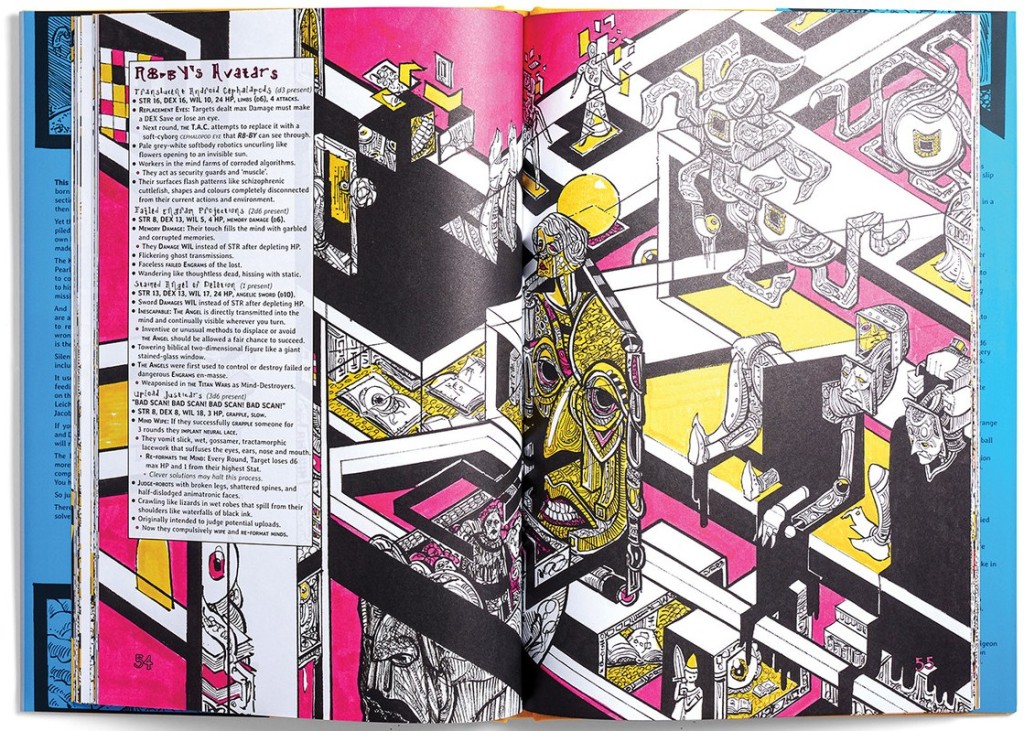
It is not just the map that is being simplified, but also the overall gaming style. One of the traditional pillars of old school disappears from the game – high difficulty and the requirement that the game be a challenge for the players. The style of play becomes more straightforward and simpler. The lost difficulty is replaced by experientiality and the general joy of (non-difficult) interaction with the offered "gizmos." The minimalist stream also very often meets with artpunk and compensates for the dropped complexity with striking visuals, poetic texts, polished layout, and other "artistic" elements.
None of this is meant as a condemnation – it is just an attempt to name how the understanding of old school has changed in some segments of the gaming scene. After all, it is true that a lot of players have no interest in infinite campaigns and complex environments requiring a large time and mental investment. "Simplified old school" can easily become a relaxing pastime for a weekday evening after work, which can't really be said about a complex sandbox. And with a minimalist game with a one-page dungeon, you can experience its "full experience" within a few sessions and then you can go play something else – in retroclones, after a few sessions, you haven't even started yet.
Although fans of retroclones condemn minimalism with gusto. From their side, snide remarks about "cargo cults" or "dumbing down the game" are common. Minimalist games received the mocking label "nu-OSR" or "nuSR" from them – and some minimalist creators adopted it as their own, thereby stealing their thunder a bit. "Artpunk" is a dirty word in some circles. In the opposite direction fly accusations of elitism, gatekeeping, and lines like "Who are you to tell us what is and isn't old school?"
"What the hell am I supposed to take away from this" or the old-school scene of today
In 2019, Google+ ceased to exist, and the "new wave" of creators (with a frequent fondness for minimalism) scattered to all corners of the internet. Despite efforts to find some new common community space, nothing of the sort succeeded, so the old-school community is now fragmented into countless partial sub-communities, internet forums, blogs, Discords, and pages on MeWe. There are warmer and sharper skirmishes between them, and some segments don't like each other. Voices announcing the demise of the OSR community appear regularly, but their prophecies do not come true, and the old-school community continues to create – it is arguably more numerous today than ever in the past.
The division into two main streams still holds. The retroclone stream continues its tradition of open sandboxes, high difficulty, and a fondness for simulationist subsystems. The holy trinity of original retroclones surprisingly still lives, and more and more adventures are being released for it, even though in recent years its fame is being stolen by the increasingly popular Old-School Essentials (2017) (a retroclone of Basic D&D). Not many new retroclones are being created (there isn't much reason), but here and there games in a similar spirit appear; for example, Helvéczia (2021) is indeed derived from D&D 3e, but it plays out a complex sandbox on a hex map and, incidentally, also contains the best "textbook" of traditional old school I have ever seen.
On the side of minimalism, new and new games and diversions are constantly being created, often highly thematic and focused on a specific environment. You surely noticed the Czech translation of Mausritter (2019); a certain popularity was gained by, for example, Cairn (2020) or Electric Bastionland (2020). Listing games of this direction makes no sense – a new 20-page game with minimalist rules and a few random tables tuned for a specific genre is released every odd Wednesday. As far as I can judge, this segment of the old-school scene is more concerned with new rules and the rapid rotation of smaller games and is less interested in creating adventures – although there are already so many one-page dungeons and pamphlet scenarios that you could shovel them.
And then, of course, there are all the shades in between. The existence of two strong and in many ways contradictory streams does not prevent many players and creators from picking what interests them from each. There are certainly players who play extensive sandbox campaigns in minimalist games. You will find plenty of artistically inclined minimalists under the wings of the traditional retroclone Old-School Essentials. And at least from a fleeting glance, it seems to me that some once-minimalist games are getting second editions in which they grow back into complexity – which is a beautiful irony of fate.
As far as terminology is concerned, the retroclone segment continues to call itself "old school" (by which it means old D&D) and commonly operates with the term OSR as well. It even seems that minimalists are vacating the field and leaving the term OSR to the traditionalists. The abbreviation OSR may thus eventually gain a specific meaning as a designation for the traditional, retroclone stream of "old D&D.".
Minimalists also call themselves "old school" (by which they mean that generalized old school not limited to old D&D), but due to the confusing connection with the retroclone scene and sometimes hostile relationships, they are retreating from it in places. No new, generally accepted term has settled yet, although sometimes (more as a joke) they operate with nuSR or nu-OSR, and the new designation "adventure gaming" is also gaining popularity.
The unqualified "old school" itself is a very broad and hazy term today, which rather than a specifically defined gaming direction denotes an evolutionarily related set of games, players, and gaming approaches. Nevertheless, I consider it useful. Yes, when someone tells you that they "play old school," you might eventually find out that within an infinite campaign they are solving the logistics of carrying treasure out of a multi-level megadungeon – or conversely, that they are playing a game so loose that it is an exercise in collaborative storytelling and improvisation. Despite this, the term "old school" still refers to enough common denominators.
Above all, "old school" remains under all circumstances a direction that is primarily interested in the exploration of pre-prepared adventure locations. Yes, sometimes these locations are complex and extensive, other times they are one-page diversions for one evening, but the fondness for drawing maps, level design, "objective" placement of obstacles, and setting traps for fellow players is common to all shades and genres of old school – from traditional fantasy, through sci-fi, to mice. All shades also share an emphasis on non-story-driven play and an open environment without a predetermined plot. And surprisingly, they mostly agree on an anti-heroic, cynical aesthetic, where the life of an adventurer is cheap and players maintain a detached view of their characters. It's not about the personal stories of the characters – it's about exploring locations. That is enough common ground for fans of "old school" to understand each other and have a rough certainty that the creations of other players gathered under this term might interest them.
Wait, it's more complicated! A few more words about games "inspired by old school"
To make it not too easy, ever since the initial boom of old-school gaming, games have been appearing that are inspired by it in partial respects but try to imitate the "old-school experience" in diametrically different rule frameworks or design philosophies. In an effort to combine it with "modern rules that aren't forty years old," or "use everything we've learned in the field of design since 1974," they pile rules and approaches taken from other design directions, often from narrative games, onto old-school motifs. Thus was born, for example, Dungeon World (2012), which implements some tropes of old D&D into the narrative engine Powered by the Apocalypse, or Torchbearer (2013), which does the same with the indie engine Burning Wheel. Similarly, some motifs of old school are also taken by the Forbidden Lands (2018) known here, otherwise a fairly standard "traditional game."
The similarity in these cases is more superficial – it is mostly limited to the fact that adventurers appear in the game who set out into dungeons, and players must to some extent work with consumable resources or encumbrance. However, from the perspective of how such games are actually played or what their pre-prepared adventures look like (if any exist at all), we won't find many intersections with old school in them. Sometimes someone coming from the outside gets confused by the superficial similarity, but overall I have good news for you: the old-school community does not consider these games old-school, and above all, they themselves do not claim to be old school (sometimes very loudly), so terminological confusion does not arise.
And then there is the fifth edition. Among games "inspired by old school," we can also include D&D 5th Edition (2014), which was released back when the old-school movement was in full swing. In reality, the fifth edition also resembles old-school games only superficially, but in recent years, games like Five Torches Deep (2019) have appeared, which attempt to "retroclone" it into a form of a game that will be closer to old-school principles. Since the fifth edition is today already a game on which a lot of people newly coming to old school started, it is a question of whether a stream of "5e old school" will eventually form. So far, nothing points to that.
How to start with old school?
If you have patiently read this far, and yet old school still seems like something potentially interesting, congratulations – you have passed the secret test of traditionalism (who reads kilometer-long articles today!?), so you might be suitable material for a player of old-school games. Today's old-school scene is so diverse that it offers a lot of potential entry vectors. Here are my personal recommendations:
I consider Old-School Essentials (OSE) (2017) to be the most suitable start. Above all, it is a clone of one of the versions of old D&D, and every serious person interested in old school should get to know old D&D – if only to form an opinion on it. At the same time, it is one of those simpler retroclones and is perfectly written, so starting to play it is a joy. But above all, the game has an active community and offers a rich selection of adventures of all styles and genres – and pre-prepared adventures are what it's all about!
In the design stream of traditional complex adventures with uncompromising difficulty and diverse challenges, I recommend Volokarno's Catacombs (2021). Then you can continue with anything from the Hungarian publishing house E.M.D.T., which has never disappointed me. It is all well-made "classic fantasy" that plays out standard D&D motifs but manages to do them in an exciting way. The adventures are mostly written for AD&D 1e (which is that more complex variant of old D&D), so you might encounter a few hitches during conversion (typically references to spells or magic items that don't exist in the more concise OSE), but these are mostly minor details.
Old-School Essentials also has its own line of official adventures, which is a bit more playful, cheerful, and less brutal than traditional hardcore old school. Start with The Hole in the Oak (2019) and continue on to, for example, Incandescent Grottoes (2021). OSE is generally a game under which the more playful creators gather. Halls of the Blood King (2021) is a teenage vampire relationship story in the setting of a dungeon crawl, and Holy Mountain Shaker (2021) is even a genuine artpunk!
If you are more interested in the minimalist stream (or "I don't want to read more than 10 pages and I don't understand at all how I read Markus's article") – in other words, if you would rather just improvise and have fun in interesting locations – Knave (2018) is supposedly quite popular. I've heard praise for the adventure The Waking of Willowby Hall (2021), and beyond that, I don't know – you'll have to manage on your own. If you are interested in minimalism, get used to that.
But there are thousands of adventures for old-school games of all different shapes and genres, good and bad, short and long. Reading reviews, searching for recommendations, and trying out what interests you and what suits you awaits you. That, too, is inevitably part of the old school! You can go through this (woefully incomplete) overview in the RPG Database, read the recommendations of others, and perhaps share your own in time.
And what should I read?
Nothing.
No, really – by reading more articles, tips, tricks, and philosophical analyses, you won't achieve anything other than even deeper confusion. You have to play. Take the rules, take some recommended adventure, try to play it, and suddenly it will click for you on its own. Trust me.
And if you really have a desire for more words, you probably won't ruin anything by skimming the document Principia Apocrypha, i.e., that collection of Zen maxims about generalized old school isolated from D&D. The older document A Quick Primer for Old School Gaming is also well-known, although I consider it weaker.
author Jiří Petrů
taken from the website Zpátky do dungeonu
Jiří Petrů
Autor článků na imago.cz


You might also like

Mytago Publishing Newsletter #37
Discover the latest from Mytago Publishing! We're releasing an expansion for The Witcher RPG, a campaign for Pirate Borg, and another installment of Fighting Fantasy. Find out what's in store for you this year. full article...
20. 8. 2026 Jiří Reiter 5 min
A Brief History of Dice
Did you know that dice have accompanied humanity for over 5,000 years? Take a look at their history from the first throwsticks to modern collector sets. full article...
13. 8. 2026 Karel Krajča 6 min
An Overview of Mark of the Odd RPGs
Are you drawn to minimalist RPGs? We've prepared a comprehensive overview of games built on the Into the Odd system. Find your favorite genre! full article...
10. 7. 2026 Jiří Reiter 21 min