


What is the Old School Renaissance in RPGs?
In this article, we look at how the term OSR originated, what it originally meant, and how its understanding has shifted over the roughly 15 years since its inception.

What do you find in the article?
- Traditional Old School
- 1. Exploration of fantastic places as the foundation of the game
- 2. Overcoming challenges and high difficulty
- 3. "Non-narrative" play in an open environment
- 4. Simulationist mentality of both rules and the referee
- 5. Lightness and variety
- Consequence: Prepared adventures as the main point of interest
(and why is it so complicated)
In this long article (you've been warned!), we'll look at how the term OSR originated, what it originally meant, and how its understanding has gradually shifted over the roughly 15 years since its inception.
First, the obligatory (and not very useful) answer: "old school," "oldschool gaming," or "oldschool D&D" is a label for a distinct gaming philosophy. It encompasses everything from a specific view on design and rules mechanics to the approach to adventure preparation and the way the game is run. It stems from how the old editions of Dungeons & Dragons were played in the 70s and early 80s, which is quite different from how RPGs have been played in the following decades. Specifically, we are interested in the three original D&D editions: Original D&D (1974), AD&D first edition (1978) – definitely not to be confused with AD&D second edition (1989), which we very emphatically do not care about – and thirdly, Basic D&D (the first variant appeared in 1977, but most people refer to the "B/X" variant from 1981).
The old-school philosophy is based on the texts of Gary Gygax (in Dragon magazine and his Dungeon Master’s Guide, 1979), the design approach of published modules and worlds from that era (primarily from TSR and Judges Guild), and the "know-how" embedded in the gaming community of the time, preserved in the minds of veterans. During the 80s, this gaming philosophy was largely forgotten, but after 2000, it was "rediscovered" as part of the so-called "Old School Renaissance" (OSR) or "renaissance of old-school gaming" (though it would be more accurate to call it the "renaissance of old D&D").
Like any proper renaissance, the old-school renaissance is partly a return to the old, but also partly an update and a re-evaluation. What is called "old school" today is not an exact reconstruction of how it was played in the 70s – we know the gaming scene back then was much more diverse. It is more about connecting to one specific tradition ("Gygaxian") and developing it further. OSR fans not only play old D&D, but also create new adventures or game worlds for it, formulate theories on how to play it more enjoyably, and very often create new games that resemble old D&D but push it in new directions. It is precisely this "pushing in new directions" that makes the term OSR so confusing from the outside – people have already "pushed it" so far that it is hard to capture its breadth with a simple description. I will make this article easier by first describing old-school gaming in its most traditional, understandable form, and only complicate it with the "pushing in new directions" part later.
Terminological note: Sometimes you will encounter the term "old school" used in a general sense as "old games" (e.g., old school Warhammer or old school Shadowrun). This is purely a linguistic coincidence and has nothing to do with old D&D and its old-school renaissance.
Now for the more useful answer:
Traditional Old School
In its most traditional sense, old school means playing one of the old D&D editions in a "Gygaxian" spirit. Such a game functions as an adventure action in the pulp fantasy genre, slightly tinged with wargaming.
Pulp fantasy, sometimes more narrowly specified as sword & sorcery, is the genre template for old-school gaming. We return to stories about heroes experiencing action-packed adventures in colorful settings. Frequently cited examples include Howard's Conan the Barbarian, Leiber's Fafhrd and the Gray Mouser, Moorcock's Elric of Melniboné, Vance's Dying Earth… For a Czech reader, the Fighting Fantasy gamebook series might be more familiar; while it isn't the source of D&D (it's the other way around), it hits a similar genre stylization. The specific works are not as important as the fact that it is a return to lighter fantasy before the genre became dominated by serious novels and epic sagas (and later, young adult themes).
From wargaming, old school inherits a fondness for complex open scenarios and simulation. In traditional wargaming, players are presented with a complex scenario with a fixed starting situation (a specific map, tokens placed on it…), they start interacting with this situation, and the rules (or the referee) are there only to simulate logical consequences. Similarly, in old-school gaming, the referee first prepares an open scenario (draws maps, places obstacles, sketches relationships…), then lets the players into it, and continues to simulate what happens using the rules.
When we combine this and apply it specifically to RPGs, old-school gaming stands on five pillars:
- Exploration of fantastic places as the foundation of the game
- Overcoming challenges and high difficulty
- "Non-narrative" play in an open environment
- Simulationist mentality of both rules and the referee
- Lightness and variety
1. Exploration of fantastic places as the foundation of the game
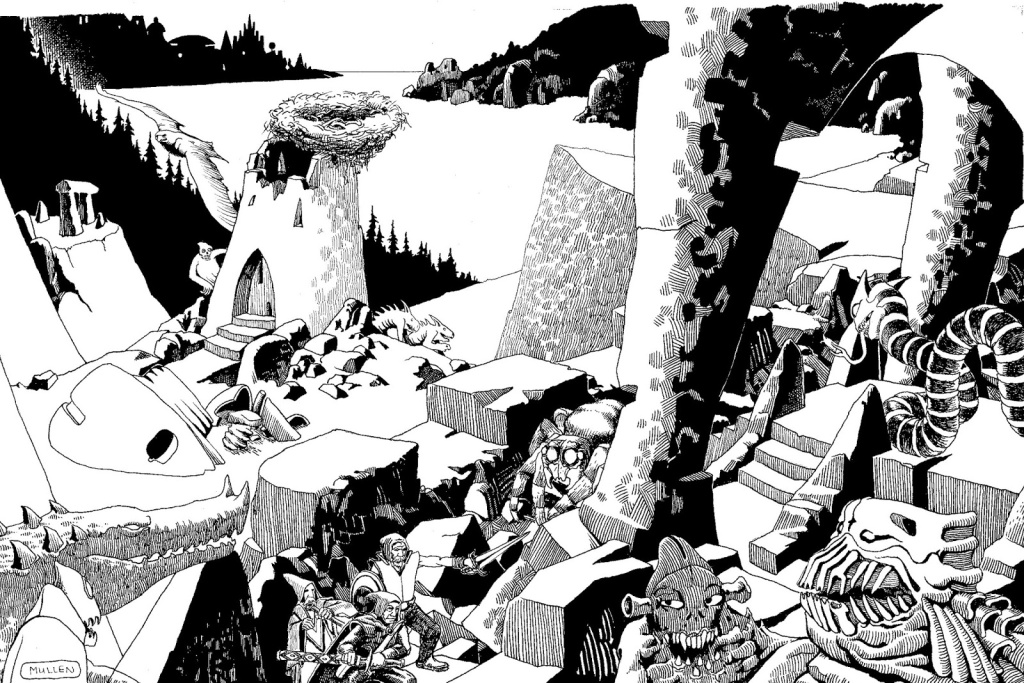
If I had to name one single thing "what old school is about," it is crawling through interesting places. In the most basic sense, "old school is about" a group of characters setting out to explore a fantastic location full of adventure and danger. So whether you are crawling through traditional underground dungeons…

…or penetrating the depths of a magical forest…

…or venturing into the lost city of a forgotten civilization deep in a mountain valley…
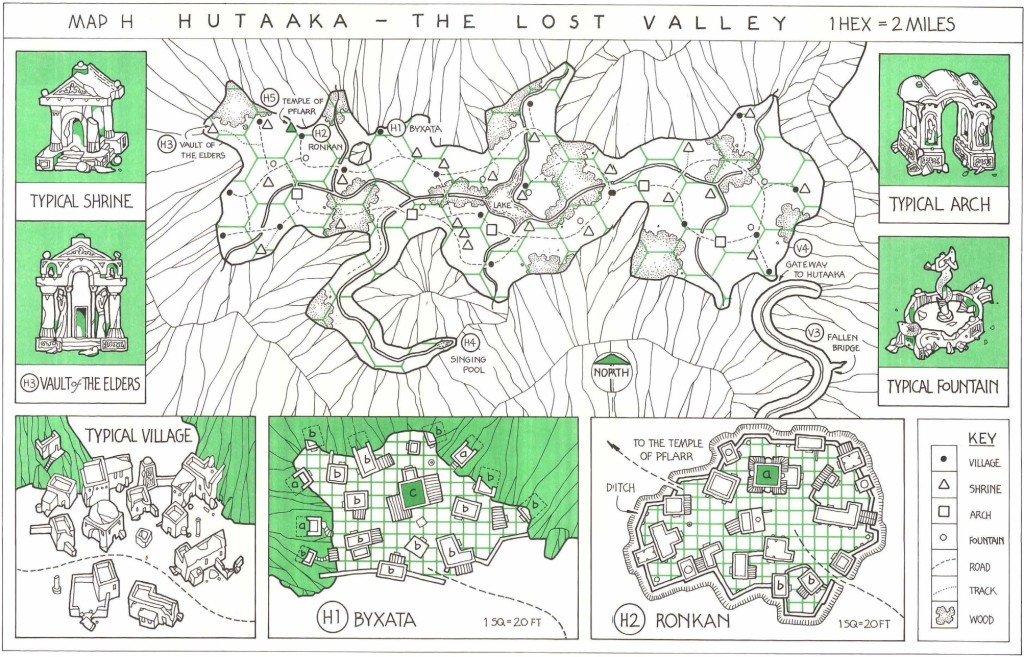
…or traveling through a spookily fairy-tale landscape…
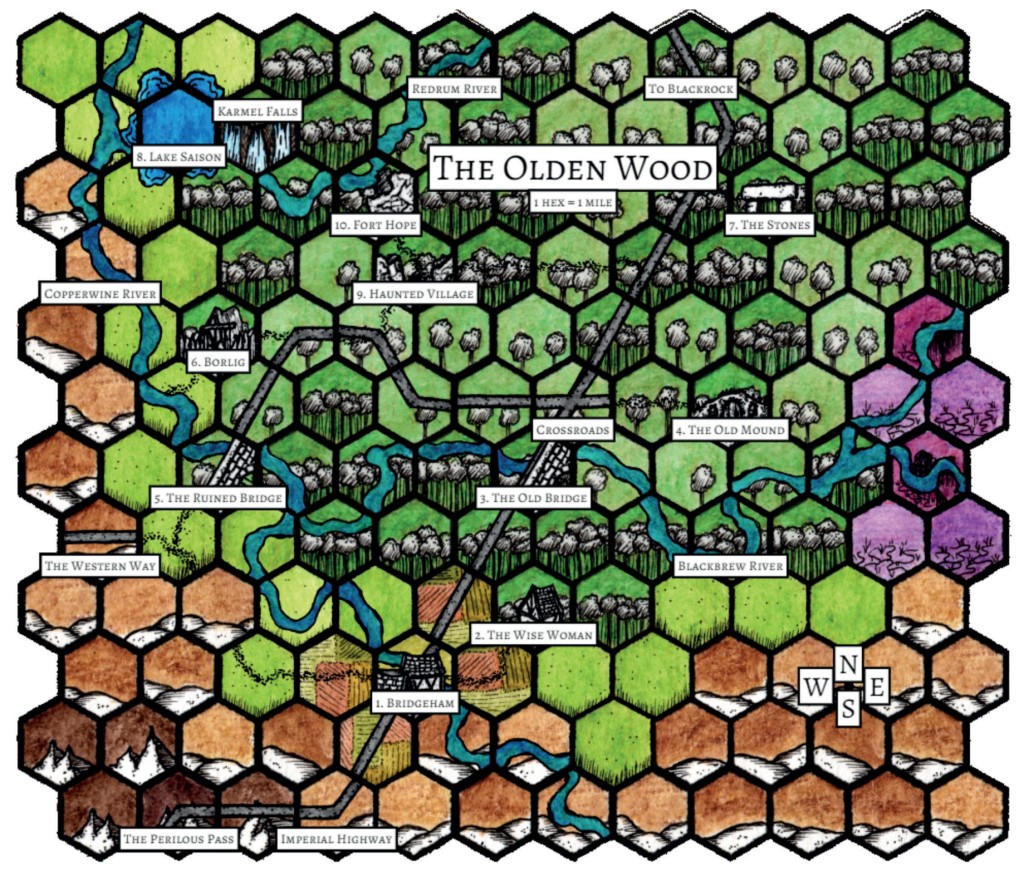
…interest in the place is always first.
Such an adventure location is objectively described in advance. In preparation for the game, the referee takes care to populate it with monsters and enemies, place traps, treasures, puzzles, and hazards, and rig an ingenious network of relationships among its inhabitants. As a referee, you enjoy preparing a place full of challenges and surprises for your friends, and during the game, you have fun watching how they deal with your traps. As a player, you let yourself be invited into the environment the referee has prepared, interact with it, let yourself be surprised, and simply try to have fun in it.
The emphasis on the place goes so far that it pushes player characters into the background. A player character in the old-school style is more of a spice to the game than its main goal. Their personal story doesn't interest us that much – the character is primarily a pretext that allows us to explore fantastic places. Similar to reading pulp fantasy, you don't expect deep character development from the characters. They are there primarily so that through their eyes we can experience an interesting place, encounter gripping obstacles, and have fun with how they overcome them.
In an old-school game, characters usually start undeveloped, without a clear character or anchor; players flesh them out through play. Only during the game do they find out who they actually are. And although characters inevitably build their own personality and start pursuing their own goals (especially during a longer campaign), this happens more incidentally, and the character still remains secondary to the exploration of the game environment.
2. Overcoming challenges and high difficulty
All those adventure locations are filled with challenges and obstacles. In underground crypts, undead guard ancient treasures; on forest paths, mythical monsters hunt poor travelers; in a lost city, dog-headed humanoids sacrifice captives to demonic gods… Various riddles and puzzles are also challenges: A Sphinx promises knowledge to those who answer a riddle (Can you guess it? And what will you wish for?), in ancient baths, multicolored and foul-smelling magical liquids spring from the wall (Do you dare to drink? Can you deduce in advance what each one does?), a headless knight on a bridge offers a reward for freeing his soul (How to achieve that? And isn't it a trap?). An old-school adventure doesn't contain two or three such elements – but rather twenty or thirty. Players spend most of their game time interacting with obstacles and overcoming them.
These obstacles are "objectively given," and there is a real risk of failure, even death of a character – or the entire party! Old school follows the philosophy that victory is sweet only if you can truly lose – players are not destined for success in advance. Moreover, the difficulty is set quite high, so the most straightforward solutions (like "Let's rush in and smash everything!") tend to end ingloriously. It is practically necessary to play smart, think creatively, and try to outsmart the environment. This applies both through the character (their abilities, spells, items…) and through the "gadgets" offered directly in the game environment: Can't the trap be bypassed by a secret passage? Are there mutually hostile enemy factions that we can pit against each other to make our job easier? Can the monster be tricked, bribed, or lured away? Wouldn't it help to leave and return a few days later with hired help… or a purchased calf?
We commonly work with the "reward vs. risk" dynamic. In an old-school game, rewards are primarily treasures, as they are the main source of experience and are therefore necessary for improving characters. (To a lesser extent, rewards include new spells or magical items.) But treasures don't fall into the characters' laps – players must earn them by overcoming challenges. It holds true that the most valuable ones are usually well-hidden or guarded. Players must constantly weigh whether they will play carefully and "play it safe" so that nothing happens to their characters (but at the same time, they will improve only slowly) – or whether they want to risk it to gain a lot and have their characters improve quickly (which simultaneously increases the risk of death).
The referee has a dual role here. In the preparation phase, they function similarly to a level designer in video games. Their task is to prepare an environment that will offer players fresh and surprising challenges, require non-obvious solutions, and at the same time offer players enough "gadgets" and freedom to even be able to come up with such non-obvious solutions.
Once the game starts, the referee shifts into the role of a judge who "only" fairly evaluates the players' ideas and logically acts for the game environment. They don't target the players, they don't try to trap them and kill their characters – and at the same time, they don't favor them or spare them. The referee becomes an impartial game environment. It is entirely up to the players how skillfully (or unskillfully) they deal with it.
In connection with old school, people sometimes talk about "player skill" – the abilities and experience of the players. This means that the game is a challenge not only for the characters, but primarily for the players. And if the players play poorly, the game will very gladly make them pay for it. However, the earned victory is all the sweeter. It is perhaps the most controversial aspect of the old-school gaming style – and at the same time, its great appeal.
By the way, do you know the main difference in illustrations between old and new D&D editions? In the old ones, illustrations commonly depict adventurers being eaten by monsters, crushed by a trap, or dissolved by slime. In the new ones, adventurers are always depicted as victorious (and handsome!) heroes.

3. "Non-narrative" play in an open environment
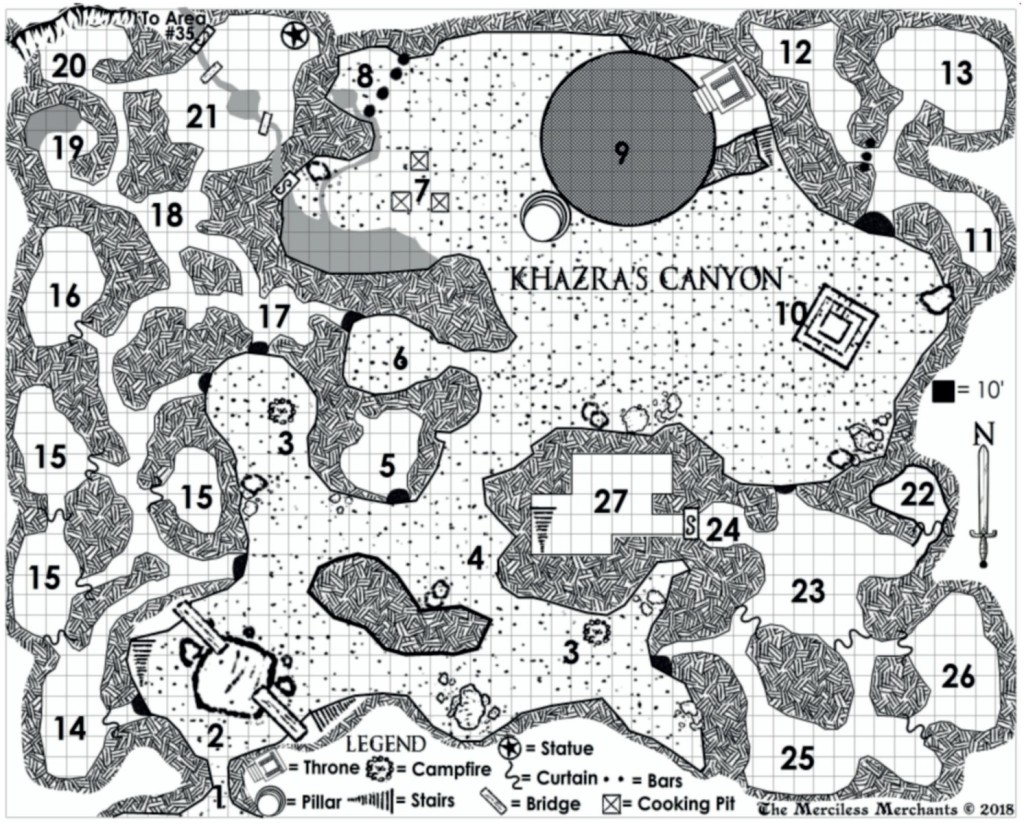
Take another look at the maps posted a little higher up. Notice that they are intricate, extensive, and open. A general preference of old-school gaming is the emphasis on non-linearity and unpredictability – both geographically and plot-wise.
This is most visible on the maps. Old-school adventure locations are not made to have one clear path (or two) that leads adventurers through a planned sequence of carefully rigged "encounters" toward a waiting climax. On the contrary, old-school adventures are usually non-linear – they have more entrances and exits, more connections between floors, more possible paths, various shortcuts, and loops. Partly, this is due to a fondness for "believability" (real locations aren't built as linear sequences of encounters either), but primarily, it is a love for unpredictability. In an ideal case, the referee should not be able to guess which path the players will take and what will happen in the game. And since there are not two or three hazards, but twenty or thirty, their order – and which ones the players encounter and which they miss! – truly matters.
A complex environment opens up more space for creative problem-solving. You would be surprised what kind of shenanigans can be invented with secret passages, overpasses and underpasses, underground rivers, cliffs stretching across several floors, and loops. In a complex environment, opportunities arise for various bypassing, luring away, chasing, running away, hiding, setting ambushes, and so on and so forth. In a linear series of five rooms, you basically can't do any of that.
The plot is just as non-linear. In old school, the referee shouldn't prepare any plot at all – their task is not to think about the story and its twists, exposition and climax, plot lines, or acts. Yes, an old-school game can have some narrative framing ("The Prince hired you to find out why interdimensional monsters are invading his gardens"), but that serves primarily as a pretext for free exploration. The referee's task is not to drag players through a story, but to prepare an environment full of gadgets for them – and leave it to them exactly how they will manipulate them. A favorite trick is to rig several plot hooks into a location, ideally mutually contradictory (perhaps different factions interested in the same problem), and let the players choose between them and let them interact with each other in various ways.
Personally, I like to talk about "non-narrative" play. It doesn't mean the game has no story (it isn't "story-less"), but that the story is not its goal. The players and the referee don't consciously try to develop it; they let it emerge spontaneously. The story is simply what happens.
Non-linearity and unpredictability are increased by various elements of chance, typically random encounters, which simulate the unpredictable movement of enemies on the map. But they are also increased by the rules. In old school, there is no such thing as "plot immunity." Any player character can drop out of the game at any time, but the same applies to non-player characters. In fact, it is often surprisingly easy to kill – or even worse, charm and control – even important non-player characters. Because of this, any pre-prepared plot basically cannot be maintained, and the game quickly takes an unpredictable direction.
The Platonic (and often unattainable) ideal of old-school gaming is the so-called "sandbox," a game mode where you take all these principles of openness, non-linearity, and unpredictability and scale them up from the level of an adventure to the level of an entire campaign. The referee takes all those non-linear adventure locations and slaps them onto a map of a smaller world. In it, they prepare a few towns that serve as safe starting bases, a few hostile organizations and powerful non-player characters, a few plot hooks that will lure players to individual locations… and then they release the players into it and watch what happens. Sandbox is a very nice metaphor. The referee's task is to prepare an interesting sandbox for the players, full of engaging toys inviting interaction. Which ones will the players play with? And what will happen? We will only find out by playing.

4. Simulationist mentality of both rules and the referee
For old D&D – just like practically all games from the 70s – it holds true that they are strictly simulationist. The rules try to capture only the "functioning of the game world" and do not deal with things like structuring the plot, imitating film or literary narration, narrative powers, dramatic mechanics, etc. There are no "meta-game" rules in the game that cannot be directly mapped to something the player character is doing – no fate points, no fluff, no game currencies, nothing impersonal to the character. At the same time, don't look for any "board game" (or "gamist") elements like inventing "builds," using "combos," "action economy" – nothing that wouldn't hold up in a simulationist view of the game.
The idea is that the player should not be distracted by "meta" rules. They should immerse themselves in the character and act for them, as if they were actually there. And the simulationist system is there so that their actions have reasonable, believable consequences.
The simulationist mentality is basically the opposite of the narrative mentality. Imagine a typical scene where heroes burst into a dark cult's temple just as an unholy ritual is peaking and the high priest's curved dagger is about to plunge into the body of a bound victim! Such a scene can only arise with a narrative mentality. In an old-school game, something like that will most likely never happen to you. In an old-school game, you will simulate "how it would probably work for real" – for example, you will determine the exact hour when the ritual takes place, and then you will count the time the adventurers spent traveling to the temple. The heroes will almost certainly not arrive exactly at the moment of the ritual, but either before it or after its completion – and you will play out (simulate) the natural consequences of such a situation in the game.
Game situations therefore do not arise from the referee's "narrative judgment." Game situations arise because they emerge from the logic of the game environment itself. And the task of the rules is to ensure that such situations truly emerge from them. That is why old-school games contain various simulationist subsystems: a system for travel, a system for weather, a system for survival and getting lost in the wilderness, a system for magical research, a system for counting time and light, a system for encumbrance, a system for random encounters depending on elapsed time, a system for hiring porters and men-at-arms…
The point is for the simulationist subsystems to run somewhere in the background (read: in the referee's head) and from time to time spit out an interesting result like: "A storm came, extinguished your torches, and some kind of screeching is approaching you." Or "You found a precious throne, but your porters' morale failed a moment ago and they ran away, so you can't carry it alone… unless you leave your armor here." In video game terminology, this would be called emergent gameplay. Game situations emerge spontaneously from the combination of simulationist rules.
It is basically the same principle on which traditional wargaming simulations work – we have a scenario (in RPGs, it is an objectively given environment or adventure), we have some simulationist rules, players do something, and consequences of their actions emergently arise from the rules.
Yes, simulation can be easily overcomplicated by adding more variables, which happened to many RPGs in the 80s. Old D&D avoids this with several measures. First and foremost, it simulates only what is relevant to adventure action. Furthermore, it uses relatively simple and abstracted simulation – there is no need for complex calculations where a random die roll suffices. And for example, the combat system in D&D is so abstracted that you can swiftly play out a fight with ten or twenty participants, which is something most more complex systems fail at. (And when your character dies, you can roll up a new one in five minutes.)
And above all: a lot of unnecessary complexity can be avoided by involving the referee's judgment in the simulation. Instead of trying to cover all exceptions and rare situations with rules that would grow to the point of unplayability, we make the rules simple and give the referee the authority to solve non-standard situations with improvisation through their own judgment – perhaps by adding a bonus, determining the probability of something happening, or simply by deciding the result outright (though "simulationistically," not "narratively"!). This principle is expressed by the well-known motto "Rulings not Rules!"
Different editions of old D&D have their simulationist subsystems with varying complexity – Basic D&D is simpler, Advanced D&D is more complex and codifies many exceptions and rarer situations directly into the rules. Regardless of the specific game, it is assumed that every referee will eventually develop personal proven practices. Maybe they will drop some official subsystems, maybe they will modify them, they will certainly add new ones. Do you want a subsystem for alchemical potion mixing, a random encounter generator in a fantasy metropolis, a procedure for getting lost in an enchanted forest, a random table of consequences for a night of debauchery? Creating similar subsystems is one of the great hobbies of the old-school scene.
5. Lightness and variety
Despite so many lines written, it is worth emphasizing that an old-school game does not take itself too seriously. When you start taking it too seriously, when you get bogged down in historical realism, when players stick too close to the wall and carefully weigh every step, the game starts to slow down, stutter, and stall. And nothing harms adventure action like dragging. Real fun comes when players rise above the game, when they gain perspective on their characters, when game situations are evaluated swiftly and we don't pick at things too much, when the referee is willing to bend and mess up all those simulationist rules from time to time. And the Zen moment for the referee comes when they renounce responsibility for steering the plot and inventing a super-elaborate world and let things emerge spontaneously through play.
Because in the end, it's about what we said at the beginning. Old school "is about" exploring fantastic places full of fantastic creatures, overcoming colorful obstacles, interacting and experimenting with an engaging game environment that our friend the referee has prepared for us.
And about prying gems from the eyes of statues, dodging ray-guns in the eyes of crystal golems, infiltrating a guarded castle in laundry baskets, turning party members into various animals depending on which one suits you at the moment, pitting a troll under a bridge against a gang of goblins living just downstream, dying in a giant spider's cocoon, exploring a barrow that turns out to be a flying saucer, the sadness that my character died because of a bad roll, the joy that I can make a new one, the surprise of the first encounter with flying sharks, feeling like a total badass when you take out the entire personal guard of a mad villain with a first-level Sleep spell…
And for me, it's also that feeling I had when I was a boy playing The Warlock of Firetop Mountain or The Swamp of the Scorpion for the first time.
Consequence: Prepared adventures as the main point of interest
All that emphasis on the openness of the environment, on the variety and frequency of challenges, on the availability of "gadgets" and various plot hooks means that the quality of prepared adventure locations matters a lot – a whole lot. For the referee, preparation is demanding both in terms of time and creativity. In old school, the referee truly becomes a level designer – and it is quite easy to design a level that will be stupid or just plain boring.
That is why so much attention is paid to adventure design on the OSR scene. And at the same time, there is a thriving market for prepared adventure modules that allow people like me – who have less time or less imagination – to outsource all this design work to someone else. I don't have to learn how to be a good level designer; I can just buy something that others have prepared for me! (And then continue to bend and reshape it myself, because modifying things to your own image simply belongs to RPG games.)
The OSR community is largely a community of people who deal with the design of adventure modules – they analyze their structure, look for what works better and worse, share their ideas, learn from each other, write reviews and critiques (because, of course, there are better and worse modules). In fact, the creation of adventure modules is the reason why the OSR movement even exists!
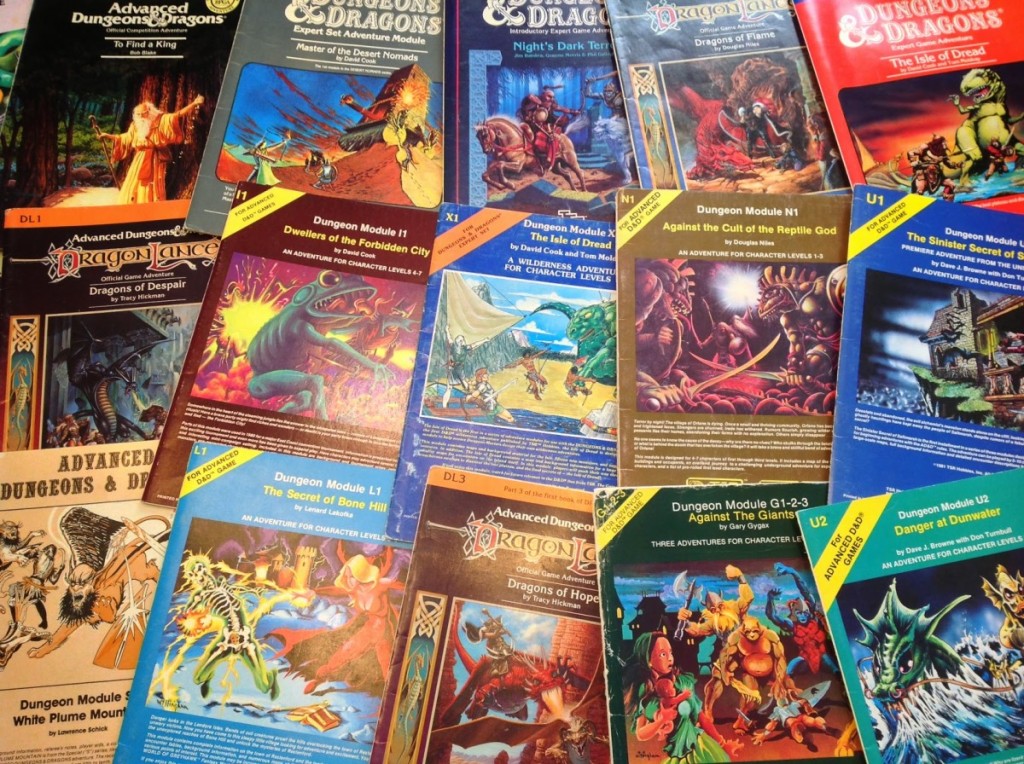
That is also why it is basically impossible to understand old school as long as you only look at the rules of the games and don't look at the adventures. A part of the game so important is hidden in the adventures and their design that without them, you are overlooking the essential. Different games tend to have slightly different traditions of module design – and that too is part of their identity. So when people talk about playing, say, AD&D first edition, they don't just mean the rules you find in the "Player's Handbook" and "Dungeon Master's Guide"; they mean the style of adventure modules and game running that this game helped establish.
And yes, for a player used to reading only the basic rules and ignoring adventures, it is then hard to understand old school. Do it the other way around – ignore the rules and read an adventure – and it will immediately be clearer.
author Jiří Petrů
taken from the website Zpátky do dungeonu
Jiří Petrů
Autor článků na imago.cz


You might also like

Mytago Publishing Newsletter #37
Discover the latest from Mytago Publishing! We're releasing an expansion for The Witcher RPG, a campaign for Pirate Borg, and another installment of Fighting Fantasy. Find out what's in store for you this year. full article...
20. 8. 2026 Jiří Reiter 5 min
A Brief History of Dice
Did you know that dice have accompanied humanity for over 5,000 years? Take a look at their history from the first throwsticks to modern collector sets. full article...
13. 8. 2026 Karel Krajča 6 min
An Overview of Mark of the Odd RPGs
Are you drawn to minimalist RPGs? We've prepared a comprehensive overview of games built on the Into the Odd system. Find your favorite genre! full article...
10. 7. 2026 Jiří Reiter 21 min