


A Brief History of Dice
Did you know that dice have accompanied humanity for over 5,000 years? Take a look at their history from the first throwsticks to modern collector sets.
What do you find in the article?
Everyone has seen a classic six-sided die. It has become a symbol of board games, easy enough for a small child or your oldest grandmother to use. Thanks to games like Ludo and various "pub dice games," they are a staple in almost every household. However, their history is far more deeply intertwined with human history than it might seem at first glance. And the sheer variety of shapes and side counts! Let's take a look at their history together.
More than just numbers: Dice as fate, a dramatic tool, and a collector's passion
When you pick up a die, you aren't just holding a piece of plastic with dots or numbers. Dice are essentially the perfect tool for generating randomness and resolving events. Especially in role-playing games (RPGs), they represent more than just cold math or simple addition—they are engines for emotion, unexpected plot twists, and tension.
In RPGs, the die takes on the role of inexorable fate. A single roll of a twenty-sided die can decide whether your character wins gloriously, negotiates the impossible, or meets a tragic end in battle. Resolving situations with dice gives both players and the Game Master the freedom to perceive risk and accept consequences they might not have come up with on their own.
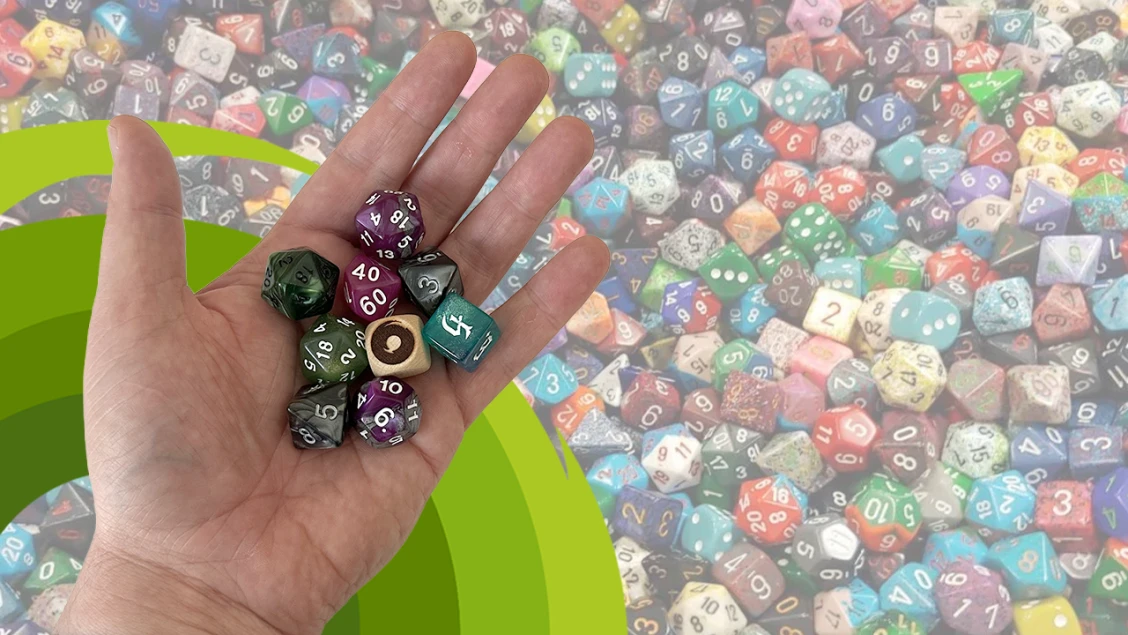
For many players, dice have also grown into a hobby in their own right. Colorful sets made of resin, heavy metal, wood, or even semi-precious stones with sharp edges and unique effects become personal talismans. Every serious player has their favorite set, believing it holds "the right energy," and builds their own collections from which it's a joy to choose for every new character.


The oldest predecessors: Bones and sticks
Before the perfect geometric die was created, people used available natural materials for throwing. More than 7,000 years ago, these were knucklebones from animal ankles, which were primarily used for fortune-telling and divination.
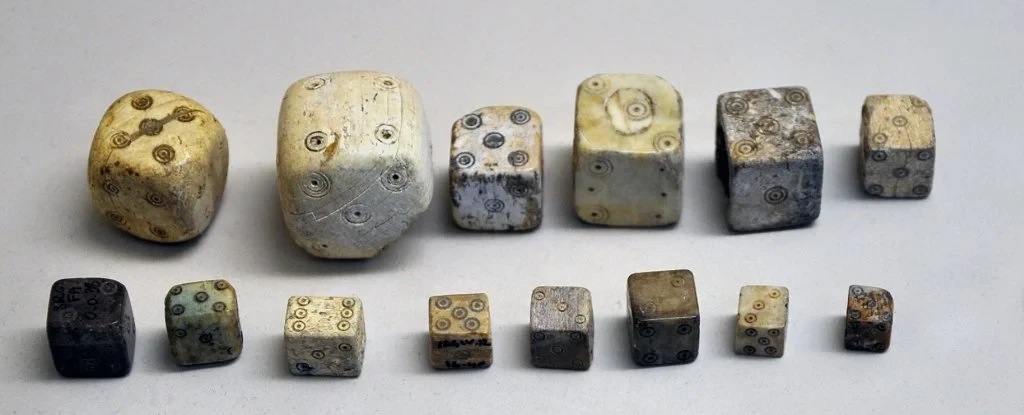
In Egypt, 5,000 years ago, flat double-sided throwsticks appeared, which determined the number of steps on a game board. The oldest confirmed archaeological finds of actual dice come from Turkey, Mesopotamia (c. 3000 BC), Skara Brae in Scotland (3100–2400 BC), and the Burnt City in Iran (2800–2500 BC). In North America, dice may have been used as early as 12,000 years ago.
The die is cast!
The influence of dice on history is best illustrated by the famous words "The die is cast" (Latin: Alea iacta est), spoken by Julius Caesar in 49 BC.
The phrase refers to Caesar's decision to cross the Rubicon river with his army upon returning from the conquest of Gaul and march directly on Rome. The act of not disbanding his army before the Rubicon made Caesar a traitor and sparked a civil war against the Roman Senate.
The metaphor of the dice symbolizes taking a huge risk and the inability to take back steps already taken—just as a player cannot influence the outcome of a game after the dice are thrown, Caesar could no longer change his decision.


The origin of the classic D6 and the first polyhedrals
In the Indus Valley (Mohenjo-daro, c. 2500–1900 BC), terracotta six-sided dice appeared. It was during this time that the rule we still use today originated: the sum of numbers on opposite sides always equals 7. In Ancient Rome and Ptolemaic Egypt (300–150 BC and 1st–2nd century AD), twelve-sided (D12) and twenty-sided (D20) dice carved from stone, soapstone, or ivory were already commonly used.
A timeline of dice history
| Year | Description |
|---|---|
| 3100 BC | The Egyptian game Senet uses double-sided sticks to determine movement. |
| 3000 BC | Oldest dice finds from Turkey and Mesopotamia. |
| 2600 BC | The Sumerian Royal Game of Ur uses pyramid-shaped four-sided dice. |
| 2000 BC | Cubic dice appear in Egyptian tombs. |
| 1333 BC | Discovery of animal bone dice in Tutankhamun's tomb. |
| 1188 BC | Sophocles attributes the invention of dice to Palamedes (Troy). |
| 900 BC | Discovery of dotted dice in Tuscany. |
| 600 BC | First finds of standard dice in China. |
| 400 BC | First written mention in the Indian epic Mahabharata. |
| 300 BC | Oldest twenty-sided die (D20) from Ptolemaic Egypt. |
| 150 BC | First twelve-sided dice (D12) in Egypt. |
| 100 AD | Roman twenty-sided die (sold for 17k USD in 2003). |
| 1000 AD | Common dice finds in Viking graves. |
| 1600 AD | Galileo and Cardano perform the first mathematical analysis of probability. |
| 1888 AD | Creation of eight-sided poker dice. |
| 1906 AD | Ten-sided die patented in the USA. |
| 1950 AD | Tokyo-Shibaura patents plastic D20s with numbers 0–9. |
| 1974 AD | Dungeons & Dragons popularizes sets of polyhedral dice. |
| 1980 AD | Modern D10 introduced at GenCon. |
| 1985 AD | Zocchihedron released – a hundred-sided die (D100). |
Famous historical dice games
Dice games were at the birth of many famous board games in history. One of the oldest is the Sumerian Royal Game of Ur (c. 3000 BC), where players raced pieces and center squares predicted the future. In Egypt, Senet (c. 3500 BC) reigned supreme, a favorite game of pharaohs where the movement of pieces symbolized the soul's journey through the afterlife.
From the 8th century AD, the game Sugoroku was popular in Japan, similar to Snakes and Ladders, where jumps forward and backward represented life's challenges and opportunities. In Europe, from the 16th to the 19th century, the Game of the Goose was a hit, a phenomenon based on pure luck and chaos while moving along a spiral board.


Modern production and the RPG era
Today, we distinguish between two basic types of dice production. Common board game dice (non-precision) are made of injection-molded plastic with rounded corners and recessed dots. In contrast, precision dice (casino dice) are manufactured with sub-millimeter accuracy from transparent acetate with sharp edges to prevent any cheating.
The real boom of polyhedral sets (D4, D6, D8, D10, D12, D20) occurred at the turn of the 60s and 70s with the arrival of tabletop wargames and the launch of the RPG legend Dungeons & Dragons, which turned dice into an indispensable symbol of the modern gaming world.
Conclusion
Whether you are holding a classic six-sided die in your hand or rolling a twenty-sided die for a critical hit, you are holding a piece of human culture and history over 5,000 years old. Dice are simply a fascinating combination of history, fate, game mechanics, and aesthetics.

Karel Krajča
Šéfredaktor, content creator a organizátor festivalu Fantastická Ostrava. Fanoušek fantastiky, videoher, deskových her a popkultury obecně. Příležitostný milovník malování figurek a craftení všeho druhu. Hudební závislák a amatérský znalec fyziky a matematiky.
You might also like

Mytago Publishing Newsletter #37
Discover the latest from Mytago Publishing! We're releasing an expansion for The Witcher RPG, a campaign for Pirate Borg, and another installment of Fighting Fantasy. Find out what's in store for you this year. full article...
20. 8. 2026 Jiří Reiter 5 min
An Overview of Mark of the Odd RPGs
Are you drawn to minimalist RPGs? We've prepared a comprehensive overview of games built on the Into the Odd system. Find your favorite genre! full article...
10. 7. 2026 Jiří Reiter 21 min
A Guide to The Walking Dead Universe RPG
Enter The Walking Dead Universe RPG. We'll show you how to play, how the dice work, and how to create a character for survival in a world full of zombies. full article...
2. 7. 2026 Dominik Gál 8 min