


How (Not) to Play Proper “Old-School” D&D?
After the first sessions played in Old School Essentials, I have my first set of insights. If I wanted to test how to play old-school D&D, I have so far verified how not to play it!

After the first five sessions played in Old School Essentials (OSE) in the style of old-school D&D, I have my first set of comprehensive insights. If my goal at the start of the campaign was to test how to play old-school D&D properly… well, I have empirically verified how not to play it!
To be more precise—I am starting to understand how the game (should not) look in terms of genre and setting, because we managed to drift into a different genre where it just doesn't quite click. I started the campaign without much thought, planning to just run (more or less) random modules created within the Old School Renaissance (OSR). Since then, I’ve read a lot, familiarized myself with other modules, both old and new, and—hopefully!—understood what made old (A)D&D unique. Let’s talk about genre and playstyle!
But first, a brief recap of our last adventure, during which I realized something wasn't adding up…
A Thousand Dead Babies
For the last three sessions, we played the module A Thousand Dead Babies (SPOILERS ahead!), where the players get tangled up in a village mystery involving a conflict of faith, the suppression of pagans, Satanism, and human sacrifice. The players arrived in a remote shepherding village somewhere in the mountains, where the only interesting building is the church and the only power is held by a reeve empowered by an absent baron and a hastily assembled militia of yokels.
In the first session, the players were recruited by the priest and the reeve to investigate rumors of pagan rituals and dark creatures supposedly seen in the woods. At night, they uncovered a “Satanic” ceremony with orgies, infant sacrifice, and the presence of a humanoid goat. With the help of mercenaries, they broke it up, killing a few Satanists and the goat.
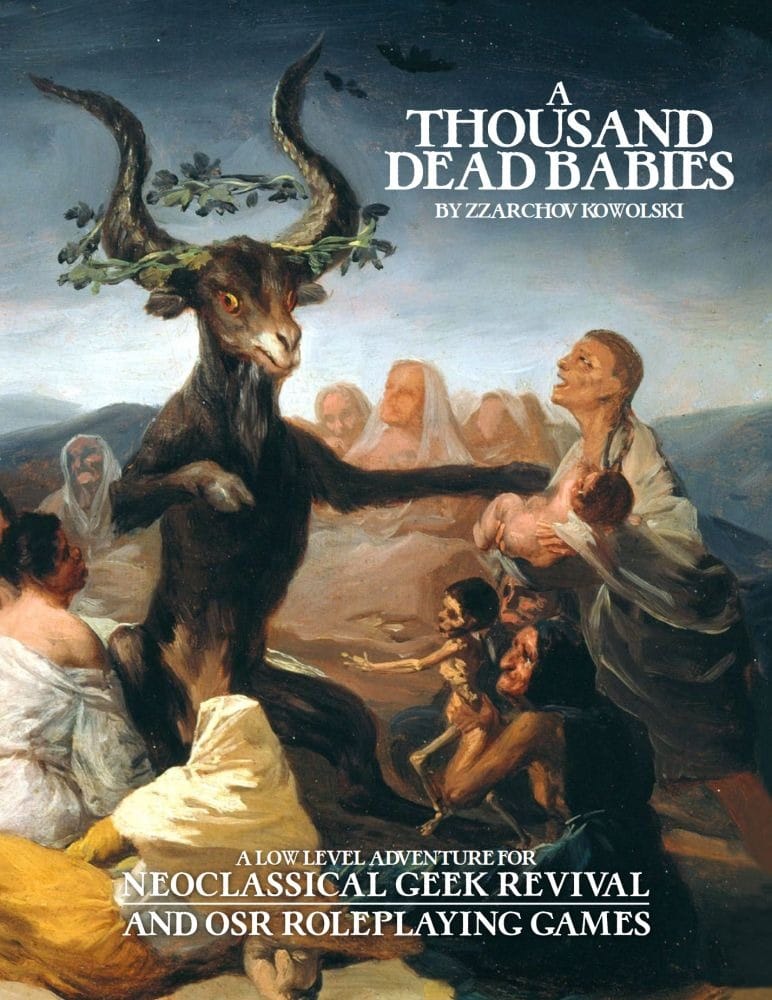
In the second session, they collected their rewards and started investigating what it was all about, who was who, and what exactly happened here. They went on an expedition into a mini-dungeon themed around fungi and slimes—clearing about 5 rooms. They found a cursed basket that attached itself to one of the player characters, and every midnight, a new baby appears in it. The players are now accumulating infants.
In the third session, they finished their “investigation,” walked around the village, talked to other actors, caught and interrogated one of the “Satanists,” and rummaged through the dead witch's cottage. A few question marks remain, but they have basically pieced together what happened.
Three sessions for a dark social-investigative adventure with a bit of action. The adventure itself is actually very good (I rate it four stars), but it is stylistically completely off. First of all, it’s off in terms of genre (too dark, more suitable for something like Warhammer), but that’s obvious. It’s more interesting to discuss why it doesn't fit in terms of structure and playstyle.
Warning: Whenever I talk about how old D&D “should” look, I am obviously talking about my own personal vision, which emerged from reading OSR blogs, old and new modules, and some foundational sword & sorcery literature (I recommend Fritz Leiber). This article expresses what I have personally arrived at—your old-school D&D can look different.
Genre: Not-So-Low Fantasy—and Keep It Light!
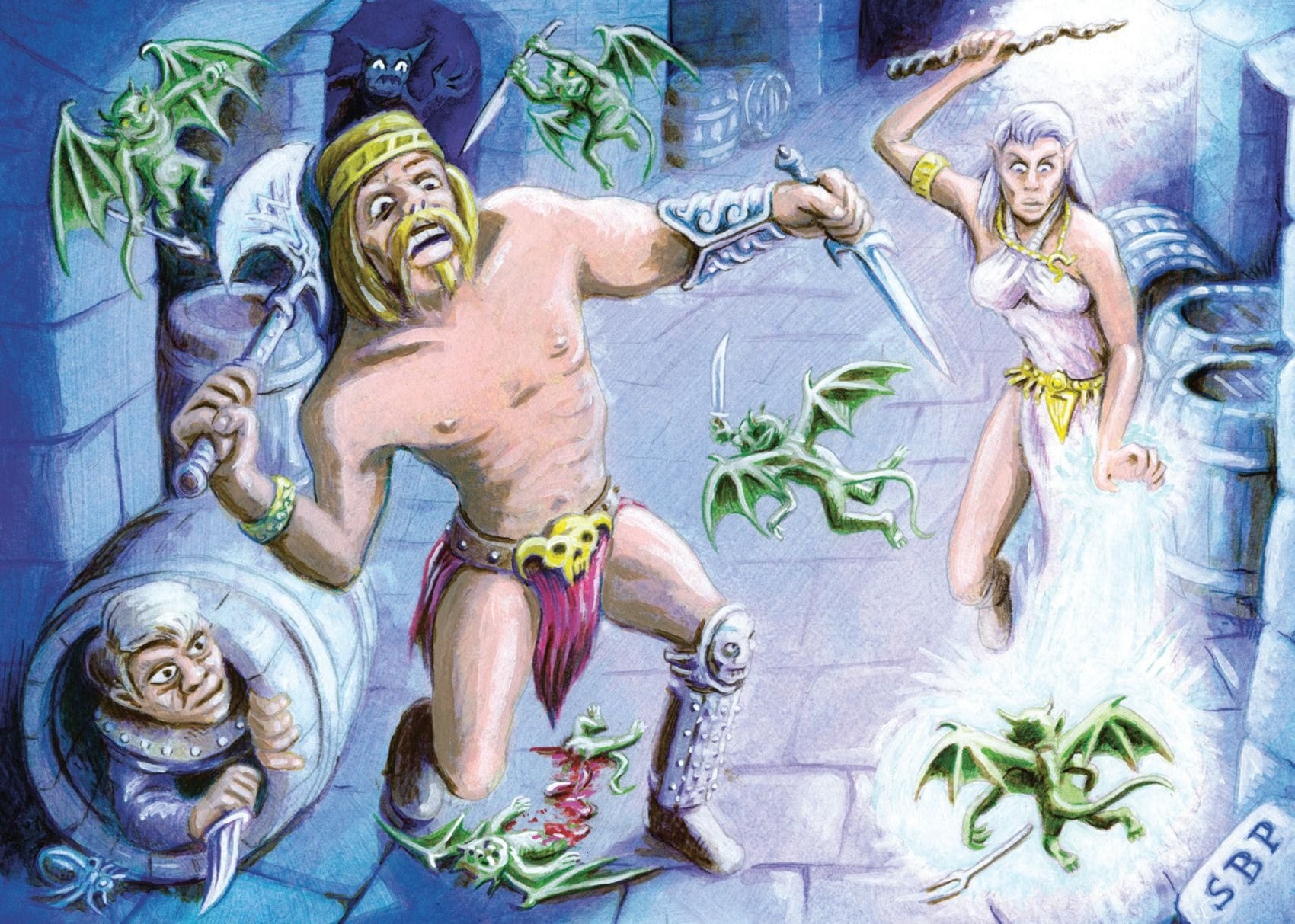
Let’s start with the simple part—the genre. Old-school D&D is pulp fantasy telling not-too-serious stories about a bunch of shady individuals who wanted wealth and fame, so one day over wine, they decided to start raiding dungeons. It moves somewhere on the border between heroic and anti-heroic, yet at least at low levels, it has enough cynicism hard-wired into it—fragile characters die after a single die roll, and it’s best not to take the game too seriously. At higher levels, characters become capable heroes, but the difficulty of enemies grows alongside them, and the game remains deadly. And the heroes haul tons and tons of treasure out of the caves. We write stories about fools who gamble with their own lives to get fabulously rich and gain power and glory they would never touch through honest work.
Investigating grievances and conspiracies among villagers doesn't fit this style. Our heavily armed group of opportunistic looters is suddenly solving “moral dilemmas” in village relationships? Who is a witch and should witchcraft be punished? What will the adventurers do with a basket that creates a new baby every day? Can we kill the participants of a Satanic ritual? How will their survivors react? The game gets bogged down in these questions and slows down. And as soon as you start digging into “deep human stories” (DHS—that’s a technical term), the absurdity of doing so in a game about loud-mouthed braggarts, greedy tomb robbers, seekers of ancient power, and murderhobos starts to show.
I am convinced that in D&D, villagers should be like flies at the feet of adventurers; their mutual relationships and grievances should be beneath the heroes' notice, their worries relevant only to the extent that they serve as a hook for an external adventure or a means to get rich. (Fafhrd and the Gray Mouser didn't go door-to-door asking Mrs. Smith if Mr. Jones had been acting weird lately.) The village, or any other civilization, primarily serves as a place to rest and a safe base from which to set out for adventure—but it is not the place of adventure itself.
It’s not that I don’t like low fantasy, moral dilemmas, and investigations. On the contrary, I do; I actually seek them out—apparently so much so that I drag them into games where they don't belong. D&D desperately wants to be lighthearted adventure action and desperately resists becoming low fantasy about human issues. This tuning goes directly against what D&D has hard-wired into it, both thematically and mechanically. There are other games for DHS.
Discovery and Exploration as the Foundation
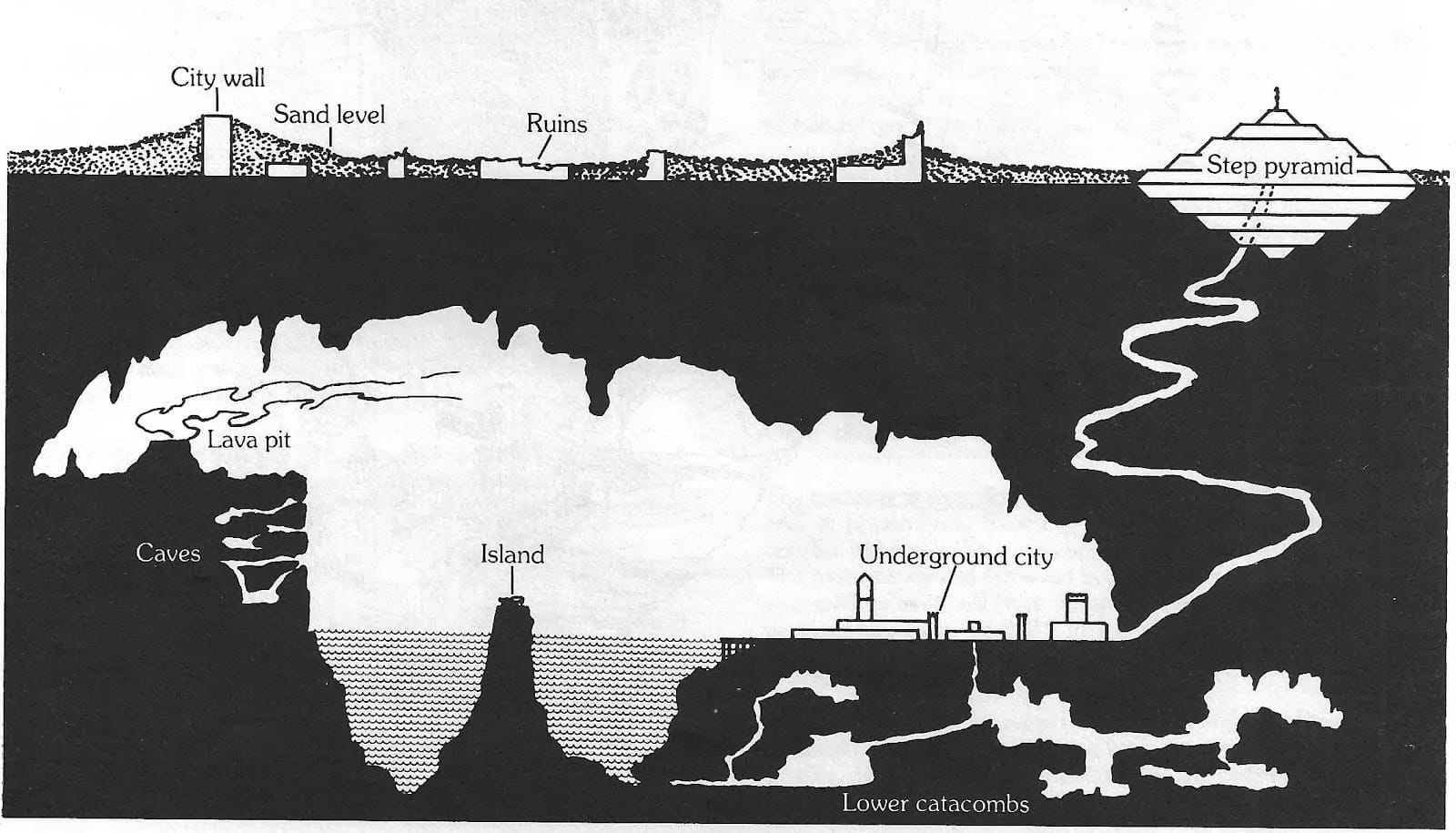
The core promise of D&D is discovering and exploring fantastic places, uncovering secrets, and penetrating spaces where no one has stepped for thousands of years. Forgotten cities in mountain valleys, terrifying underworld tunnels, ruins of ancient civilizations, magical castles, mythical dungeons, dusty crypts, jungles full of dinosaurs, and even untamed wilderness hiding mysterious creatures.
There is something inherently satisfying about preparing an intricate map full of surprises as a Referee and looking forward to the players finding them. Which path will they take? What will they do there? What will they discover, and what won't they? What will happen? It is satisfying as a player to enjoy the feeling of entering unknown places, not knowing if a dead end, a treasury, an enemy camp, or a passage to an entirely unexpected location will appear around the next corner.
The best old-school adventures are based on a complex map and a diverse environment where players always have something to think about, plan, and solve. One path is blocked by a hydra, another by a riddle—where to go next? Are there any secret passages? Couldn't those troglodytes we talked to earlier help us with the hydra? Can we come up with something else? Discovering the unknown and exploring fantastic spaces is the main draw of D&D and the reason why the dungeon-crawling genre is eternally popular.
By the way, it is precisely because of the missing aspect of exploration that I don't like one-page dungeons, mini-dungeons, and other short-scale adventures. It is basically impossible (or at least extremely difficult) for them to provide a true experience of exploring the unknown. A cluster of ten rooms cannot be explored very well. Yes, it can be walked through and cleared, but it doesn't offer much for exploration. You need scale for exploration. (Or, for example, scattering dozens of mini-dungeons across a landscape map and exploring that.)
Lately, I’ve been really into “unfinished” modules that surprise players by transforming into something else and leading to more and more adventures. For example, you think you’ve entered an ordinary city cellar, but suddenly you find an underground river that leads you to a system of natural caves inhabited by unknown creatures. Or while looting a random barrow, you find a passage to a mythical underworld. In the castle basement, a magical forest. In the magical forest, a circle of menhirs that transports you to another sphere of existence. While exploring a Neanderthal cave, you find a passage to a forgotten mountain valley with a city of a long-dead civilization… That’s what the best old-school modules look like—they have the potential to excite and sweep you away. That’s what adventure looks like.
I like the idea that no module ends in a dead end. It is never “finished”; it just seamlessly transitions into another. The campaign branches and branches, and players must choose what they want to explore next. So many options, and they can never explore them all! It is precisely the unused choices and unexplored paths that give decision-making and exploration meaning.
But you can’t explore interesting places when you’re spending three sessions solving village relationships.
Risk vs. Reward Dynamics
All those fascinating places you explore are packed with deadly danger.
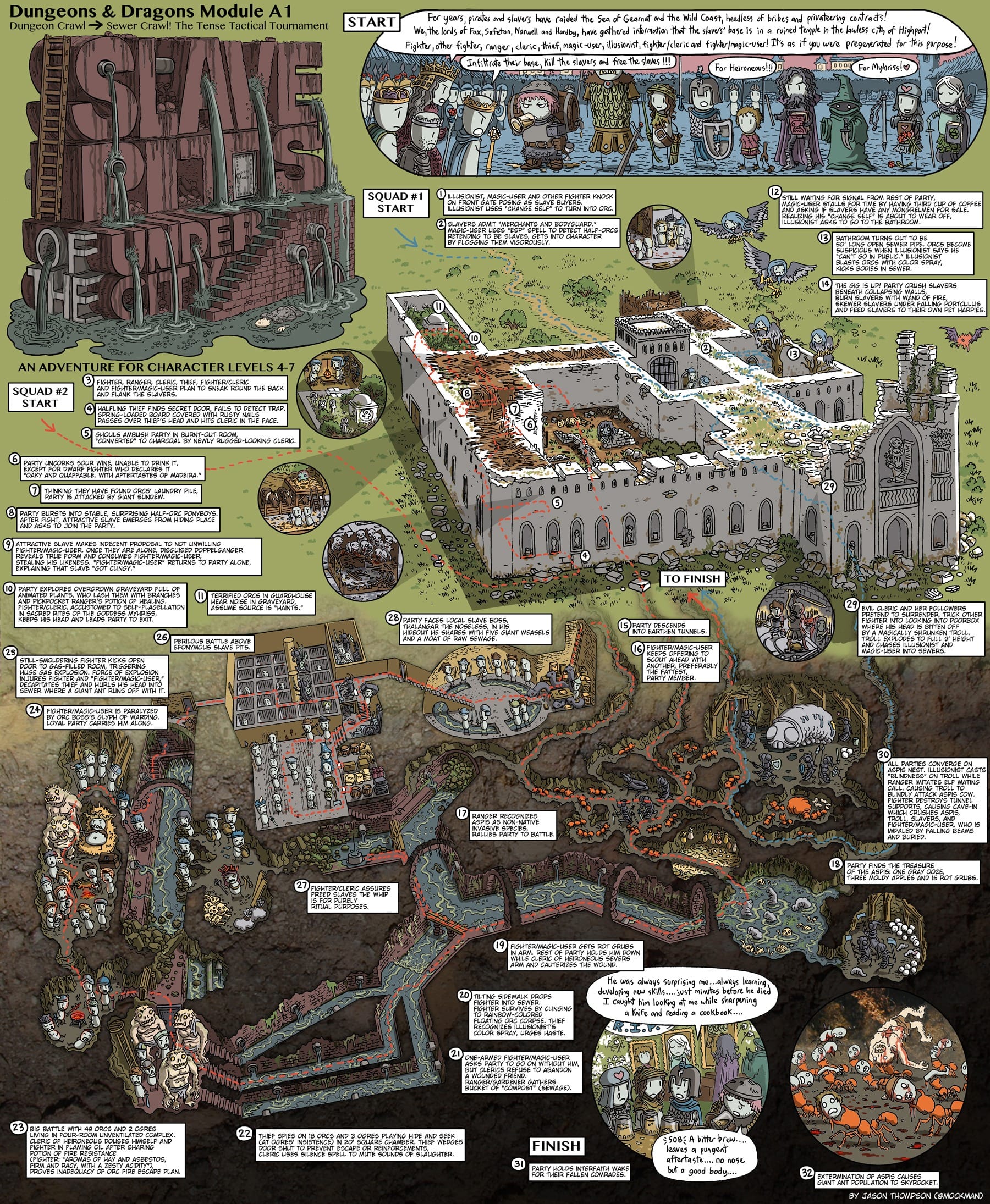
The central dynamic of old-school D&D is the tension between the size of the risk and the size of the reward. Game progress is measured in experience, experience is gained primarily for treasure, and treasure is found in dangerous places. In well-made modules, the rule applies that low danger = low reward, high danger = high reward. The module offers both simple challenges for which you get a small reward and obviously difficult challenges for which the reward is significantly higher. For example, Caverns of Thracia contains a huge underground hall full of hundreds of undead who are slowly waking up one by one. The undead guard a large treasury. At first glance, it’s suicide to even go in there, but in the middle of the hall, there is a huge bottomless chasm. Couldn't you figure out a way to push or lure those undead into the chasm while the thief sneaks into the treasury? In one of the other rooms, you come to a pile of treasure sat upon by a powerful undead wizard. He isn't moving yet… but what if you start stealing his treasure? Do you want to try?
This game dynamic is highly satisfying because it constantly presents players with interesting decisions. What more will we risk? And what won't we dare to do? Therefore, the game must also offer highly demanding challenges so that players can challenge themselves to take them on.
Old-school D&D is hard, can be cruel, presents players with tough challenges, and strictly punishes failure—dying is easy. In other games, especially newer ones, it is popular to lower the game's difficulty, provide characters with “plot immunity,” minimize the chance of random death, and so on. It’s understandable, but it suits games based on a different dynamic. In old-school D&D, the main source of satisfaction is the danger itself. Old-school D&D is a game about cleverness, overcoming obstacles, and a little bit of luck. It’s like playing a computer roguelike RPG or a game in Ironman mode—the ability to prevail despite the risk is the main source of satisfaction for the player.
The trouble with investigative village adventures is that this transparent dynamic is missing. While in a cave or wilderness, players can estimate the risk they are exposing themselves to quite well, this doesn't apply as much in a social environment. In a social adventure, the danger (and rewards) can actually be quite minimal; the content of the game isn't so much action as it is conversations, persuasion, and interpreting clues—all generally safe activities. In our three investigative sessions, the players didn't risk much, but they didn't earn anything either, which in old-school D&D can easily lead to frustration because characters aren't gaining experience and aren't moving forward.
I’m not saying investigative games aren't fun—I’m saying old-school D&D isn't built for them. Its system provides tools for evaluating action; it won't help you in social matters. Its core dynamic is built on the “risk vs. reward” principle, which is more or less missing in social adventures. The game demands action and danger. Its platonic setting is a “points of light” style world, where human settlements represent isolated islands of civilization surrounded by dangerous wilderness and mysterious dungeons. From a gameplay perspective, civilization serves primarily for resting, picking up hooks, and characterization scenes. But the core of the game is expeditions into dangerous places—and the further and deeper you penetrate, the more both the risk and the potential rewards rise.
It might seem that the exception to safe “civilization” is primarily large cities, where there is plenty of room for dangerous expeditions, perhaps into underground labyrinths, abandoned temples, or the palaces of decadent rulers. However, in terms of structure, there isn't much difference between a safe village with a terrifying dungeon hidden in the forest behind it and a safe tavern from whose cellar you can descend into dangerous catacombs. In both cases, you are working with the contrast between a safe base, where the adventure does not take place, and unknown dangerous places where you go on expeditions.
Ubiquitous Danger
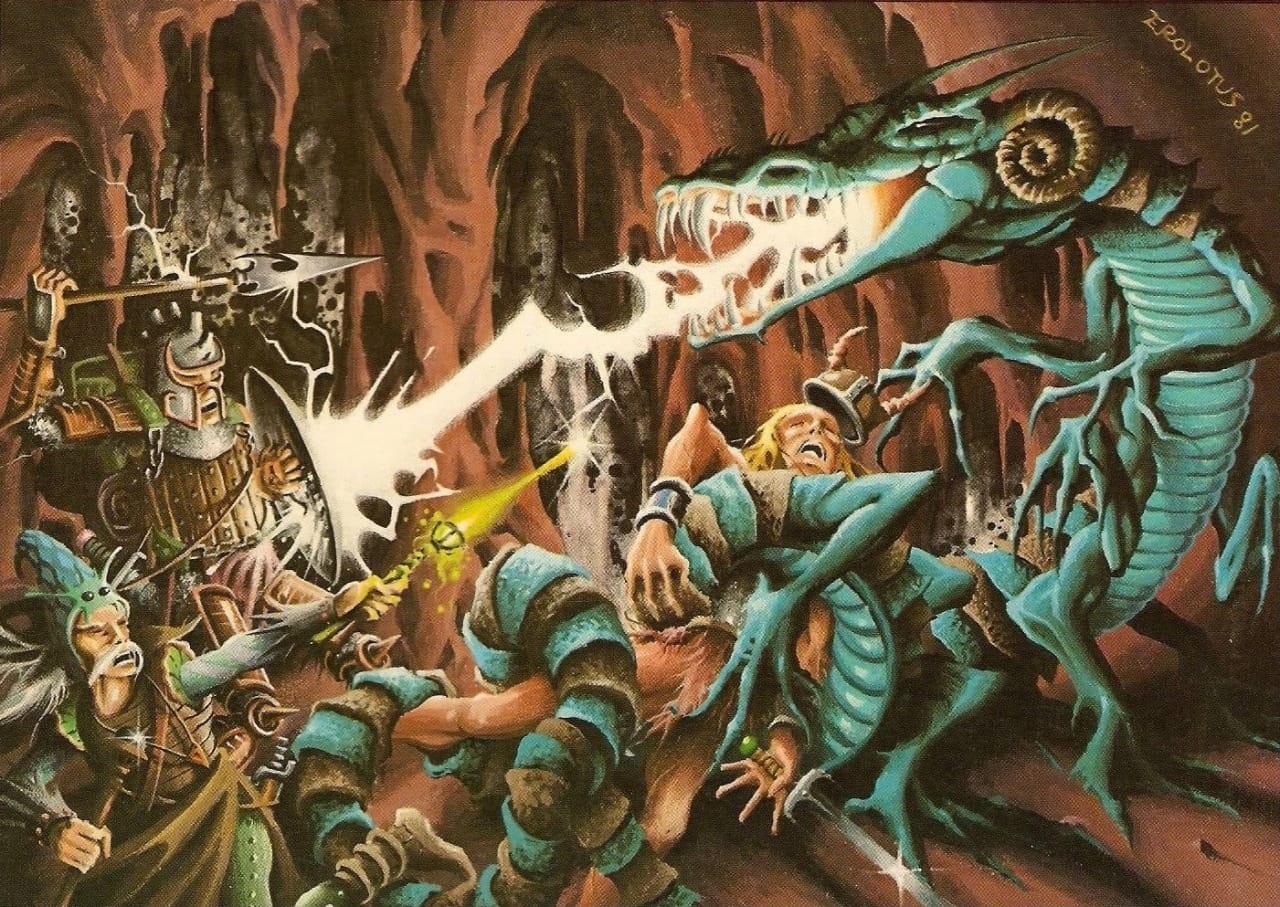
During the game, I also empirically verified that the game must contain a lot of different dangers—one is not enough. Old-school D&D is a very unpredictable (“swingy”) game. Even starting characters have spells in their arsenal that can easily solve many enemies. Already at the first level, they can cast something like Sleep, which is basically a nuke—it puts enemies to sleep, and then you slit their throats. Charm Person disrupts any social obstacle—just charm the right person, and the investigation is solved. A well-cast Entangle immobilizes monsters and turns a forest fight into a simple massacre.
That is exactly what happened in our game. When the players discovered the place where the “Satanists” meet, they decided to ambush them. It was supposed to be a difficult “final” fight against a witch, a dark knight, a demonic goat, and a crowd of minions. Instead, thanks to surprise and a clever spell, it turned into a one-sided slaughter.
Fights in old-school D&D are generally not balanced. While newer editions—from the third onwards—place emphasis on calculating a balanced “challenge rating” so that every fight is just the right length and just the right difficulty, in old-school D&D, you only encounter a balanced fight by accident. Much more common are one-sided massacres skewed now for one side, now for the other. Combat is usually decided before the fight, in the preparation and planning phase, not in the phase of rolling dice in individual rounds. In a way, a balanced fight is even undesirable—ideally, players shouldn't get into one at all; they should try to prepare that one-sided massacre (see the risk calculation dynamic).
That doesn't matter, because tension and interesting decisions in old-school D&D are found elsewhere than in the phase of detailed combat evaluation, turn by turn, square by square. Fun decision-making doesn't happen in combat; it happens before it. That’s because D&D is largely a game about resources, their management, and gradual depletion.
- Character hit points are a resource that gradually decreases.
- Spells are powerful and can solve almost any situation, but (1) you only have a few for the whole day and (2) you have to prepare them in advance, and in the game, you hope you prepared the right ones. This makes them a textbook strategic resource.
- Another resource is, for example, mercenaries. Players commonly hire various men-at-arms for help, but (1) they also have hit points and gradually die, (2) their morale can fail and they might decide to run away in the middle of an adventure, (3) they want a share of the treasure, which directly affects the “risk vs. reward” dynamic (mercenaries reduce risk, but also the reward).
- To a lesser extent, you work with one-time resources, such as minor magic items, potions, and scrolls, which also have the potential to decide any situation… but you will miss them later.
For perspective: our adventuring party usually sets out on expeditions with the following composition. As a simplified indicator of their power, we will use the number of Hit Dice (HD).
- Four player characters, each at 2nd level, i.e., 8 HD total.
- One permanently charmed warg, 4 HD.
- Two to four mercenaries, usually at 1st or 2nd level, so let’s say 4 HD total.
- Total strength: 16 HD
In our last investigative adventure, one of the conflicts was catching a cultist—a 2nd-level thief (2 HD). He didn't stand a chance; the disparity is evident. I would have needed many more and much more powerful enemies.
A well-prepared, rested, equipped party accompanied by mercenary support can demolish quite a lot. But all of these are resources: as the adventure continues, the fighters in the front lines take damage and are afraid to continue fighting. The wizards run out of spells. Mercenaries might revolt. Players must calculate what they can still afford, how far they want to continue, or if they should retreat to safety. And the return journey is, of course, also dangerous. Did the players leave enough resources in reserve?
In this setting, adventures built on one big “boss fight,” like ours, don't work very well. When players arrive at the “final fight” well-prepared, they handle it easily. That’s bad when—like me—you don't have any other danger in the adventure. Players might exhaust a lot of resources in a big fight, but if no other danger awaits them, nothing stops them from retreating to safety and replenishing resources. The loss of resources and the decision of whether to spend them or save them become irrelevant.
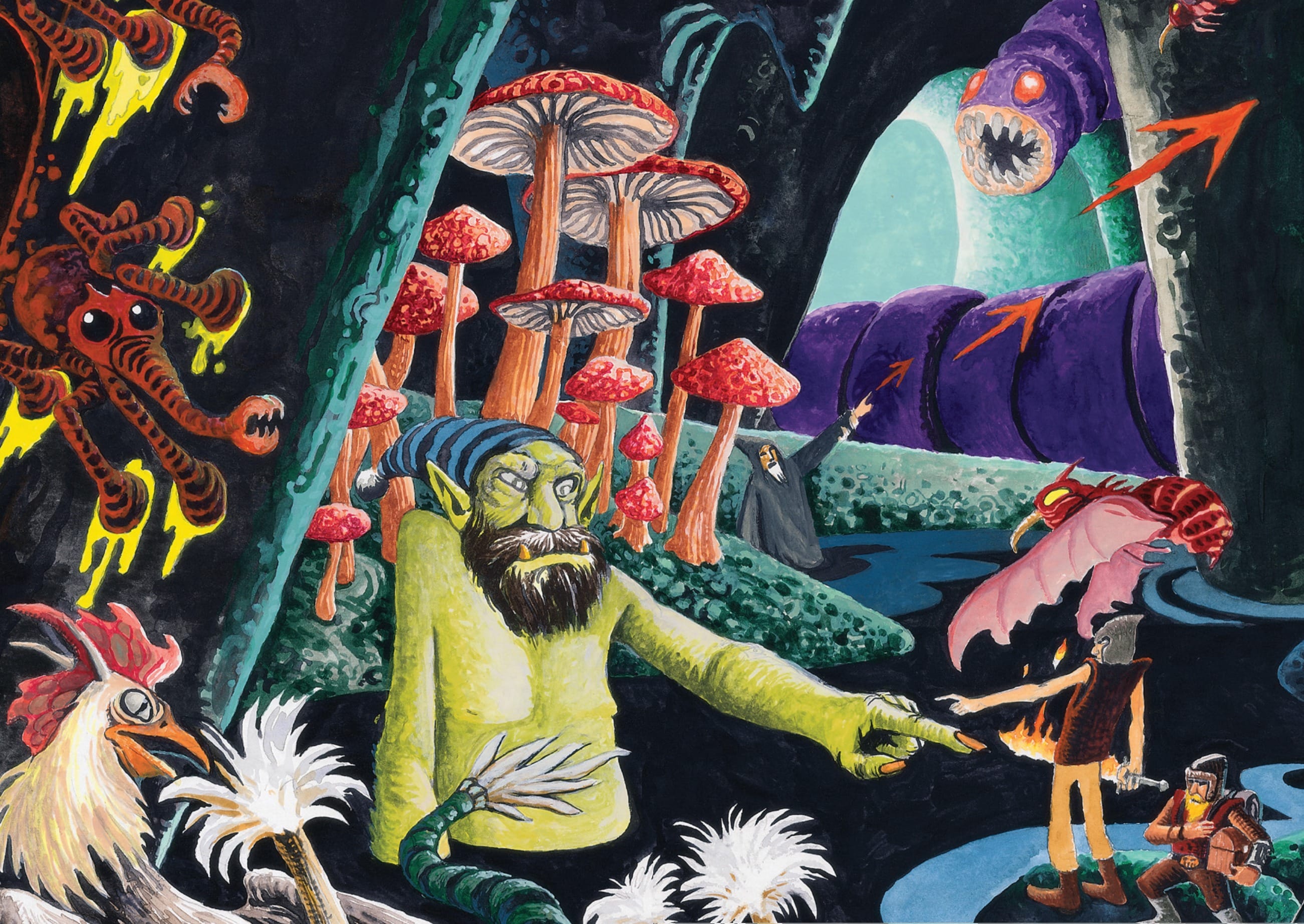
That is also why old-school adventures are extensive and full of danger. One victory is not enough to win. Players must carefully choose and decide between individual challenges which ones they will go into fully prepared, which ones half-exhausted, and which ones they would rather avoid. And we are back to it: old-school D&D needs scale.
Scale, Scale, Scale
That is roughly the result of my getting used to “old-school” D&D (in the form of Old School Essentials). Over time, I may refine my findings; after all, we have only had a few sessions, but I think the combination of reading and personal experience already gives me at least some basic insight into how the dynamics of this game should work. To summarize:
- The foundation of the game is discovering new fantastic places.
- Civilization is a space for recovery, replenishing resources, characterization scenes, and gathering hooks that invite you on expeditions.
- You undertake expeditions to places full of demanding challenges and dangers, where the “higher danger = higher reward” dynamic works. Players choose what risk they are willing to take.
- At the same time, working with resources and their gradual depletion must function. A prepared party is powerful; as the adventure progresses, its strength decreases. Players decide when it is still worth it to keep risking and when they would rather return to civilization.
- There must be a lot of danger so that players can choose, strategize, and, most importantly, so that you avoid the “atomic spell totally ruined my only prepared boss fight” effect.
- And all of this requires scale.
Scale is the main lesson here, because most of these principles only have the opportunity to fully manifest and develop on a large scale.
Scale works both in terms of the adventure—you need an adventure extensive enough to create space for working with resources and their gradual depletion, for calculating risks, and for choosing different paths. One “expedition” can easily stretch over several sessions because resources often cannot be sufficiently depleted during a single session. But scale also works in terms of the campaign—many principles only manifest during long-term play, when the consequences of previous decisions pile up on the characters. Conversely, in mini-dungeons, one-shots, or play composed of closed episodes, such things are hard to stand out.
These are not universal truths for any adventure game, not even for any “old-school” or OSR game. These are truths specifically for old-school D&D and its retroclones, i.e., games built on the “experience for gold,” “risk vs. reward,” and resource management dynamics.
author Jiří Petrů
taken from the website Zpátky do dungeonu
Jiří Petrů
Autor článků na imago.cz

You might also like

Mytago Publishing Newsletter #37
Discover the latest from Mytago Publishing! We're releasing an expansion for The Witcher RPG, a campaign for Pirate Borg, and another installment of Fighting Fantasy. Find out what's in store for you this year. full article...
20. 8. 2026 Jiří Reiter 5 min
A Brief History of Dice
Did you know that dice have accompanied humanity for over 5,000 years? Take a look at their history from the first throwsticks to modern collector sets. full article...
13. 8. 2026 Karel Krajča 6 min
An Overview of Mark of the Odd RPGs
Are you drawn to minimalist RPGs? We've prepared a comprehensive overview of games built on the Into the Odd system. Find your favorite genre! full article...
10. 7. 2026 Jiří Reiter 21 min