


What is a gamebook? History and the most famous series
Half game, half story – that is how you could briefly describe the phenomenon called a gamebook. And what are the most famous gamebook series?
What do you find in the article?
A gamebook is a book where you choose the next number at the end of a paragraph, thereby determining the plot. You are half-reading, half-playing. Some titles add dice, a character sheet, and stats, much like role-playing games.
In this text, we will first clarify the principle. Then, we will look at the history and the series that are worth starting with. You can find a deeper look at the genre in The Splendor and Misery of Gamebooks.
How a gamebook works
The foundation is branching storytelling in numbered sections. You read a paragraph, choose an option, and turn to a different number. Depending on the branches, you might experience a completely different story than a friend with the same book.
The game layer often borrows mechanics from RPGs. Numbers describe your character: stamina, combat, luck, and sometimes sanity. These change based on your decisions. When you encounter a fight or a trap, you roll the dice. You compare the result with your stats.
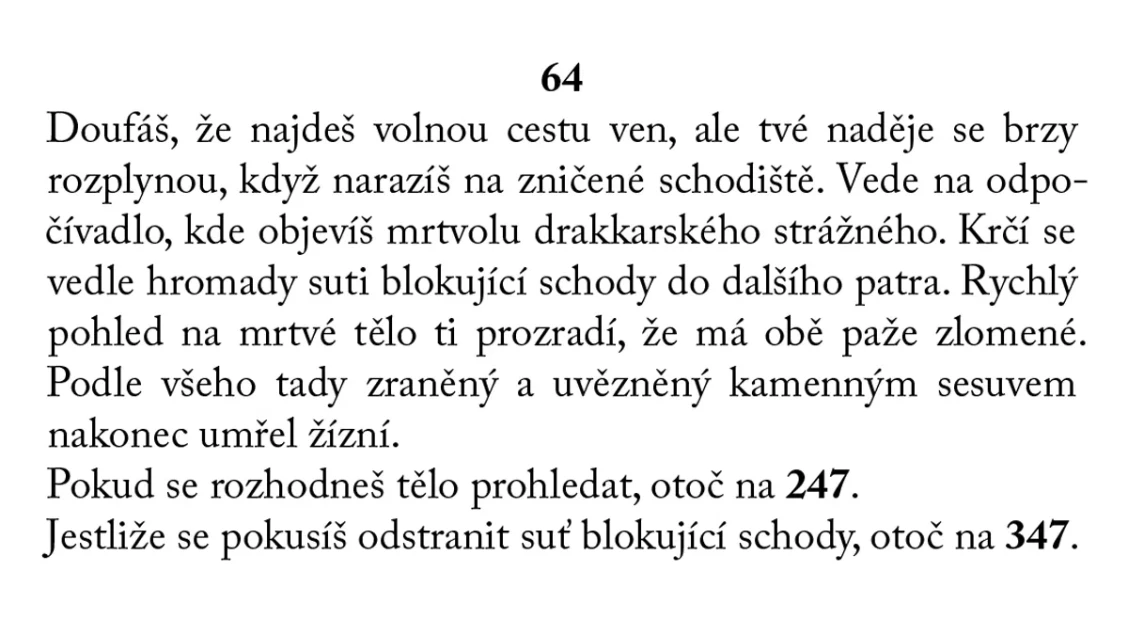
While reading, you collect items and clues. You write them down on a sheet or in a journal, which the book usually includes. If you don't write them down, you might lose a key that unlocks the ending fifty paragraphs later.
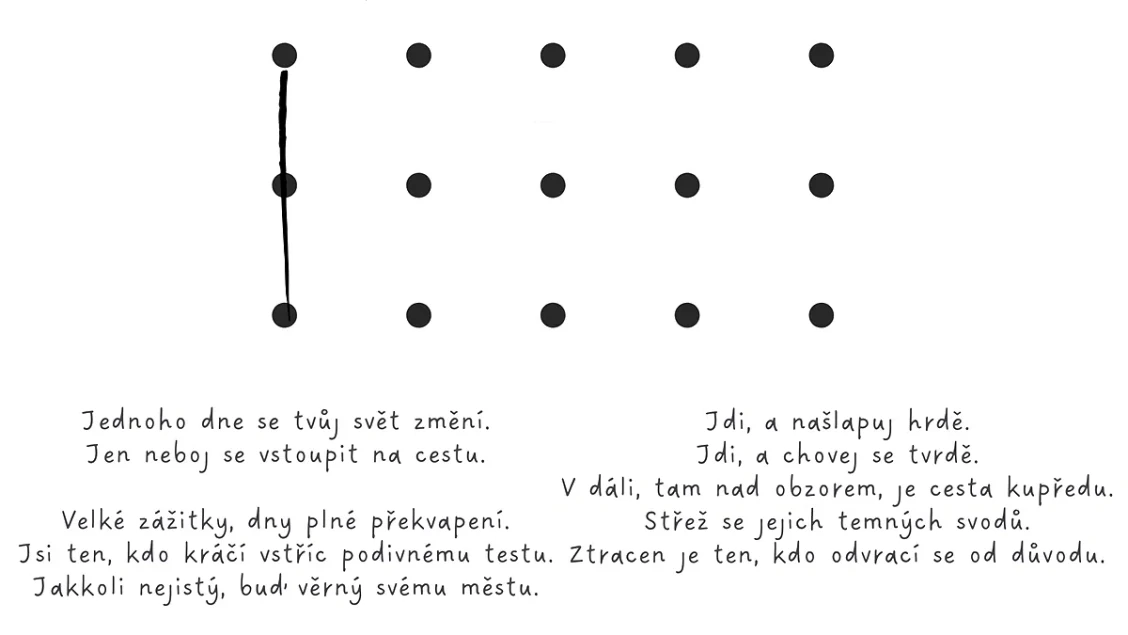
Added to this are riddles, puzzles, and illustrations. Sometimes an image just sets the mood. Other times, you will find a hint in it without which you cannot proceed.
In terms of genre, gamebooks fit mainly into fantasy, sci-fi, and horror. That is where they met RPGs and dice. We have a selection in both Czech and English in the gamebooks category.
A brief history of gamebooks
Ideas for branching stories are older than the 1980s boom. In the 1940s, Jorge Luis Borges experimented with branching paths. The French group Oulipo incorporated them into short texts and theater. Psychologist B. F. Skinner used a similar principle as a teaching aid.
Buffalo Castle (1976) by Rick Loomis is often considered the first true gamebook. It was a solo adventure for the Tunnels & Trolls role-playing game: ruins, monsters, treasure, and about 150 paragraphs.
Mass popularity came with the Choose Your Own Adventure series. Edward Packard and R. A. Montgomery launched it in 1979 with the book The Cave of Time. According to Wikipedia (as of 2026-08-03), Bantam Books sold more than 250 million copies between 1979 and 1998. The series was published in 40 languages. It is now being re-released by Chooseco.
In the 80s, RPG elements arrived in full force. Fighting Fantasy, Lone Wolf, and other series added stats, combat, and long-term character progression. The gamebook stopped being just "turn to page 47." It became a solo quest with rules.
The most famous series
Choose Your Own Adventure
This is where the mass wave began. You read in the second person and choose the next page at every crossroads. Early titles targeted children and young adults. Authors later experimented with secret endings and loops that you can only escape by restarting the book.
Fighting Fantasy
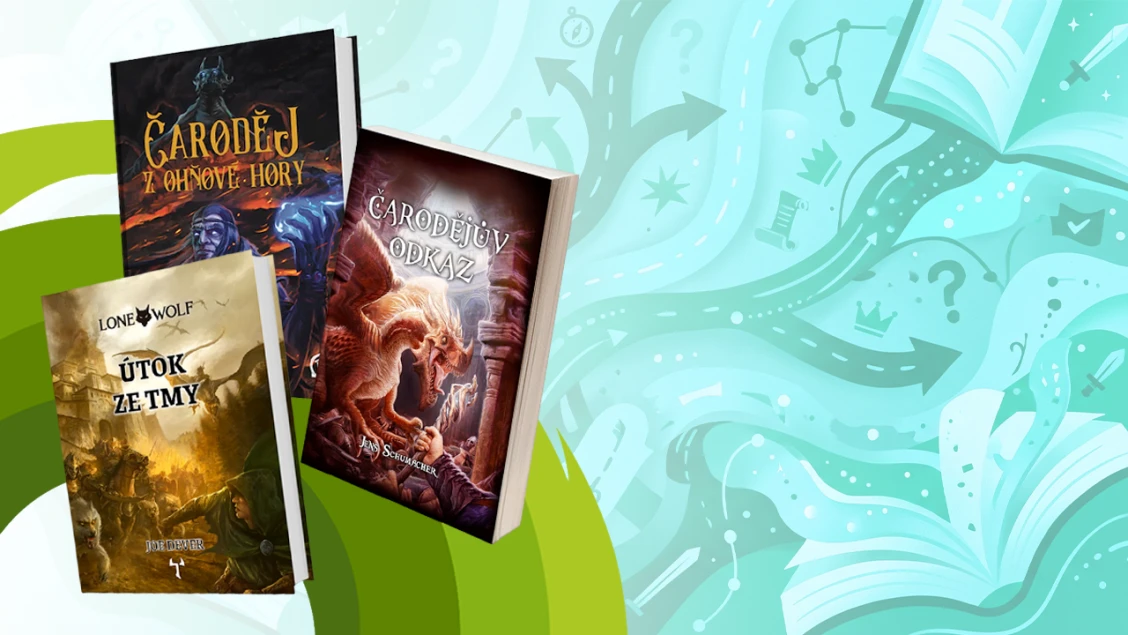
Steve Jackson and Ian Livingstone launched the series in 1982. The first installment, The Warlock of Firetop Mountain, was published in Czech as Čaroděj z Ohňové hory. The cycle has about sixty books: classic sword and sorcery, urban fantasy, and sci-fi.
In terms of gameplay, it is often a case of "collect A, B, and C, or you won't pass." Later installments offer more paths to the goal. In Czech, it is published by Mytago, including the 1–5 box set.
Lone Wolf
Joe Dever built the series around Lone Wolf, the last knight of the Kai Order, in the world of Magnamund. The first book was published in July 1984. According to Wikipedia (as of 2026-08-03), more than 12 million copies have been sold worldwide.
Unlike one-offs, the installments are connected. The character grows, the world map fills in, and choices have long-term consequences. After Dever's death, his son Ben and Vincent Lazzari continue the series. In Czech, Mytago handles the series. You can start with, for example, Flight from the Dark in the Definitive Edition. An overview of titles is in the Lone Wolf.
Fabled Lands
Dave Morris and Jamie Thomson built an open world instead of a linear mission. They originally planned twelve books; six were published in the 90s, and the rest arrived thanks to Kickstarter. It is published in Czech as Bájné země by Mytago. It is perfect if you want to wander the land and return to the same book with a different goal.
GrailQuest
J. H. Brennan sends Pip to Arthurian Avalon. The tone is lighter, sometimes parodic. In our country, the series is being re-released by Polaris. The first volume is Hrad temnoty.
The Czech footprint
The pre-revolutionary Na rozkaz krále, which is practically unavailable today, is often cited as the first Czech gamebook. The first officially published one is Ve službách krále Reginalda by Michael Bronec (1993): a castle, 875 paragraphs, and solid combat rules. The author's passion for tabletop games is evident.
Zlodhův hrad (Libor Pavel and Libor Kejklíček) offers less branching and requires returning to previously visited scenes. It hurt more than it helped on the second playthrough.
Among later domestic names, Vladimír Chvátil holds the scene with the parody O Norikovi, Eva Lassler with Druhá Země, and Jiří Mikulík with the Gabriel Knox series.
What to start with today
Don't want to deal with the chronology of all of Magnamund right away? Pick one self-contained title and see if branching suits you.
- Classic with dice: Čaroděj z Ohňové hory or Lone Wolf: Flight from the Dark.
- Horror without RPG numbers: the Zvol Cthulhu series.
- Humor: O Norikovi.
- Sci-fi: Verax: Experiment.
- Dark horror: Klinika smrti.
- Rock and roll: Metal Heroes: The Fate of Rock.
- Post-apo by Dever: Freeway Warrior: Highway Holocaust.
- Open world: Bájné země or Legendární království.
The entire assortment is in gamebooks in Czech and in English. Comic book branching has its own shelf: comic gamebooks.
FAQ
Do I need dice? Not always. Choose Your Own Adventure typically doesn't. Fighting Fantasy and Lone Wolf do.
Is it the same as a solo RPG? No. A gamebook has a finished text and branching. A solo RPG generates scenes using rules and an oracle.
In what order should I read Lone Wolf? From the first book onwards. Later books account for equipment and decisions from previous ones.
Are gamebooks suitable for children? Yes, especially the CYOA style and comic branching. For horror and Fighting Fantasy, check the age rating and tone.

Jiří Reiter
Věčně punkový podnikatel, průzkumník slepých uliček, samouk, geek, fantasák, otec čtyř dětí.

Karel Krajča
Šéfredaktor, content creator a organizátor festivalu Fantastická Ostrava. Fanoušek fantastiky, videoher, deskových her a popkultury obecně. Příležitostný milovník malování figurek a craftení všeho druhu. Hudební závislák a amatérský znalec fyziky a matematiky.

You might also like
Gamebooks for kids – why play them and which ones to choose?
Gamebooks lead children to reading in a fun way and develop other skills too. Our guide explains everything and advises you on which gamebooks to choose for little adventurers. full article...
Tips and guides 14. 9. 2026 Jiří Reiter 6 min
Mytago Publishing Newsletter #37
Discover the latest from Mytago Publishing! We're releasing an expansion for The Witcher RPG, a campaign for Pirate Borg, and another installment of Fighting Fantasy. Find out what's in store for you this year. full article...
20. 8. 2026 Jiří Reiter 5 min
TOP gamebooks of 2025
Which gamebooks ruled 2025? Check out the bestsellers at imago: fantasy classics, new releases, and horror full of tentacles. full article...
23. 2. 2026 Karel Krajča 5 min