


Veronika Marhounová and the Planeta9 Publishing House
Planeta9 is a small publishing house focusing primarily on classic and modern sci-fi literature. It quickly gained recognition among readers and secured rights to some very interesting titles.

Planeta9 is a small publishing house focusing primarily on classic and modern sci-fi literature. It quickly gained recognition among readers and secured rights to some very interesting titles. They have even dared to release a new edition of the legendary fantasy series Malazan Book of the Fallen, which boldly ranks among the most extensive texts you can read. Roman Bílek sat down for an interview with Veronika Marhounová, one of the key figures behind the publishing house.
Where did the desire to leave the passive role of a reader and become a publisher come from? What was the deciding impulse that turned the plan into reality? And why did you choose the name Planeta9 for your publishing house?
It came from a simple need to read good sci-fi in Czech. My colleague Martin Královec and I started reading books by English-speaking authors in the original because we couldn't find texts in Czech that we enjoyed or that even stimulated or excited us. I have to say that Planeta9 began to form from the accretion disk of our ideas about five years ago. Today, the situation is different; many publishers produce sci-fi literature in various forms, with varying degrees of quality. Planeta9 sticks to its eccentric orbit, and the only points defining it are the preferences and whims of its two permanent inhabitants, with consideration for a significant number of friendly immigrants.
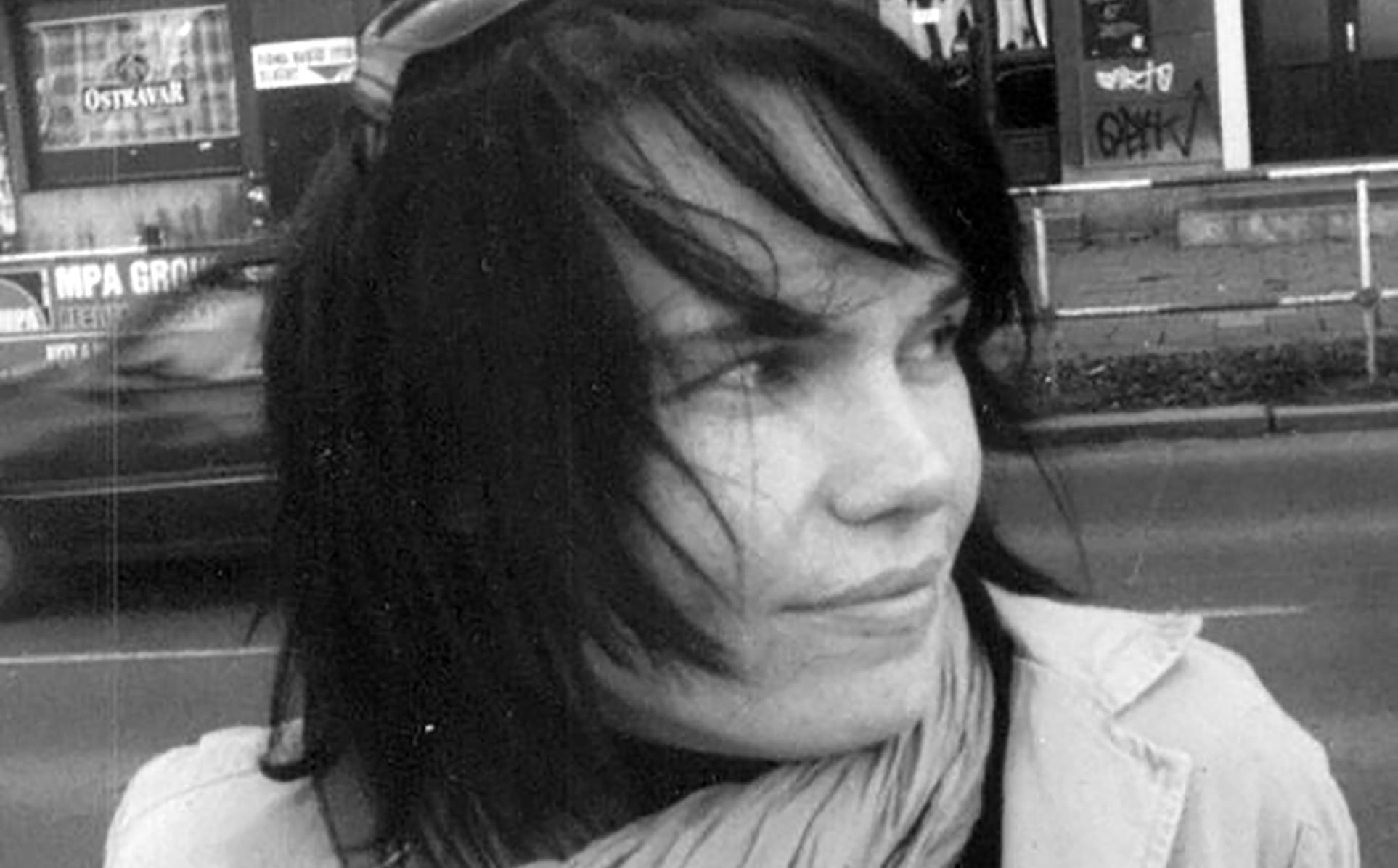
Planeta9 consists of two hemispheres: the practical and the creative. Each has its own moment that pushed its trajectory in a decisive direction. For me, it was meeting Iain M. Banks and his books. My psychiatrist brought the first one from England, and it turned out to be unparalleled therapy. I recommend it to everyone. I wanted them to be published in Czech so badly, to make them accessible to everyone who can't read them in the original.
Why Planeta9? It probably relates to a lifelong feeling that we are from another planet. You deal with that best by turning a problem into an advantage. We considered books from Mars. But then an unknown planet flashed through our minds—one that only occasionally and mysteriously crosses a human path, perhaps influencing it irrevocably. Planeta9.
What concept did you choose for publishing your books? The domestic book market offer is quite broad, after all. What did you decide to build your portfolio on, and what were you missing in the local market?
This will sound terribly silly, but we just said we would do "good sci-fi stuff." Just like that. That we would set out on the open sea of foreign literature and pick what we liked. Martin and I both grew up on books from Laser, and I still have great respect for their Masterpieces. But we felt that new adventures were waiting beyond the horizon, even for old and cynical readers. Well, mostly hard work was waiting there, but also some new authors.
What I missed most were books with an exciting vision of the future, because that's the best thing about sci-fi. Where is it all heading? Whether the visions are catastrophic or full of optimism. And also books where the author takes into account current findings and theories from astrophysics and science in general.
The first book under your brand was published in 2017. How much time did the "preparations" take before you actually held the finished work in your hands? How much did your idea of publishing books differ from reality? What did you have to learn, and what surprised you the most or required the greatest effort?
The first book was a bit of an accident. Despite that, I still have warm feelings for it and it moves me every time. We knew absolutely nothing about publishing books, except perhaps for loading books into boxes. We had ridiculously naive ideas. Our bold plans focused on Peter F. Hamilton, author of the book The Suspect Genome, and his big space operas. We got the novella The Suspect Genome cheaply as a sort of add-on to Hamilton's opuses.
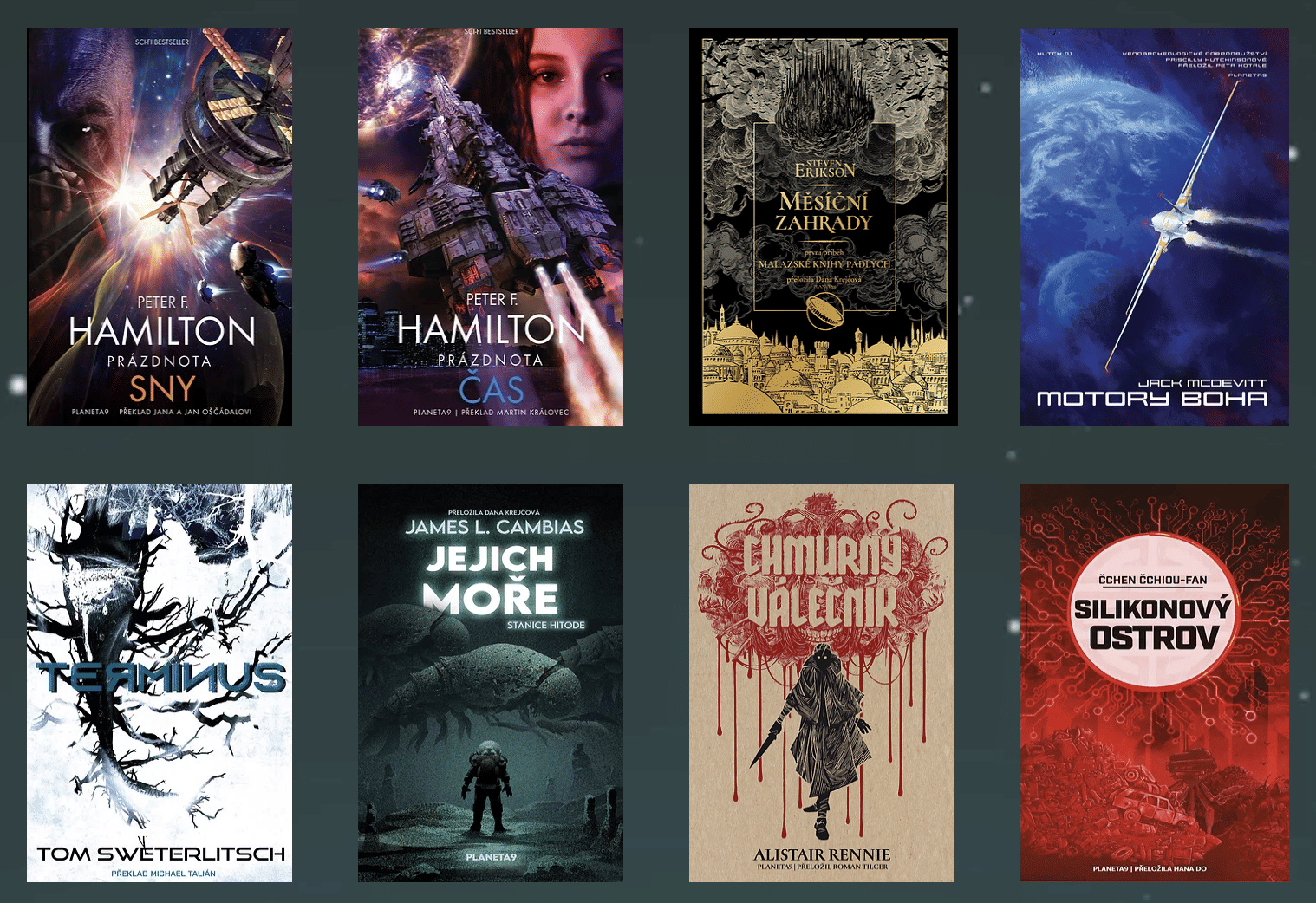
At the beginning, I foolishly thought we had everything figured out, perfectly planned—in short, failure was impossible. Nothing could be further from the truth. We knew nothing, not even how to assign work to external colleagues, or how to communicate our idea so they could, for example, draw it. How to set data for printing? A nightmare even today. We are still learning.
The biggest surprise was the realization that publishing books is not solitary work in inner contemplation; quite the opposite—I do nothing but write, call, explain, urge deadlines, then urge them more, then beg, threaten…
Did you draw experience and knowledge from your colleagues who have been in the publishing industry for a long time? Who was the biggest contributor in this regard?
Certainly, Planeta9 owes its existence to some of our friends and colleagues. Besides the aforementioned epochal publisher Zdeněk Pobuda, who had great patience with the small, angry Planeta9 that knew nothing but acted as if it had swallowed all the wisdom of the universe.
It probably would never have been created without Tomáš Němec from the Mystery Press publishing house, who literally kicked my colleague—the other half of Planeta9—to lose his shyness and fears and dive into publishing headfirst. And thanks to his selfless willingness, we learned a megaton about the work of a publisher.
Planeta9 has operated in the distribution space of the Seqoy company from the beginning. I imagine it as a kind of Yggdrasil reaching into all spheres of bookstore sales. It is an exclusive representation, which suits us. From both small and large publishers, you can hear painful complaints and hateful wailing about the inhumane conditions of distribution, especially the level of the discount. On one hand, I completely understand and share this attitude; on the other, I am glad that the distributors do the work for me. The thought of having to supply bookstores with my own resources makes me faint. A small planetary e-shop is more than enough.
You chose The Suspect Genome by Peter F. Hamilton as your first book; why that one? Did you know in advance that you wanted to continue publishing this British author?
Yes, Peter Hamilton has been the backbone of our editorial plan from the beginning. Space operas are simply a great genre; they aren't easy to write. In the sense that they are extensive and epic, the story usually spans several alien and human worlds, and there are "more characters than on an astronomical clock." Keeping order in the plot while not losing pace, and especially maintaining the core idea, is insanely demanding. Moreover, Hamilton can escalate a story into a grand finale. So yes, we knew for sure that we could work with this guy for a long time and wonderfully.
It would probably be fair to add that he also has slightly simpler sides; for example, the characters are clearly defined from the start and don't undergo much development or catharsis. With the honorable exception of those who are secret agents of aliens, of course.
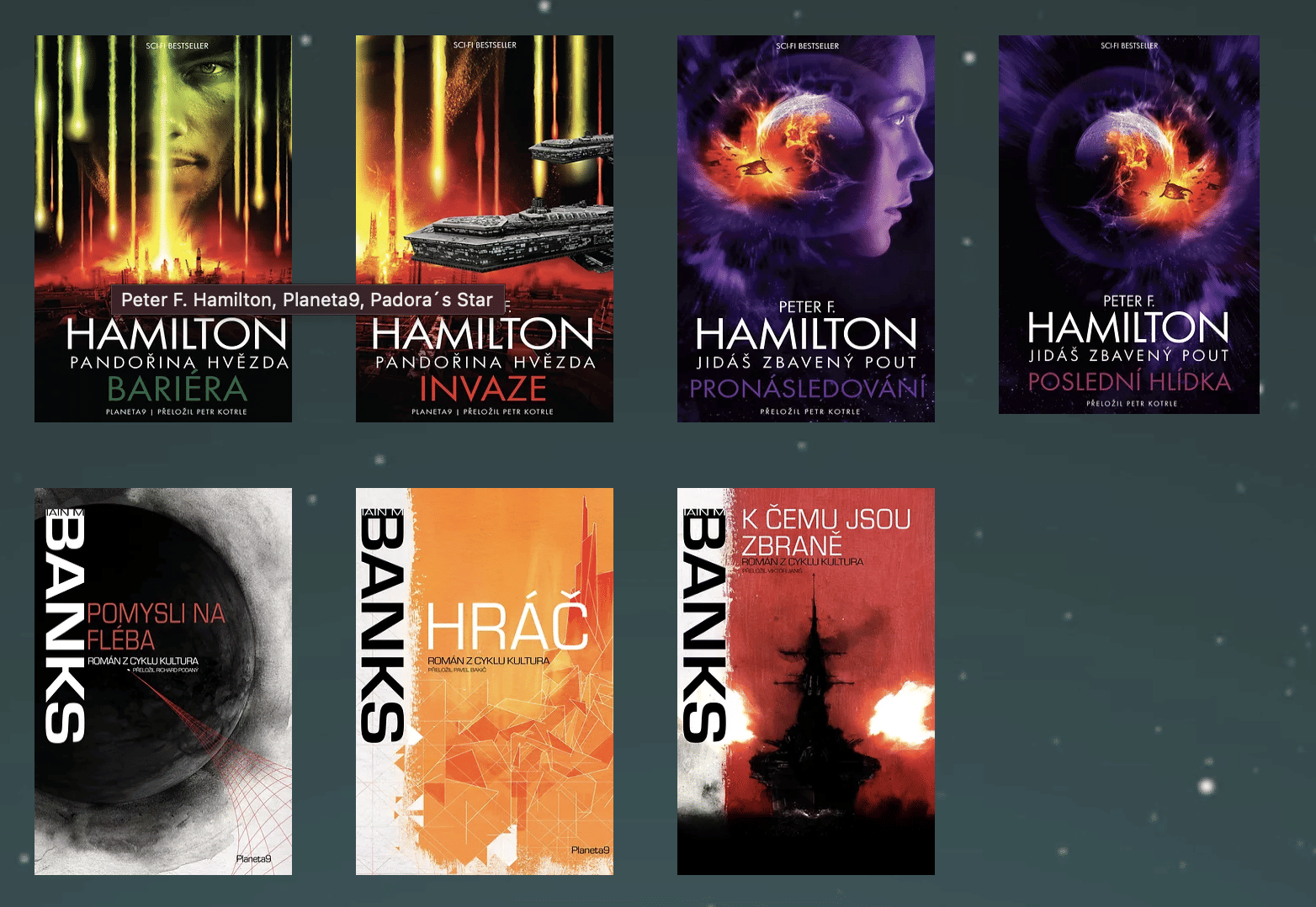
From Hamilton, you then launched the Commonwealth Saga, soon joined by Iain M. Banks's Culture series, and currently, you've dived into the Malazan Book of the Fallen by Steven Erikson. Aren't series too big a risk for a starting publishing house? After all, many fans of fantasy and comics often suffer from skepticism toward such sweeping projects due to past experiences with other publishers…
Iain M. Banks is love. Mine, primarily. And the best sci-fi author ever. The first book I received and read in the original literally turned my life upside down. It was completely clear that we would publish the Culture series, and I definitely want to publish the whole thing. We are the only publisher that is actually doing Culture. 😊
Suffering readers to some extent generate suffering publishers, and paradoxically, they deepen their own suffering. That "I'll wait until it's all out and then I'll buy it" leads to the whole series not being published because the publisher calculates "that it's not selling and people don't want it." How to cut this Gordian knot of mutual dependence? I don't know, but the planetary council decided early in its existence that we would publish everything to the end. Unless we run out of money. So buy our books and you will be relieved of your suffering!
Which of your books surprised you with their sales, whether in a good or bad sense? Which of your books are the best-sellers, and how do series perform compared to standalone titles in this regard?
The absolute biggest surprise in terms of reader interest and sales is the book Grimwar. I pushed for it as a personal whim, a personal bizarre choice that I was thrilled about. It also turned out that Roman Tilcer is a huge fan of the book's author, Alistair Rennie.
We had no expectations, and that meant a certain freedom for me, and we went a bit wild during production. After all, that completely corresponds to the text, which is a crazy ride in itself—playful and raw. A reader can either love or hate Grimwar, and that is exactly the right thing. No mediocrity. And we were surprised by how many readers understand and take the book the same way.
I probably can't evaluate in general how standalone books perform compared to entire series or, say, their first volumes. Planetary production is, well, quite varied.
Wherever I can, I praise you for how your books look. In one review, I even wrote something to the effect that thanks to you, it's suddenly visible what a reader can get for the same price as elsewhere. Who takes care of the overall look of the book, and how? Where do you get your inspiration? Do you think a reader should get (with cynical exaggeration) more for their money than a bending paperback cover, printing on translucent thin paper, and dense typesetting?
That is high praise, thank you.
As for the price, we are balancing on the edge of a loss. We should raise the prices of our books significantly if Planeta9 wants to earn at least enough for the next books.
I was also intrigued by the covers of your books; how does that work, and how do you choose the artists? What do you say to the original foreign covers, and what do you bet on for your own? Who does the overall visualization of the cover, including font selection, etc.? And who comes up with ideas for special effects? Like, for example, a cover that glows in the dark.
A planetary book is born in my head and then in a discussion with my colleague, during which we try to discard bad ideas and improve the good ones. Usually, the editorial board meeting takes place in a pub, so the results don't always match the expectations from the beginning of the evening. The best is the whole-planetary creative process, into which external colleagues also bring their ideas; I don't like just assigning tasks.
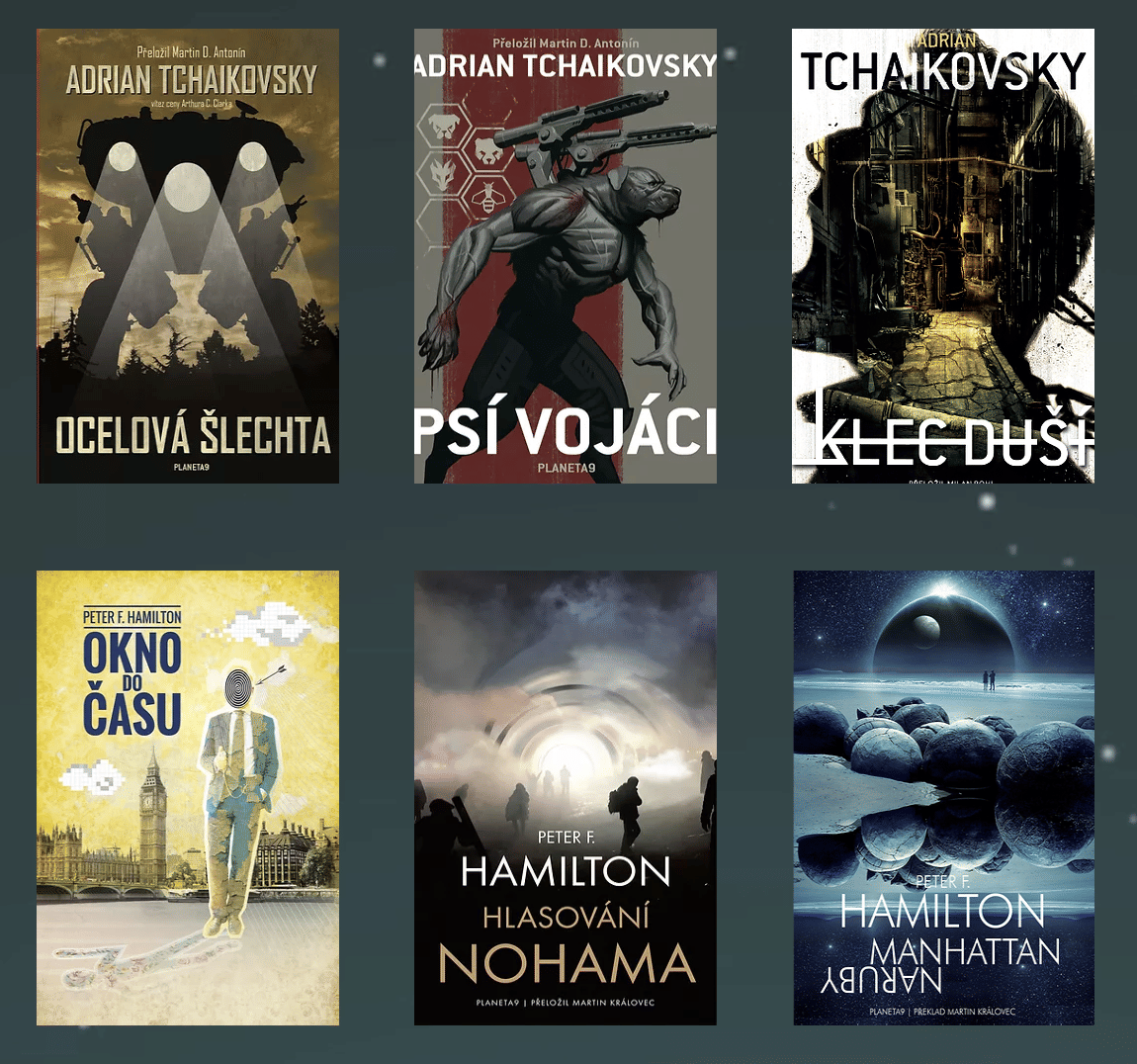
Usually, each book functions as an independent organism; already during the first reading of the text, the first idea forms of what would express the story visually in a nutshell, because that's what a cover is, which of the translators might like the text, how it should feel when you hold the finished product in your hand. I probably change it about six times and force others to redo something because it doesn't work well, but that's another story.
We have some favorite artists we've been working with for a long time, and I'm still amazed that masters like Tomáš Kučerovský are willing to work with us.
I also follow various websites for artists and illustrators, and I choose first based on the feeling of whether their work fits the book. Then based on an estimate of how much the work might cost. That is the limit of every decision, and a sad truth.
You also carefully choose your translators; based on what criteria do you decide that this or that person will translate a book? Some translators, of course, have contracts signed in advance, so do you prefer to wait for them, or do you give an opportunity to someone currently available?
We choose them partly intuitively, based on an estimate of which text might appeal to whom. Also based on the difficulty, of course. But mainly, I am happy when the translator enjoys working on the book; I expect—and perhaps it's an unfounded illusion—that it will show in the quality of the translation. It looks like there is solid anarchy at Planeta9, right?
And yes, I prefer to wait until the right translator has time.
For example, Iain M. Banks is translated by someone different every time; why did you choose this approach for the *Culture* series?
Iain M. Banks is the only author for whom we chose such an unconventional approach; the reason is simple: Culture is not a classic series that leads from somewhere to somewhere and follows one hero or one group. The common thread is only the Culture itself; individual volumes take place in different places and at different times. The narrative style adapts to that.
When the story unfolds on the platform of a spy novel, it is completely different from a book built essentially as hard sci-fi. We choose different translators based on which style best "fits" the specific story. At the very least, we try to. The supervisor is the amazing Richard Podaný, who oversees the unification of everything the books have in common.
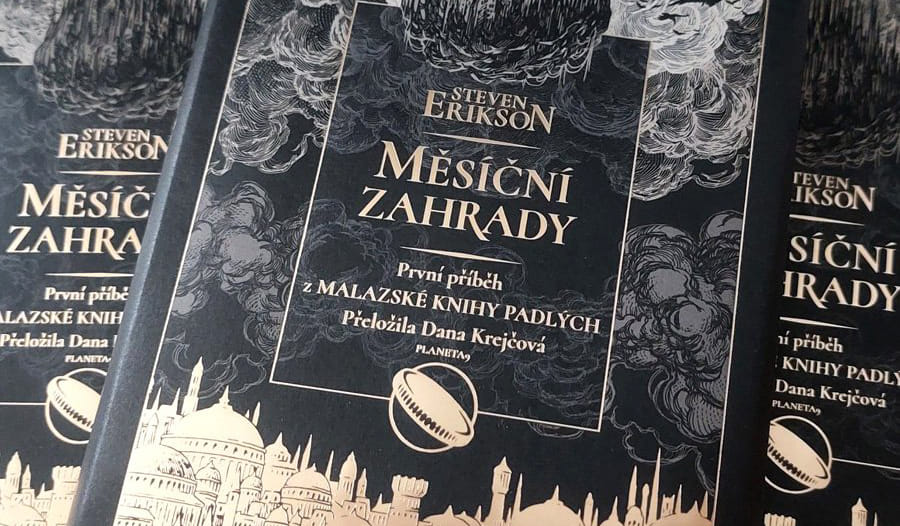
Steven Erikson's Malazan Book of the Fallen recently started coming out with you; why did you decide on it? Is it a bet on a "sold-out certainty" and the fact that fantasy has a large number of devoted readers?
Because Steven Erikson is a fantastic author. Fantasy as a genre doesn't suit me much—too much magic and too little science—but Erikson is an exception. Deadhouse Gates is the only book I cried over in public while reading, and I couldn't stop reading or crying. Erikson is great; he is strict and doesn't coddle the reader at all. He lets you form an intimate bond with a hero, and then kills them without blinking an eye. Above all, the Malazan Book of the Fallen skillfully combines the events of the great world of the Malazan Empire and the specific fates of ordinary foot soldiers. It is simply a great work.
On the contrary, I would object to the claim that it is a bet on a certainty from a sales perspective. Malazan has a lot of devoted fans; they are amazing and have supported Planeta9 a lot. That makes my feeling that I must not disappoint them even stronger. Erikson's work probably won't be the type of literature like, say, The Witcher, nor can it be—it is too demanding, too sophisticated, and too cruel. So for me, the best fantasy author.
From your production, I was also interested in the novel Waste Tide, written by Chinese author Chen Qiufan. What kind of response does the book have, and how is it selling? What difference do you perceive between Anglo-American and Chinese sci-fi? Can the popularity of Liu Cixin help Chinese sci-fi authors here? And do you have any other Chinese fantasy planned? Do you think the Chinese style of thinking and mentality can appeal to Central Europeans?
Sci-fi by Chinese authors seems fascinating to me because, I think, it can somewhat ignore the censorship that is omnipresent in China and probably unimaginable to us. Including the fact that it works on a voluntary basis. We get to Chinese fantasy in Europe circuitously only thanks to the mission of Ken Liu, who, although a great writer himself, dedicates himself to translating Chinese authors into English. Without his effort, we would know nothing about what is being written in China.
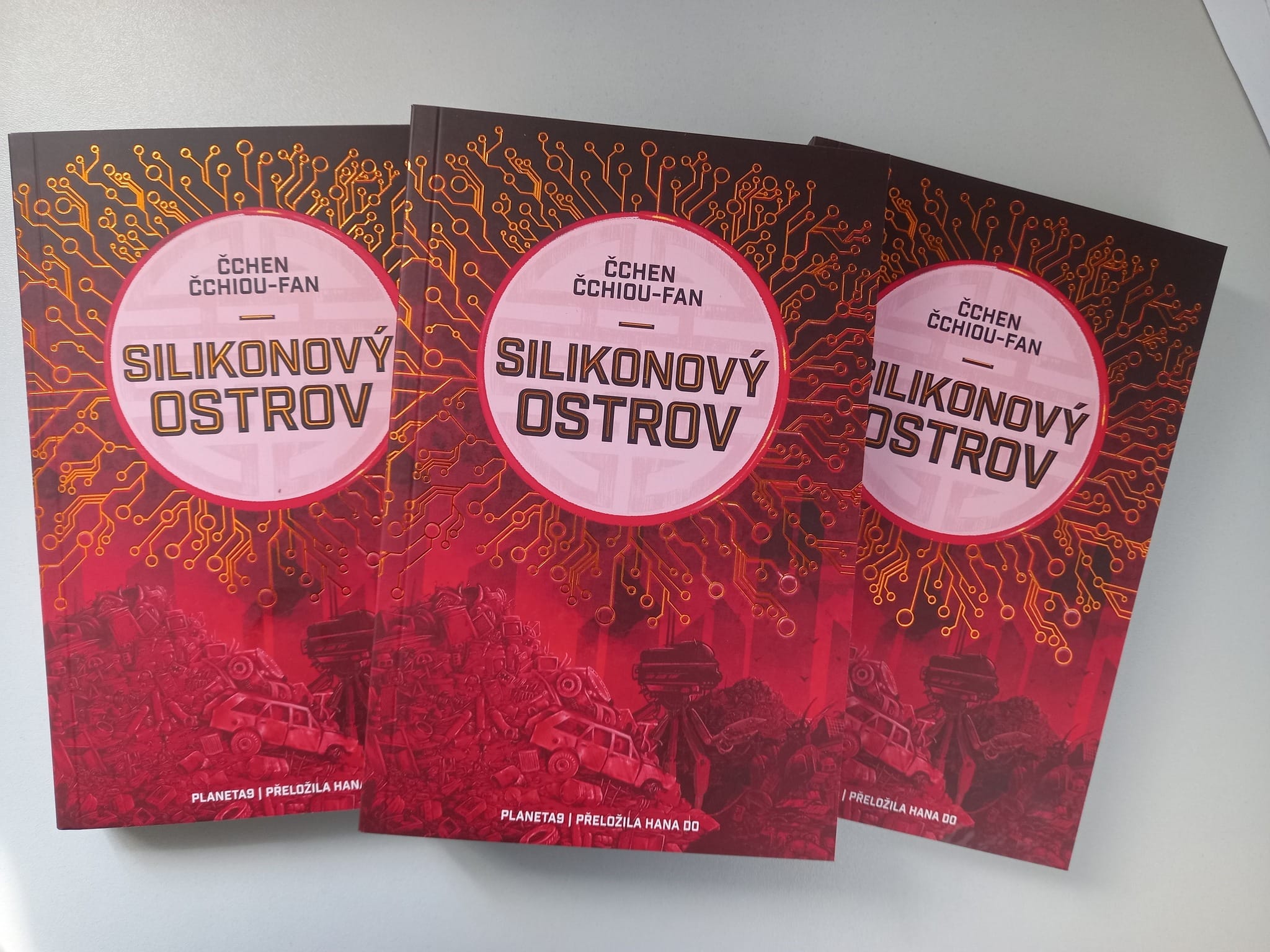
How and whether Chinese fantasy can appeal to us is hard to say; I take it as a kind of secret insight into a completely different culture. It can certainly appeal to an observer longing for foreign civilizations and cultures, even if they won't perfectly understand what they see. Or read.
Even a detail often surprises; for example, I don't understand at all that girls around eighteen from a small Chinese town are really that naive and ignorant of the world? And on the basis of this detail, we could develop a wide debate…
Chen Qiufan is currently writing another book together with artificial intelligence; I would really like us to publish it too. But the sales of Waste Tide are not convincing, and my colleague, who fortunately represents the voice of reason, won't allow it. And probably not another Chinese author either. After all, I am currently reading excellent bizarre Japanese short stories, and we won't publish those either; even for me, they are on the edge of true understanding. Actually, I don't mind; I just fascinatedly watch the scenes written on the other side of the world.
One last thing—Liu Cixin, the best-selling Chinese fantasy author in the West, writes most like a European.
There is a lot of talk about the renaissance of small publishing houses. What do you think about this trend? And what advantages or disadvantages do you think our small publishers have compared to the big ones?
That it's a revolution of small publishing houses! Not that we took flails and polearms, stormed the temple of the big players in the market, and smashed the decorations a bit. We are stubbornly trying to carve a path among them. But seriously, in my opinion, we are increasing in number lately thanks to technical possibilities. You can simply do a lot of things at home in the garage on your knee because it's possible to buy hardware and software, and find instructions for practically everything. Sci-fi in practical life. Without technical progress, we wouldn't stand a chance. Maybe with that polearm.
A large publishing house is usually a target of both contempt and unattainable desires for a small publisher. "They" have those big budgets; when negotiating with agents, that time-tested and battered colossus stands behind them; they also have a marketing department and, in general, service. We only have ourselves and an alternating obsessive desire to learn it all in a few hours of reading on the internet and total frustration that I don't understand any of it and no one will help me with anything.
The disadvantages are also advantages themselves, because a number of books that I like and would like to see among Czech readers wouldn't pass the editorial sieve, and certainly not the marketing department. I can't shift anything onto someone else and then make excuses that they messed it up. It is maximum personal commitment and personal responsibility. With every book, I am not just putting my editor's chair at stake, but my whole life. So that was very pathetic. 😊
There is also talk that small publishing houses keep the fantasy offer diverse. How do you perceive that? For me, it is certainly true, because with titles published by "big players," I feel the sales potential, but on the other hand, I often have the feeling that the pioneering spirit of fantasy, innovative ideas, has disappeared somewhere, and that current production is primarily about what sells the most. Or am I wrong?
This is a tricky question because I have the urge to pat myself on the back for how well and ideologically correctly we are doing it. Unfortunately, that's not the case. We must have enthusiasm, as well as enchantment with stories and words, but no one can do without strict counting. We dare to take risks, yes. There are books that are worth it. But if we care about the future, we must earn money.
The "current production" part is also a bit shaky. Planeta9 stands on the reading taste of the two of us, and current production largely misses that. There can't be many great authors and books; exceptional quality is simply exceptional. It is hard to find, or obtain, and sometimes even to recognize. And sometimes I can't shake the impression that even an author writes according to a manual for a sales bestseller, but has nothing to say and wants to offer me a kingdom for one sparkling idea.
Banks or Hamilton are considered genre stars of the present in the world; how is it possible, in your opinion, that they end up with a small publishing house here (no offense!), and previous attempts to publish them failed?
Those gentlemen are stars; they are several cosmic lengths ahead of the others. At least some of the others. Banks invented a concept of a utopian society that has no equal since the days of Thomas More, which gives a clear answer to how to solve our real and petty crises. And it is an answer written excellently.
Banks's texts are exceptional, but they are also demanding. The first translation of the book Consider Phlebas was desperately bad and quickly gained the worst possible reputation. It could have discouraged many publishers from further attempts, but honestly, the sales aren't dazzling even by the standards of a small publishing house.
Perhaps other publishers had a good guess or instinct that Czech readers wouldn't accept some authors as their own. Even the best ones. But I'm not giving up, not a chance; Culture will be published in its entirety.
What role do marketing, public relations, and social media play in publishing books?
In general, they play a big role, right? We believe comments under products on e-shops or social media; it has become the equivalent of a personal recommendation from friends. Which is a bit ridiculous when we take into account how easy it is to create such reviews. Ad absurdum, how easy it is to hire a clicking firm from Bangkok.
How to get out of that trap? I have no idea. Planeta9 chose the easiest path; we take it that things we like and enjoy will also be enjoyed by the readers of our books, i.e., people with similar taste and sense of humor. Our entire marketing and social media stand on that. If we went to a pub with the readers of planetary books, we would understand each other. From a marketing perspective, weak, but I can't think of anything better.
(And there are, of course, sour grapes; I would like to be able to do it better. Or have a pile of money and hire Jakub Horák.)
What did the coronavirus pandemic give and take from you as Planeta9?
Now I will say something unpopular; I try to take covid as one of the things I can't influence, I just try to survive them and navigate through the pitfalls of fate as best as possible. Covid or my own mistakes, it makes no sense to whine, but to run the e-shop better, just keep going. Enough has been said about losses in the book industry. However, I would have one big contribution—Mikoláš Tuček and his campaign to support book sales during covid showed us how crowdfunding works, and we would like to use that for the next volumes of the Malazan Book of the Fallen.
The war in Ukraine has a bigger impact; it crushed me personally much more and has a greater impact on Planeta9, primarily due to the critical shortage of paper and its high prices. We realized quite intensely that "something" can run out, not be available, be too expensive even for our bold calculations.
In conclusion, reveal your publishing plans for the future. According to the editorial plan on your website, it looks like you definitely don't lack ambition. And out of personal interest, I will ask if there is anything planned like the very successful *Terminus* by Tom Sweterlitsch?
A favorite question. 😊 Two interesting and unusual books are being translated. The first is the title 2184, and if it seemed that the title refers to Orwell, that is the right hunch. A chamber story, a kind of post-noir, where an artificial intelligence acts in the role of femme fatale, in the environment of a monstrous but dirty and poorly managed dictatorship. Then the title Heroes Die, a mix of sci-fi and fantasy world. In the first mentioned, there is a perfectly thought-out caste society that is bored and indulges in decadent entertainment. In the second, heroes appear like from an eighties Conan movie directed by David Fincher.
At the end of August, Shaman will be published, a book written by another of the great but here underrated sci-fi authors, Kim Stanley Robinson. Planeta9 has turned and is traveling into the past; Shaman is a kind of "new and fantastic version of Hunters of the Mammoth and Journey to the Beginning of Time," a harsh survival story from the life of our ancestors. And compared to Štorch, it contains a lot, a lot of sex.
In the autumn, together with the Triton publishing house, we are preparing the first volume of the Architects of Memory series, it is called Shards of Earth, and it is divine; after a long time, a real, genuine space opera, and what a great one. There will certainly be more Erikson; that is already being worked on hard. And most importantly, we are still looking for more stories.
author Roman Bílek
Roman Bílek
Autor článků na imago.cz
You might also like
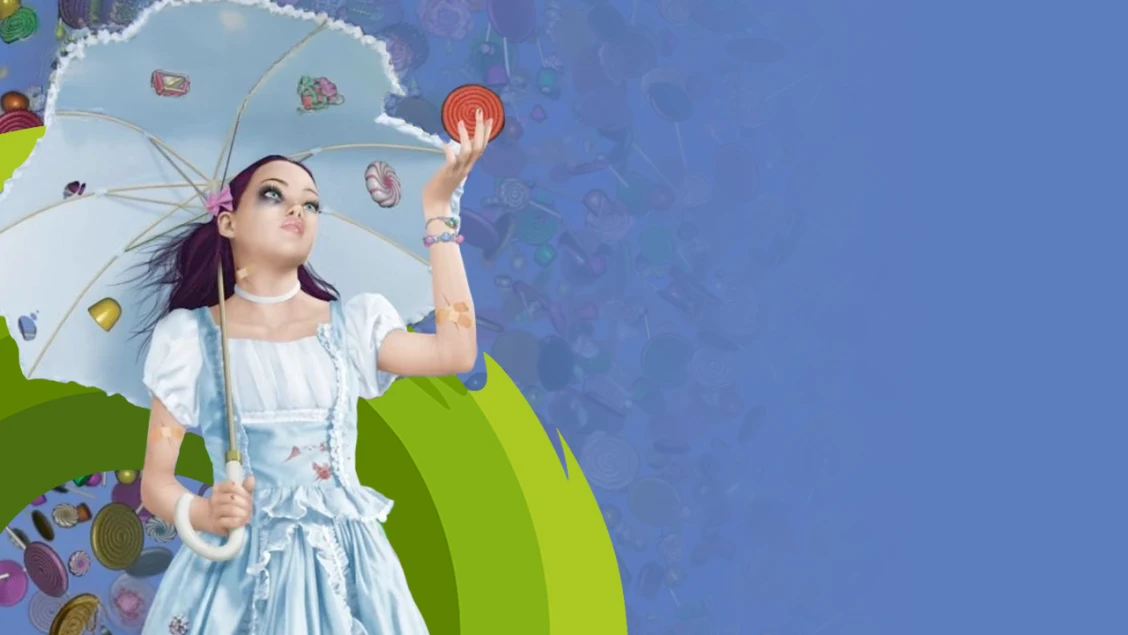
Book Review: Sladký příběh – A Dark Fairy Tale of Bizarro Fiction
Do you dream of reaching the end of the rainbow? In Sladký příběh, a childhood dream turns into a dark reality. Find out in our review why this slim book will consume you. full article...
25. 8. 2026 Tereza Nesvadbová 3 min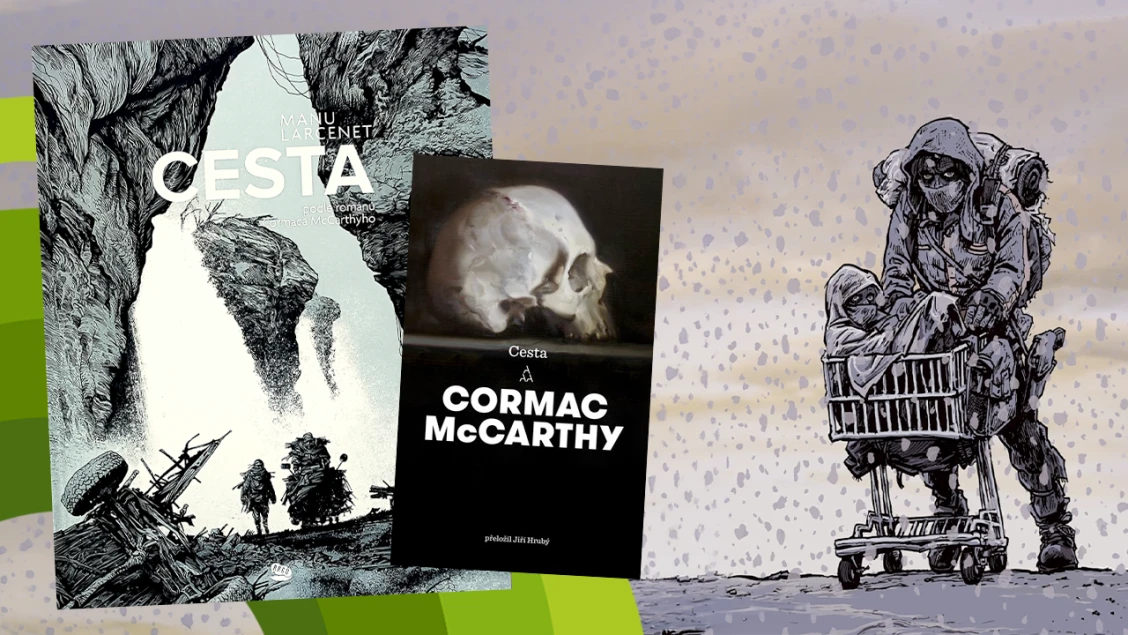
The Road Anniversary: What Did Cormac McCarthy Leave Behind?
Cormac McCarthy's novel The Road celebrates a major anniversary. Remember this post-apo cult classic through the legendary book, film, and the new comic by Lercenet! full article...
1. 7. 2026 Jana Mrkvicová 5 min
How hard is it to publish a book?
Do you want to publish your own book but don't know where to start? Learn about the options from classic publishing to self-publishing and find out how to succeed in the competition. full article...
15. 6. 2026 Michal Dlouhý 9 min