



How to read Discworld books?
Although each novel is a standalone work and you don't have to worry about any order, you can categorize them by thematic arcs: City Watch, Witches of Lancre, etc.

If you've ever dabbled in fantasy, you must have stumbled upon Discworld. The world created by Terry Pratchett has a massive fanbase and ranks among the best the genre has to offer. It adds a healthy dose of clever, sometimes wickedly dark humor, philosophy, science, politics, and who knows what else. Discworld is a phenomenon! It's an amazing place where practically anything is possible.
Because the author's untimely death left us with 41 novels, numerous short stories, and other materials, it might seem dauntingly vast and confusing to a new reader. Fortunately, it's not that bad in practice. Even though each novel is essentially a standalone work, knowing the others certainly doesn't hurt. Let's sort it out.
But first, a personal confession… My love for reading began with The Lord of the Rings. One beautiful summer afternoon in 1999, I visited the legendary Geralt bookstore in Ostrava, where Mr. Pilch recommended some Pratchett to me. He said I'd like it if I enjoyed fantasy. He was right, and I think he changed my life. I literally grew up with Discworld, devouring every novel, and whenever I didn't have a new one, I read the previous ones over and over. To this day, Discworld has a place of honor in my overflowing library, and I believe it's the same in every library of the infinite book multiverse. Oook!
It's not always the case, but in the case of Discworld, we must mention the incredible contribution of the late translator, Jan Kantůrek. He is largely responsible for Discworld's popularity here. I can't imagine what it would be like without him, and I'm grateful I never had to find out.
Now, let's bring some order to this. If that's even possible… Or at least, let's list all the thematic arcs.
It all starts with Rincewind
The first novel in the cycle is The Color of Magic. It introduces the clumsy wizard Rincewind, who accidentally gets in the way of the first Discworld tourist, Twoflower, and his lethal Luggage. Thus begins a crazy sightseeing tour of the Disc, involving fires, dragons, demons, and falling off the edge of the world. Poor Rincewind becomes the central figure of the series. Thanks to him, the world began to flourish, and the reader gets to know all the magic and quirks of the Disc, which slightly fade in later books as the Disc moves closer to the idea of embarrassingly ordinary round worlds. However, if you want to start with Discworld, The Color of Magic and the entire Rincewind series are perfect for it.

My personal tip for the best installment: The Last Continent - Rincewind's "Australian" adventure is arguably one of the most humor-packed novels in the entire Discworld series.
Rincewind books: The Color of Magic, The Light Fantastic, Sourcery, Eric, Interesting Times, The Last Continent, The Last Hero, Unseen Academicals
City Watch
Ankh-Morpork, the largest, dirtiest, and most dangerous city-state on the Disc. A city of endless possibilities… True, mostly the possibility of losing your money and your life (not necessarily in that order). Its police force used to be useless, which starts to change under the command of Samuel Vimes. The City Watch series can be described as detective fiction, if you squint, though it wouldn't be Pratchett if he didn't approach it in his own unique way. The Watch provides insight into magical city life and a host of amazing characters.

My personal tip for the best installment: Men at Arms - an emotion- and tension-filled fantasy detective story that has made me shed a tear more than once.
City Watch books: Guards! Guards!, Men at Arms, Feet of Clay, Jingo, The Fifth Elephant, Night Watch, Thud!, Snuff
Witches of Lancre
There are always three - the maiden, the mother, and the crone. In this case, the grumpy Granny Weatherwax, the cheerful Nanny Ogg, and Magrat Garlick, a naive believer in occult objects who somehow accidentally falls in love with a royal fool. Through the witches, we discover the extraordinary lives of ordinary Discworld inhabitants, the magic of psychology, and encounter some magic, werewolves, vampires, the basics of royal family sex lives, and other joys of country life. The witch books are driven mainly by the amazing Granny Weatherwax, who might not be your best friend, but you'll be glad she's not standing against you.

My personal tip for the best installment: Carpe Jugulum - a royal christening in Lancre quickly goes wrong when vampires arrive on the scene. For me, it's probably the best and most sophisticated installment of the entire Discworld.
Witches books: Equal Rites, Wyrd Sisters, Witches Abroad, Lords and Ladies, Maskerade, Carpe Jugulum
Tiffany Aching
The Tiffany Aching series is closest to the witches in terms of story. It is often placed outside the standard cycle and recommended mainly to younger readers, likely for marketing reasons. I don't know, I think Tiffany has a firm place in the entire Discworld canon. Nine-year-old Tiffany is a strange, independent child whose intelligence outshines everyone around her (admittedly, in a backwater like her native Chalk, that's not much of a problem). She meets the Nac Mac Feegle, who are essentially 15-centimeter-tall fairies, but they'd break your jaw if you said that to their faces! With their help, she first sets out to fight the Elf Queen (who aren't the good guys in Discworld mythology like elsewhere) and gradually grows into a powerful witch.

My personal tip for the best installment: The Shepherd's Crown - the bittersweet final Discworld book, which etched itself into my memory mainly because of the farewell to Granny Weatherwax.
Tiffany Aching books: The Wee Free Men, A Hat Full of Sky, Wintersmith, I Shall Wear Midnight, The Shepherd's Crown
At the end, there is always Death, YES
On the Disc, anyone can be an anthropomorphic personification. But one of the most important is Death himself, a skeleton in a black robe whom everyone meets sooner or later. Death appears in every Discworld novel (except Snuff and The Wee Free Men), but he has also taken on several lead roles. It all started when he decided to find an apprentice (Mort), then he took a vacation (Reaper Man), turned to rock and roll (Soul Music), saved Christmas (Hogfather), and had plenty of worries about the end of the world (Thief of Time). But he was always there somewhere. Him, his granddaughter Susan, his servant Albert, and the Death of Rats.

My personal tip for the best installment: Reaper Man - a melancholic story about how Death tastes the cruel beauty of human life and wizards discover the deadly danger of shopping malls.
Death books: Mort, Reaper Man, Soul Music, Hogfather, Thief of Time
Industry and Moist von Lipwig
Discworld is far from a shallow world without development. It's a world where everything happens sooner or later. And so, the first film, journalism, emancipation and women's rights, the post office, banks, and railways appear. Meanwhile, a certain con artist and forger, known as Moist von Lipwig, receives a simple order from the Ankh-Morpork tyrant - die, or improve the world. Moist chooses the latter. This loosely connected series intellectually links several otherwise more or less independent novels and culminates in the trilogy featuring Moist, thanks to whom the Disc is finally less flat and increasingly resembles our own "reality".

My personal tip for the best installment: Going Postal - Moist might not have the best character, but he has a pure heart, which he proves in the way he resurrects the city post office.
Industrial Revolution books: Moving Pictures, The Truth, Monstrous Regiment, Going Postal, Making Money, Raising Steam
Gods and Ancient Civilizations
Under this title, there are only two books - Pyramids and Small Gods, which otherwise stand as standalone novels and connect to the rest only very loosely. Together, they provide a look at the spiritual world of the Disc. Personally, I consider Pyramids more interesting, mainly because of You Bastard - a camel who, as luck would have it, is also the greatest Discworld mathematician.
Gods books: Pyramids, Small Gods
Science of Discworld
The four books in the separate Science of Discworld series technically fall under the Ankh-Morpork wizard stories, but they aren't novels as such. Part of each book is Pratchett's story of the wizards of Unseen University, which is interspersed with popular science texts by mathematician Ian Stewart and biologist Jack Cohen. In the first book, the wizards accidentally manage to create a strange, illogical round world where magic doesn't exist. The scientific part deals with the theory of the origin of the universe, the solar system, and life. In The Globe, the story of the globe-world continues, and the scientists focus on the development of humanity, consciousness, and faith. In the third installment titled Darwin's Watch, evolution, wormholes, or mathematics come into play. And finally, in the last installment titled Judgement Day, the authors focus on quantum theory, the theory of the expansion of the universe, dark matter, and the future of the universe. In the story part, the wizards fight a battle for the survival of the Disc itself.

Science of Discworld is a unique mix of classic Discworld, humor, and popular science text. If you're afraid the scientific text will be full of boring rules, you're very wrong! Both gentlemen hit it off beautifully with Mr. Pratchett's style of humor and perspective, and you definitely don't have to worry about a boring lecture.
Science of Discworld: The Science of Discworld, The Globe, Darwin's Watch, Judgement Day
So how to read Discworld?
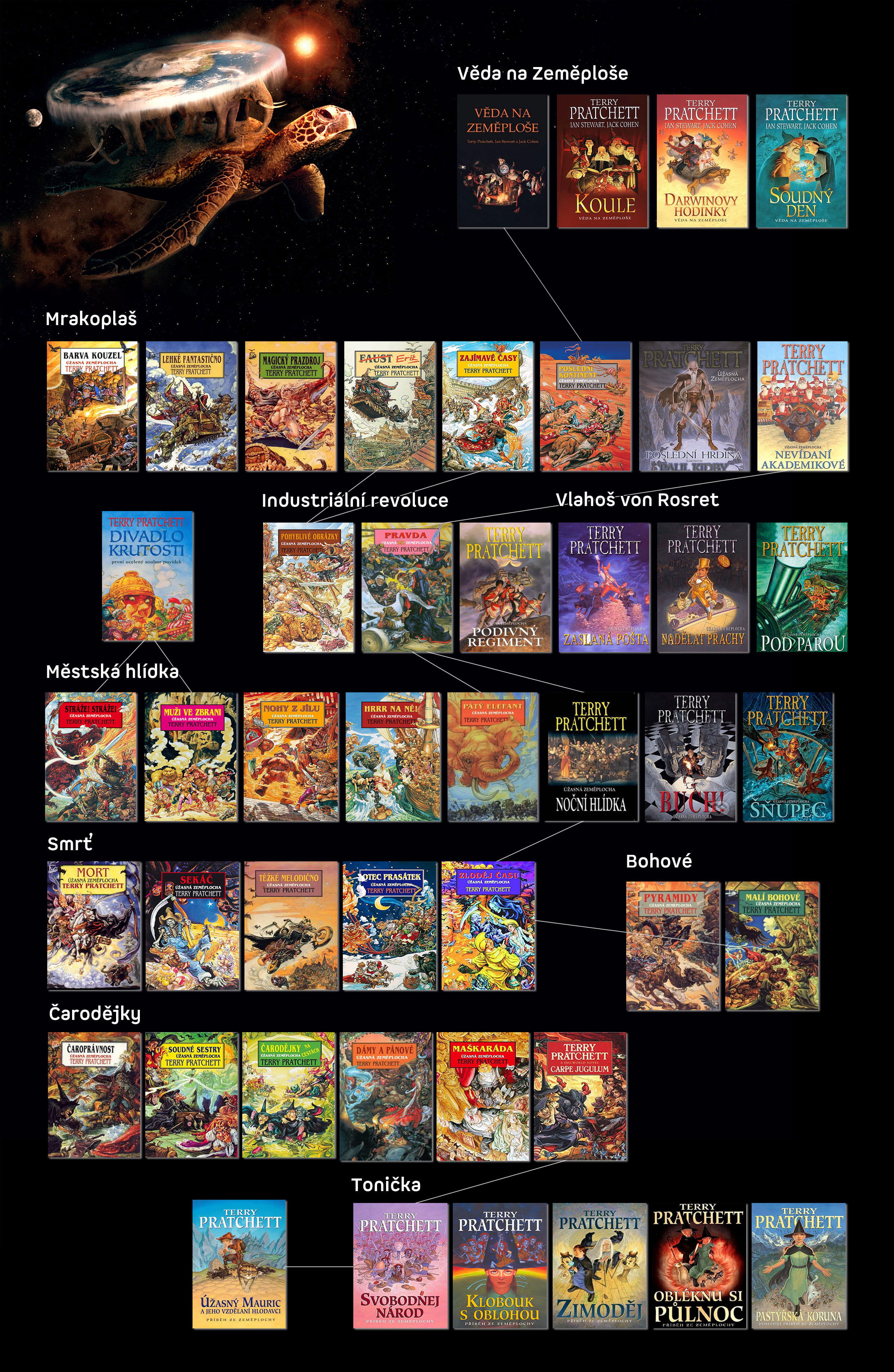
Although I started with The Color of Magic, I read the other books in various orders, depending on which one was available and which one I happened to stumble upon in the bookstore. Back then, I couldn't just sit on my butt and wait for the postman to bring me the next piece. It didn't matter at all. Each installment is a standalone book that only loosely follows previous events. But if you like order and systems, we've included a clear "diagram" (full-quality image) from which you can read how the books logically follow each other.
Don't be afraid to visit Discworld! It's a magical world that conscientiously holds a mirror up to our own. Terry Pratchett populated it with living characters you'll never forget. Whether they are powerful witches, furry librarians, aging heroes, suspicious meat pie vendors, or Death himself. These are books you'll often laugh out loud at, and you'll often learn something interesting too. Because Terry Pratchett was no fool!
author Karel Krajča

Karel Krajča
editor-in-chief
Author profile and more articles
Editor-in-chief, content creator, and organizer of the Fantastická Ostrava festival. A fan of fantasy, video games, board games, and pop culture in general.
You might also like

A Guide to the Star Wars Book Canon
Do you want to start reading stories from the Star Wars world and don't know where to begin? Our handy overview will help, even though not everything has been released in Czech yet. But we'll get there! full article...
Tips and guides 29. 9. 2026 Eva Lassler 6 min
Book Review: Sladký příběh – A Dark Fairy Tale of Bizarro Fiction
Do you dream of reaching the end of the rainbow? In Sladký příběh, a childhood dream turns into a dark reality. Find out in our review why this slim book will consume you. full article...
25. 8. 2026 Tereza Nesvadbová 3 min
The Road Anniversary: What Did Cormac McCarthy Leave Behind?
Cormac McCarthy's novel The Road celebrates a major anniversary. Remember this post-apo cult classic through the legendary book, film, and the new comic by Lercenet! full article...
1. 7. 2026 Jana Mrkvicová 5 min