


How to create your own language: What is a conlang?
A practical guide to creating your own language, from the basic steps of choosing sounds and words to more complex levels of grammar and custom scripts.

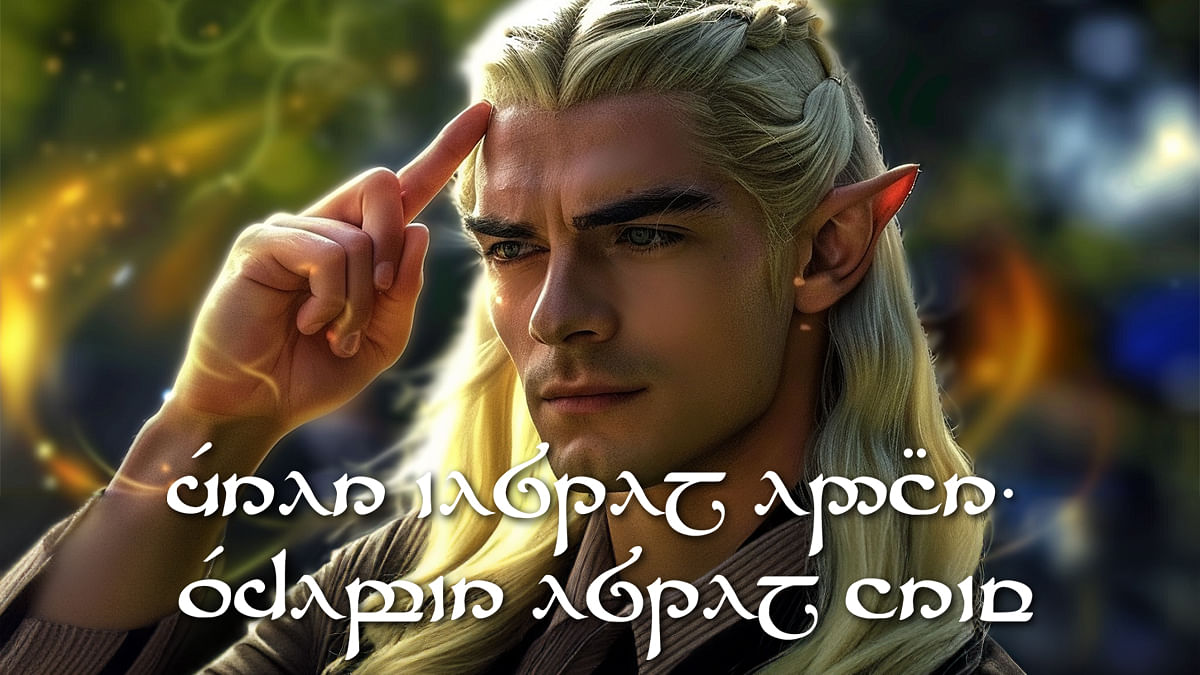
Conlang is short for constructed language, meaning an artificially created language. There are several types, but people most often develop conlangs to add depth to their fictional worlds. Some well-known conlangs include Klingon, Dothraki, and Sindarin. These are all languages for fictional worlds. Want to take your tabletop RPG sessions to the next level? Create your own language!
Sometimes a conlang is created for the real world as well. Usually, these languages don't catch on or spread enough to have any real-world utility. These include Esperanto or Interslavic, a language that all Slavs are supposedly able to understand without learning it.

In this article, I'll show you how you can create your own conlang, and don't worry, it's not difficult at all—it just takes a bit of persistence. After all, no language was built in a day. I'll create one conlang in this article so there's an example for every step.
Who speaks the language?
It's important to know who speaks the language. Ask yourself a few questions about them. How advanced is their technology? What is their environment? Desert, jungle, or perhaps they live underwater? Are they even human? Speakers of Imagonian will be humans at our technological level. Therefore, they have words for both a sword and a spaceship.
Name
Your language needs a name. It's not the most important thing, but sooner or later, it should have one. For me, the name isn't the first thing to solve when building a conlang, but it's up to you—feel free to name it first. My conlang will be tiny and primitive, and it will be called Imagonian. Why? If you don't know yet, you'll understand in the next step.
Sounds
In my experience, it's best to start by choosing the sounds you want in your conlang. The easiest way is to pick sounds from languages you already know. For example, if you can't pronounce the French 'r', don't use it, or conversely, if you can pronounce the Czech 'ř', feel free to use it. You can add some exotic sounds, but I'd only recommend that if you can actually pronounce them. If you want, you can look at the IPA, the International Phonetic Alphabet. It's a collection of all known sounds that a human can produce, and each is assigned a symbol. That's why the IPA is the perfect place to look for interesting and exotic sounds.

For Imagonian, I've chosen these sounds: /ɪ/, /m/, /a/, /ɡ/, /ɔ/. These symbols are from the IPA. The sounds they represent are also in Czech and are pronounced i, m, a, g, o. (Why 'imago' specifically? Hmm?) I've decided that when I create the script, I'll add a symbol that lengthens vowels. More on that later. Usually, there are more sounds in a language, but as I said, this conlang will be tiny and primitive.
Words
With your chosen sounds, you can start creating words. It's best to start with basic phrases, e.g., hello, goodbye, excuse me, what's your name, my name is…, how are you, I am… and others. Later, you can start creating more specific words. When you run out of ideas, don't be afraid to draw inspiration from real languages or use a word generator.
Below are a few words and phrases in Imagonian:
Hello = imago
Goodbye = aimagó
Good luck = góm giamí
Sword = mog
Spaceship = gomagíta
I = mi
You = gi
It = go
To be = gím
To have = mam
To eat = ogmi
Cat = miao
Friend = amigo
Day = ím
Today = ime
Tomorrow = mime
Yesterday = gime
Grammar
The easiest way is to use the grammar of a language you speak fluently. However, everyone has different preferences, and some prefer a challenge, so they might want to make the grammar a bit more complex. If you use the grammar of an existing language, it doesn't matter what you keep or change. Think about declension, conjugation, sentence structure, and other factors.
I've decided that there will be no declension or cases in Imagonian, and conjugation will be handled only by adding words like 'tomorrow', 'yesterday', or 'last year' to the end of the sentence. In conversation, this might cause misunderstandings, so I wouldn't highly recommend it, but it greatly simplifies language creation and is enough for Imagonian. The only thing I'll play with is sentence structure. In English, we use SVO (subject-verb-object) structure. In Imagonian, I'll use SOV (subject-object-verb). This means the literal translation of the sentence: "Mi miao mam." is not: "I have a cat.", but: "I a cat have."
Script
This step can be skipped. Feel free to use an existing script. However, creating your own script isn't very complicated. First, you need to decide what type of alphabet you want. You can choose an alphabet where one symbol represents one sound, or use the same system as Japanese, where each symbol represents a syllable. Also, decide if you want to write from left to right, right to left, or even top to bottom. Probably the best method in any case is just to scribble on paper. Draw some symbols, and if you like one, circle it, underline it, or highlight it in color. This way, you will slowly but surely build a script for your language. If you run out of ideas, you can get inspired by existing alphabets.
In Imagonian, there are 8 sounds: a, á, o, ó, i, í, m, g. I will create only 6 symbols: a, o, i, m, g, and the sixth will function as a diacritic that lengthens vowels.
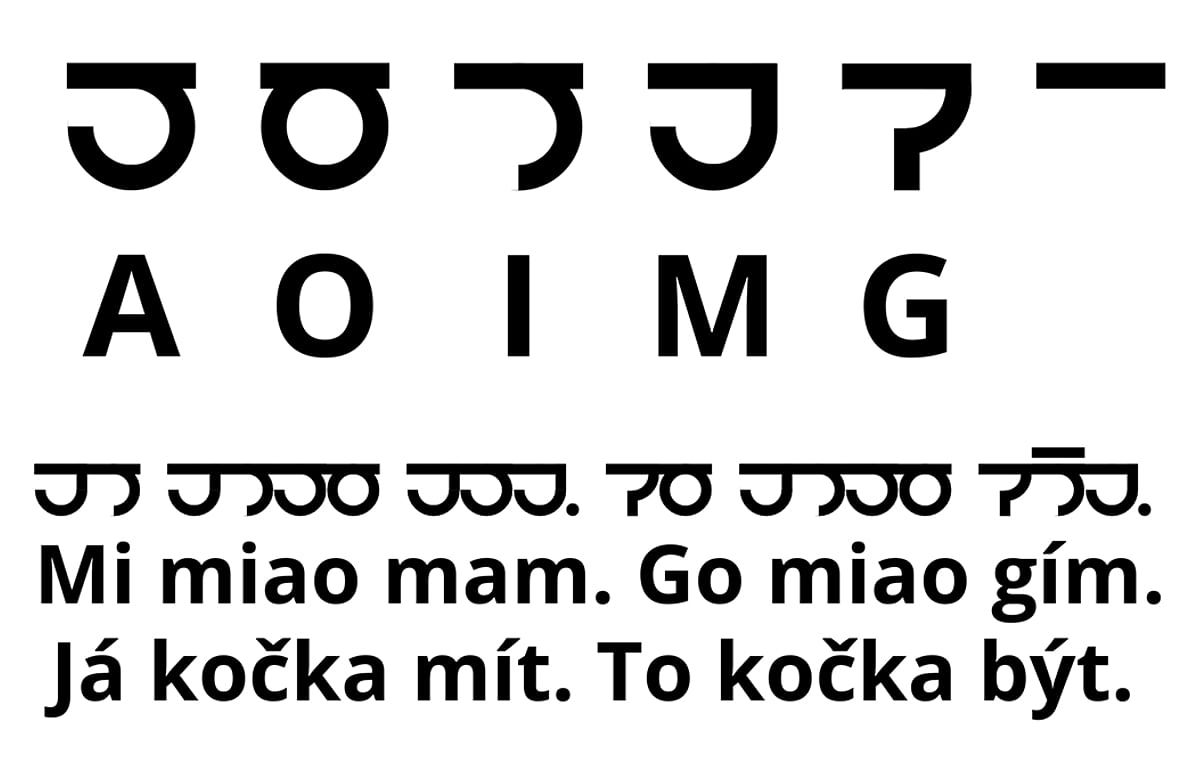
Góm giamí
As you can see, creating a conlang is as hard as you want it to be. You can spend years developing it and refining every tiny detail, or you can fully create it in a month. Both options are correct. It only depends on your preference and patience.
I wish you good luck, success, and patience in creating your new conlang!
author Jan Konečný
Jan Konečný
Autor článků na imago.cz


You might also like

Mytago Publishing Newsletter #37
Discover the latest from Mytago Publishing! We're releasing an expansion for The Witcher RPG, a campaign for Pirate Borg, and another installment of Fighting Fantasy. Find out what's in store for you this year. full article...
20. 8. 2026 Jiří Reiter 5 min
A Brief History of Dice
Did you know that dice have accompanied humanity for over 5,000 years? Take a look at their history from the first throwsticks to modern collector sets. full article...
13. 8. 2026 Karel Krajča 6 min
An Overview of Mark of the Odd RPGs
Are you drawn to minimalist RPGs? We've prepared a comprehensive overview of games built on the Into the Odd system. Find your favorite genre! full article...
10. 7. 2026 Jiří Reiter 21 min