


The Meaning and Methods of Tournament Armor Decoration
Peek into the world of noble PR and knightly alter egos at tournaments. Find out why armor didn't have to look scary and why perfect symmetry left craftsmen of the time cold. Inspiration for living history fans and game developers.
What do you find in the article?
My name is Martin Klecán, and as a historian at the museum in Strakonice, I focus on medieval warfare and equipment. In our introductory article, we covered the symbolism and aesthetics of plate armor. Today, we’ll look at tournament armor decoration – whether armor served as a tool for intimidation and what the quality of craftsmanship was really like.
Again, this text is not a rulebook on how things must look. It serves as an insight into the mindset of armor wearers and makers, and as inspiration for living history fans or game developers.
The Social Significance of Tournaments and Heraldry
In the previous article, I mentioned how important PR was for a nobleman. It played an even more crucial role at tournaments. Originally meant for honing martial skills, they quickly grew into a popular form of entertainment and a welcome opportunity to show off one's wealth. Especially at the turn of the 16th and 17th centuries, tournaments became increasingly popular.
A tournament participant represented not only themselves but also their family and their liege lord. For many, it was a way to increase their modest wealth. In times of peace, tournaments offered a chance to build a martial reputation. A nobleman wanted to present himself in the best possible light, and his jousting performance was only part of the journey. Tournaments were places to network and climb the social ladder, and you had to look the part.
We have confirmation from many sources that the show was an integral part of the event. For example, the aforementioned Emperor Maximilian I, an enthusiastic fan and participant in knightly jousts, had prototypes of mechanisms built to hold shields. When struck by a lance, these mechanisms were designed to make the shield shatter spectacularly.
In the book Le Livre des tournois by René, Duke of Anjou, which contained tournament rules, many illustrations have been preserved depicting warriors in richly decorated clothing and armor.
Duke of Brittany and Duke of Bourbon, Le Livre des tournois, 2nd half of the 15th century (Bibliothèque Nationale de France)
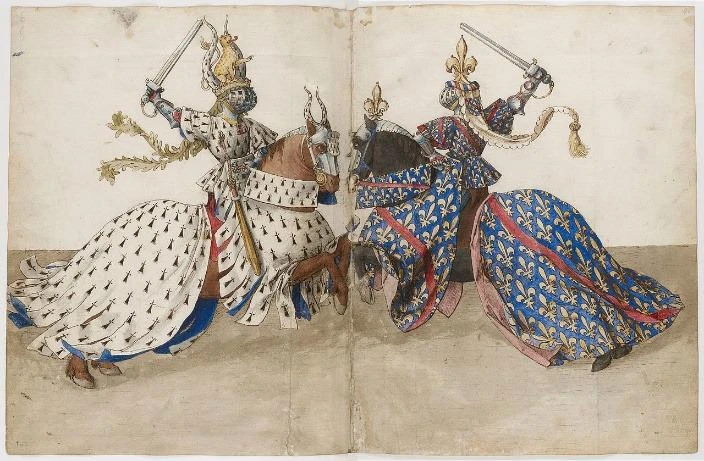
Heraldry played a huge role here; a nobleman wanted everyone to know who he was and where he came from. Family crests adorned not only shields but also surcoats worn over armor, and bulky crests mimicking heraldic figures appeared on helmets. These crests were usually made of hardened leather, as it provided the ideal combination of strength and low weight.
Surcoats were also used in classic battles, just like heraldry on shields. They served for easy identification and helped with orientation in the chaos of battle. However, crests had no place in this context – they would only hinder the warrior and, in extreme cases, could even kill him by giving the opponent a way to grab him, pull him off his horse, etc. At a tournament, however, no such danger existed.
Knightly Alter Egos and Themed Disguises
There were situations where a tournament participant wanted to hide their identity for some reason, creating an alter ego or posing as a character from a story. For example, Ulrich von Lichtenstein traveled through Styria and Austria disguised as King Arthur, challenging noblemen to friendly duels. Or so he describes in his book Frauendienst; whether it actually happened and he really used this disguise remains a question.
And for a third example, we can mention Emperor Maximilian I. He created a literary character named Freydal. Freydal participated in the same tournaments as the Emperor, so it’s not hard to guess what that was all about.
Disguises and alter egos didn't have to be just literary, and some tournaments were even built around them. Unsurprisingly, the aforementioned legend of King Arthur and the Knights of the Round Table became a popular theme. We have evidence of many tournaments that worked heavily with the symbolism of this story. This included costumes for participants, reenacting famous scenes, etc.
At Winchester Castle, you can still see the Round Table made during the reign of Edward I – we know he organized similar jousts to celebrate the conquest of Wales. Whether he also ordered the table to be made is not documented, but it would fit the puzzle.
Because Europe was in close contact with the Turks, whether through conflict or diplomacy, a certain fascination with Middle Eastern aesthetics emerged. The Electors of Saxony, for instance, collected a relatively large number of various Ottoman artworks, weapons, and armor over many decades. Part of this equipment came from repeated battles with the Turks, but a large portion consisted of diplomatic gifts. Thanks to this, a so-called Turkish Chamber could be created within the electoral armory, where items were thematically gathered.
However, the fascination with Turkey went far beyond collecting. In 1607, Elector Christian organized a tournament in Dresden that included a procession of noblemen dressed as Muslim warriors. Such tournaments were not an exception, and the equipment for the "Turks" was often provided by the organizer himself.
A Tool for Intimidation
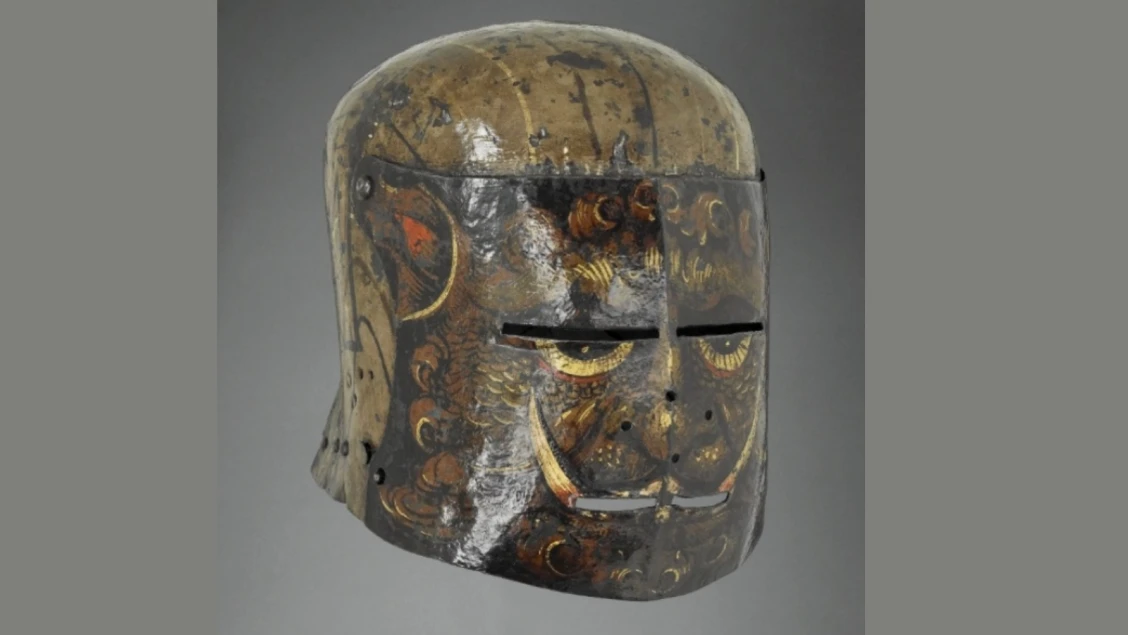
It is tempting to think that armor could certainly serve as a tool of psychological warfare, such as a sallet painted to look like some kind of wild animal.
Painted sallet, 15th century (Wallace Collection).
Winged Polish Hussars are certainly not an unknown concept to many readers and serve as a textbook example of modifying appearance to induce fear. In the second half of the 16th century, the Polish elite cavalry began using structures decorated with bird of prey feathers on their armor, which truly resembled wings.
The goal was to intimidate the enemy – the warrior's silhouette truly resembled a supernatural being, and the feathers likely produced a specific sound while riding. Whether this unusual decoration had any other practical use is not entirely clear.
However, this type of decoration was more of an exception, at least as far as battle armor was concerned. As mentioned above, it could easily become a risk for the wearer, and the benefits were not great enough to justify risking one's life. Paradoxically, one could say that the appearance of Polish Hussars makes more of an impression on a modern person than on their contemporaries. They fit perfectly into the fantasy aesthetic we are often raised on, and few people immediately think to consider whether they were actually making their lives more complicated with those "wings."
On the other hand, armor itself provided enough space to come up with something, even without such additions. In museum collections, we often encounter bizarre helmet shapes. The visor of a helmet is an obvious place to experiment with various shapes – it's perhaps the first thing another person notices. Of course, the same rules apply here as for the rest of the armor – you shouldn't overdo it, lest the helmet end up serving the enemy.
Thanks to this, we find many closed helmets across armories where the visor is shaped into human faces. It can be said with a high degree of certainty that at least some of these helmets were used in battle; they were not just made for ceremonial purposes. We can only guess at the effect of these steel faces. It was probably not very pleasant for an enemy to see the expression of the warrior in front of them without any mimicry; we are entering the realm of the "uncanny valley." And it's easy to imagine what advantages covering one's facial expressions could bring to the wearer.
For most preserved armor, however, we do not directly observe a deliberate attempt to decorate it to intimidate the enemy. A nobleman wanted to look as aristocratic as possible, presenting his wealth and taste. If he led soldiers in battle, his presence was meant to inspire and motivate them, and this was doubly true for a monarch.
For example, we have a description of the equipment Richard III wore at the Battle of Bosworth. The King had a helmet decorated with a royal crown and wore a surcoat with the royal coat of arms over his expensive armor. Absolutely no one was to doubt that he was the King of England and the most important person on the entire battlefield.
Knightly ideals of honor and fair combat also never disappeared, and a man clad in armor preferred to see himself closer to King Arthur than to some hellish or wild creature. Moreover, we have documentation of quite a few sets of armor whose components could be combined for both battle and tournaments, so the decoration had to suit both occasions.
In short, armor that looked significantly terrifying did not fit into this picture.
And, in principle, it wasn't even necessary. A knight dressed in full armor became an apex predator, and both he and his enemy knew it. He wasn't invulnerable, but he was definitely the best protected. At the same time, he usually had years of training behind him, and this combination certainly influenced his self-confidence. This factor is not unknown to modern armies – a well-equipped soldier is more confident and performs better. In the case of the nobility, their social status was also a dividing factor. Together, the heavily armored knights' confidence surely rose with every additional plate they put on.
A common soldier could hope that the enemy's heavy cavalry would be stopped by archers – if they managed to shower them with a quantity of arrows, statistically there was a decent chance that some arrows would find weaknesses in the armor and take out at least some of the enemy armored troops. A common soldier's survival could also be ensured by good tactics from his commander, an experienced and solid formation, or perhaps a terrain advantage, or a combination of these factors.
However, knightly cavalry was considered one of the most dangerous weapons of the medieval battlefield, and for obvious reasons, its charge decided many battles. Armor didn't have to look scary – the reputation of its wearers was enough; their charge was terrifying in itself, and there was no need to add anything more.
Imperfections and Inaccuracies
Across the equipment of all economic groups, we see another interesting trend, one that could be called the exact opposite. So far, we have been talking mainly about very precisely crafted pieces of armor, at least as far as the nobility is concerned. Although appearance played an important role and everyone with money to spare cared about it, it had its limits. This is most evident in weapons; a sword or knife hung at the owner's side most of the time, so only one side was visible. Much less time and resources were spent on the non-visible part of the weapon, and they often remained relatively plain.
Whether the armor was going to the simplest soldier or the emperor, we can notice various imperfections, sometimes of a quite surprising nature. Even on expensively crafted breastplates, it happened that a craftsman measured a hole for a rivet incorrectly and punched it somewhere else than needed. The solution? Make a new hole, and if the old one wasn't in a strictly critical place where it would threaten the integrity of the armor, he didn't worry about it. Likewise, armor makers were not overly bothered by traces of modifications when the armor went to a different owner or when it needed to be remade for the original owner.
Medieval man did not have our current demands for symmetry. We are trained by industrial production, which can mirror perfectly. In the past, they had nothing of the sort at hand, and symmetry was just optical and somewhat "plus or minus." Even so, one can find quite funny examples where even this optical symmetry is nowhere to be found.
Left: Sallet from the exhibition at Norwich Castle, 15th century. Right: Sallet, approx. 1480 (Metropolitan Museum of Art, NY)
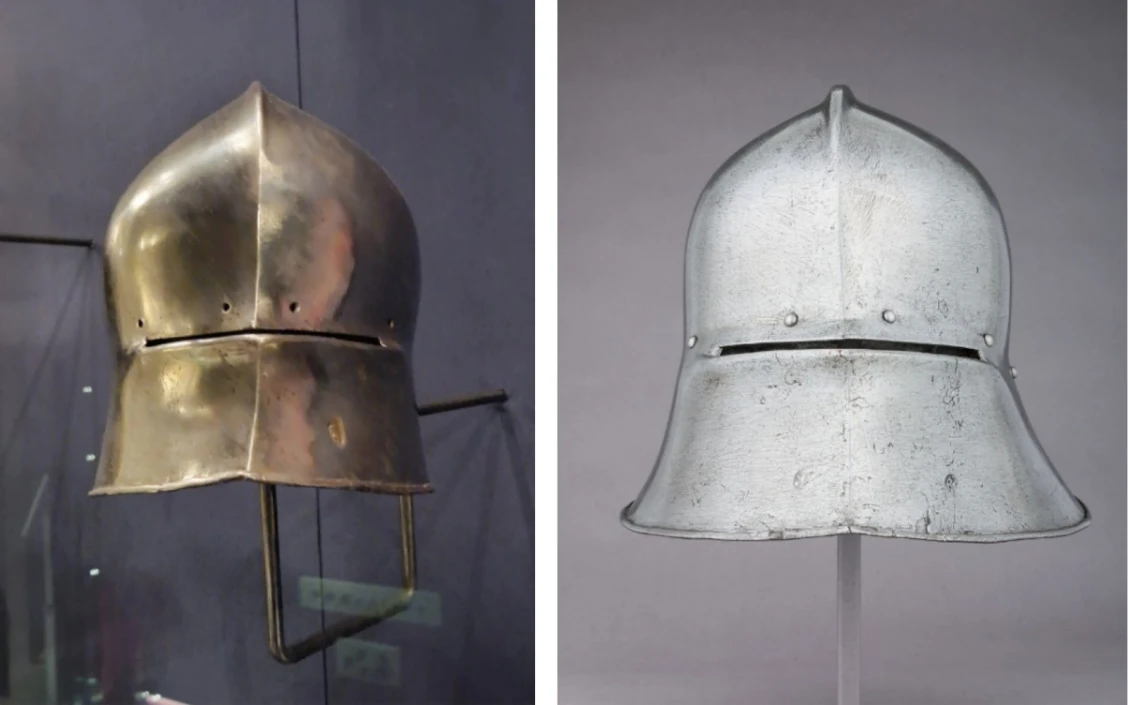
For example, in the exhibition at Norwich Castle, we would find a sallet where the craftsman's hand slipped significantly. Whether this helmet then went into someone's equipment remains a question, but it would be no surprise if it did. It's still better to have an asymmetric helmet on your head than none at all. A similarly "failed" sallet can be found, for example, in the collection of the Metropolitan Museum in New York, and if you look closely at other pieces of equipment in the exhibitions of other museums, you will surely find plenty of other examples.
The mentioned helmets are rather extreme examples, and of course, these are specimens that did not end up in the armories of the wealthiest. But together with the approach to decorating weapons and repairing mistakes, it gives us a pretty good idea of the mindset of the people of that time.
I hope that reading about armor decoration was a pleasant walk through history, and if you haven't read the introductory article dedicated to the aesthetics and symbolism of armor, just click the link and you can continue.
Martin Klecán
Autor článků na imago.cz
You might also like
The Aesthetics and Symbolism of Plate Armor
An unconventional talk by historian Martin Klecán about the decoration of plate armor in the Middle Ages and the early modern period, about symbolism and the PR significance of armor with specific examples from museums. full article...
16. 6. 2026 Martin Klecán 13 min
Non Sancti Olomouc: Medieval Cuisine Full of Flavor
About medieval cuisine with the Non Sancti Olomouc group, which focuses on traditional craft demonstrations, and a tip for the book Gastronomy of the Czech Middle Ages. full article...
Non-fiction journalism 16. 6. 2025 Kristýna Totová 4 min