


Jakub Němeček and the Gnóm! publishing house!
An interview with Jakub Němeček about the Gnóm! publishing house, focusing on translated speculative fiction that isn't afraid to occasionally jump out of its established box.

The Gnóm! publishing house is a small publisher focused on translated speculative fiction that isn't afraid to occasionally jump out of its established box. Today marks exactly 7 years since it appeared on our market. We caught up with Jakub Němeček, the translator and the main figure behind the publishing house, for an interview.
A gnome is defined as a character of small, perhaps even miniature, stature. Can we look for an intended parallel here with the creation of a small publishing house?
Originally, I was mainly looking for a suitable word – short, punchy, and unused. I believe a bit in the magic of words (and names), so it was important to name the brand correctly. Gnóm (Gnome) suited me both in sound and meaning, and the fact that it's a small creature and the publishing house is also small was just an extra bonus. (By the way, the exclamation mark is also an extra bonus; it was squeezed into the logo just for balance, so that the "o" could be under the tip of the angular "G" while avoiding a hole on the right.)
Moreover, it is said that the concept of a gnome differs significantly in magic, fairy tales, and fantasy. Can we deduce from this that your publishing house should also present itself with such, let's say, refined variety?
I don't know much about that, so if that's the case, this is also an extra bonus. I understand the word "gnome" as relatively mysterious and the creature as poorly defined, which suited me. It's clear that everyone imagines it differently, but I don't consider the concepts of fairy tale authors, fantasy, or games to be binding for me. I think vague words provoke the imagination, so it's logical that the concepts differ because everyone imagines and processes a "gnome" in their own way.
And as for the genres, yes, I definitely didn't want to limit myself to one specific genre. If I were to come up with a metaphor, a gnome travels through the depths – through various geological layers – and smoothly transitions from one area to another.
If I'm not mistaken, the Gnóm! brand appeared on the book market in 2016. What was the main motivation for a translator to decide to try the work of a publisher from scratch? And how do you evaluate your idea of founding a publishing house with a perspective of about 7 years?
Surprisingly, I wanted to publish books long before I started translating them. Which probably stemmed from the fact that I always read books and also occasionally admired them as artifacts. I had the idea of founding a pocket book series, if I'm not mistaken, even before 2000. But back then, it was just a very vague longing.
Well, but in 2016, the main motivation was partly a dare ("now I could manage to translate and typeset a book, so why not try it – couldn't I make a living from it at least a little?") and partly a desire to change the *status quo* on the local SF&F scene. Because I unfortunately had the feeling that everything I got my hands on was either well-translated, or well-designed, or had a good cover, but unfortunately never all at once.
Looking back after 7 years, it seems to me that it wasn't a bad idea at all. Those who scared me with financial troubles were more or less right. But at the same time, I see a trail behind me that I like. In other words, I feel it made sense.
Did you have an idea of what publishing a book entails, or were you finding out "on the fly"? How did the original idea eventually differ from reality? Have you never regretted your decision to found a publishing house, even in the corner of your soul?
I had a pretty good idea because I had already co-owned one publishing house between 2000–2004. Back then, there were only two of us, and I was in charge of the entire technical side of things. What was a bit shaky were my ideas from 2004 applied to 2016, because the world changes. I guess what changed most was that both books and publishers have increased since then, and the market was even tighter than before. But no, I never regretted it (or I have mercifully forgotten those states).
I have encountered the opinion several times that small publishing houses led by enthusiasts bring quality literature to fans. Can it therefore be understood that large publishing houses actually publish, albeit well-selling and marketing-supported, "crap"?
Actually, I would correct both. Small publishing houses don't necessarily have to bring "quality literature," but their contribution is that they are always "crazy." They often go outside any reasonable marketing plan, outside the mainstream. And sometimes it works out. I don't know if you know how mountain bikes, today's big business, were created. But it started because a bunch of hippies somewhere in California were riding down some mountain on old bicycles because they just enjoyed it insanely, and then they started improving it. (At least I read that somewhere.) Well, that's the chance for small publishers. But even if it doesn't work out for them and they don't end up making a living from it, it's always "different from the majority," and that is their contribution. Today there is even a term for it, it's called "book biodiversity" (or something like that).
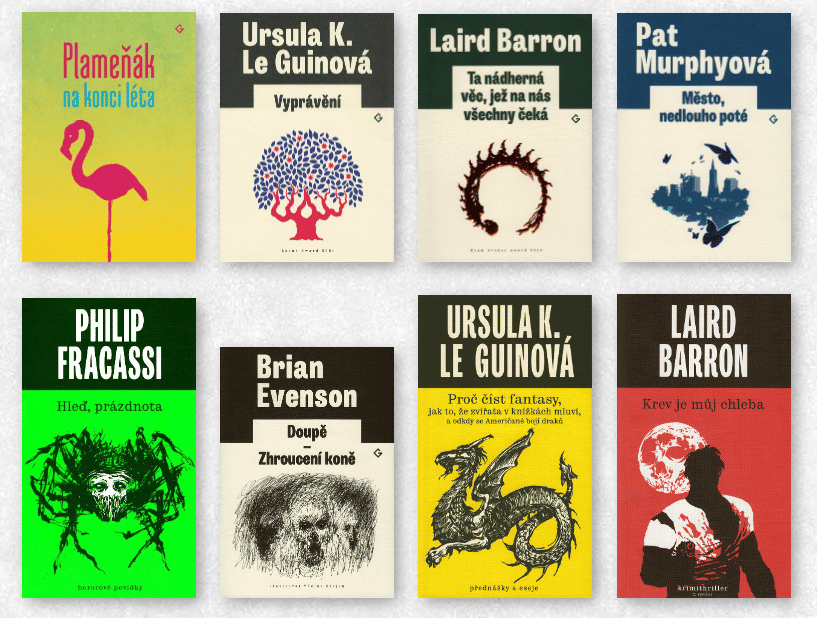
Large publishing houses are inherently more like factories the bigger they are. And factories, yes, produce en masse, and therefore "crap." They produce as efficiently and cheaply as possible, and at the same time, it brings them enough money for marketing so that their goods get everywhere and become mainstream. But I wouldn't blame them for this. What I think is terrible is when you can feel an intention behind it – when you suspect that behind it are not people who love books, but people who love money. And that they want that money for themselves and don't put it into those books, into their production, so they gradually resign on editing, proofreading, creative design, and suddenly the book is just cheap merchandise, and not a certain event with cultural significance, a certain manifesto of seeing the world, but just and only business. That, in my opinion, is the thin line that distinguishes a good (large) publishing house from a bad (large) one.
How did you get into translations in the first place? Did you always want to translate fantasy, or was that not the original intention? If I'm not mistaken, you also translated comic books by Max Andersson, whom I like, or Exit by Thomas Ott.
Those comic books you mention, that was exactly those years 2000–2004. On "Exit," however, there was nothing to translate; it is wordless, and I think I only translated the author's bio and came up with the text for the back cover. With "Pixy" by Max Andersson, it was different; that was my very first official translation, and I was struggling quite a bit. Fortunately, I managed to get a contact for an experienced translator who corrected the biggest nonsense for me.
I translated the second comic by Max Andersson together with my future wife, and she eventually – a few years later – recommended me as a translator to Triton, for which she had been translating for a long time; unlike me, she had actually studied English. Only then did my official career as a hit m… translator begin. To be honest, I was always strong mainly on the Czech side, and I was penetrating into English "on the fly."
Yeah, "always fantasy." I had been reading it since childhood. I didn't care what genre, it just had to be adventurous and colorful and/or fantastic. The greatest suffering for me was always realism. Long-winded descriptions, tedious psychological processes of stereotypical characters… except that today, as reality gets closer and closer to sci-fi, even sci-fi is starting to seem like boring realism to me, and I'm losing interest in reading (and translating) it, especially if the author limits themselves mainly to descriptions of technical wonders and the characters are just stereotypical puppets.
How do you handle the selection of titles? What is the criterion for you to start striving for the publication of a particular book? Is it just something like a personal measure of quality, or do you also think about sales potential?
This question is repeated often, and surprisingly I don't have it in my FAQ on the website. The answer is that, unfortunately, I don't know how I choose the books. It's a strongly intuitive matter, and certainly a very personal measure, a personal sieve. It has to do both with my previous reading experience and with "what the times are like." For example, I discovered Fracassi by random surfing, wrote to him, and within a few months translated and published his collection. I felt that it was meant to be, that it was the right moment. With other authors, I mess around for years, but even so, I feel they are "the right ones" for me. It just matures longer.
Sales potential is of course important to me, but I actually rely only on the fact that if it interested me, it will also interest "my" audience. It's not very numerous, but it's the greatest possible potential I've achieved so far. And that's how it works for me. I don't think about potential in the sense that "that's stupid, people will like it" (Werich). It's often true, unfortunately, but I couldn't publish something that I don't like.
From the beginning, your books have been published in a smaller/pocket format and have a "collective" visual - How did this intention arise and do you intend to stick to it? If, hypothetically, you were "mesmerized" by some novel, but for any reason its publication in this format was out of the question, would you rather renounce the opportunity to publish the work?
When I was a sixteen-year-old lad, I walked around Opava with long hair and in a green work jacket. In the breast pocket of that jacket, I carried small, pocket books, often from the SNKLHU *World Reading* edition, which was designed by František Muzika. And these books fascinated me so much by how pleasant, portable, and at the same time, despite their small scope, content-rich they were, that I stole this concept – including the dimensions of the edition – a few decades later and used it for myself in a different context.
The collective visual – in other words, an edition – is definitely not my invention, but perhaps I am one of the first to publish fantasy in this form. No, I'm not the first; I recall at least the Pevnost edition by the Epocha publishing house, which meets the parameters of an edition with its visual unity. However, it doesn't meet the parameters of a "typographically clean" edition, because – unfortunately – there is still the idea here that fantasy must primarily be a literal and large picture, and some font is just "plonked" there. In this, I am an innovator because I proceed in reverse, but you didn't actually ask about that.
Ad the second question: If I encountered such a novel, as has already happened, I will publish it outside the existing editorial series. Even in that case, however, I will stick to certain principles, by which (perhaps) it will be recognizable that it is from the Gnóm design workshop.
You also translate all Gnóm! titles yourself; is this an ideal solution, if I ignore the financial side of things, of course? Are there not missing, perhaps in some criterion, the opinions and views of other people, like large publishing houses have?
I didn't plan from the beginning that I would translate everything myself, because it slows me down a lot. Just look at Planeta 9, for example, how they got going. :) But this is related to the question about choosing books. When I choose a book, I am so involved in it (I don't want to say in love with it) that I eventually want to translate it myself. And at the same time, I still don't have enough resources to be able to distribute work simultaneously to three other translators (or even one), plus: translators never have time, so why deal with it and waste time myself with some coordination. Maybe it's a bit of a vicious circle, I admit.
However, those "opinions and views of other people," I think I have those. That is simply editing, and that is done very thoroughly at Gnóm. I would even dare to claim that more thoroughly than in many large publishing houses, because there, collation, i.e., parallel reading of the original and the translation, is often not done.
How much do you divide your time between translation commissions and work on titles of your own production? Is there any difference in the sense that, for example, you enjoy working on titles you want to publish yourself more?
I divide it as needed. Actually, according to whether I have money or not. When I don't have it – which is most of the time – then Gnóm! must go aside and I have to earn money. In terms of work on the text, there is no difference – I translate just as honestly "for a stranger" – and at the same time, there is a difference.
Because when I translate on commission, I am warmed by the feeling that I am earning for future bills and we will be secure with the family for a while, whereas when I translate for Gnóm!, I am warmed by the fact that I have artistic control over the book and I see it off until production and then even further, to the customers. Direct sales from the e-shop are often hard work, but I wouldn't give it up, because of that feeling that you are sending a book that you personally made to people who, from personal contact, you know are looking forward to it.
How did your love for literature arise, and what appealed to you about fantasy that you decided to publish it?
At our home, there was always a lot of reading, and unhealthily so, and books, statues, and paintings were piling up. I haven't told anyone yet, but my maternal grandmother used to hang around the leftist avant-garde of the twenties. She was therefore also a communist, although "only" until 1948, then no more. The point is that sometimes, between washing dishes, she would tell me how a drunk Nezval was crawling on the table back then and how Teige and Toyen were doing this or that… I don't remember it exactly, but the feeling that you are hearing this first-hand, and that she sat with them in a pub, was very strong, even though I barely had any sense back then. Because culture and literature learned in school is one thing, and lived culture and literature is another. My grandmother influenced me perhaps more than my parents, and I owe her for many things.
Well, and as for fantasy, I don't know where I got it from, but I've had it since childhood. That feeling, coming into a small-town library and finding a novel by Ludvík Souček there that I hadn't read yet, that was something like finding the Holy Grail for Arthur. Or when your mother, who always had a nose for books, brings you the very first edition of The Hobbit, it's about 1982 and you are fourteen, only no one had defined "fantasy" yet and you just know that it is something new and amazing, some completely new way of writing that you just discovered only yourself. Those are non-transferable experiences.
At the same time, I read everything that came to hand, it didn't always have to be fantasy, but it had to be subversive in something, new, different from the average.
Do you think that the sales and popularity of individual authors are also helped by the fact that their books are published by more domestic publishers? Laird Barron was published by Laser, Ursula K. Le Guin by Argo and Triton…
I wouldn't dare to guess that. It certainly sounds logical. When I think about it, it also probably depends on who the audience of those other publishers is. They can be completely different groups of people, and in that case, it may not influence each other. For example, those who come to buy another Le Guin from me at Knihex sometimes tell me that they already read "Why Read Fantasy" and thus discovered the author for themselves. But Le Guin has been published here since the eighties. So these people didn't know her because they themselves don't belong to the circle of old-school sci-fi readers, and they discovered her only thanks to me. Perhaps I am raising sales for Argo and Triton, but it could easily be the other way around. I think these mysterious flows are not mapped by anyone, but it seems like a certainty to me that a different way of presenting a book attracts different people. And by "presentation," I mean, of course, the translation, design, cover, but often also the material execution of the book, because the difference between "laminate or paper," "hard or soft cover" can play quite a big role in what kind of person the book attracts.
You have gradually launched three separate editions for your books. How would you explain to the uninitiated how they differ and what parameters each edition has in terms of processing, content, etc.?
The very first edition was the one I already talked about, the one copied from František Muzika. But compared to the model, I conceived it luxuriously; for example, the dust jacket is made of expensive Conqueror paper and occasionally there is embossing on it. As a result, I had the feeling that it wasn't selling much precisely because of how elitist it is. For the first two years, I only published three books, and I had the feeling that they weren't selling well. And back then, they really weren't. I wanted to move on somehow, and so the inventing of editions began. (Originally, I didn't even plan editions; they somehow emerged for me. Logically, because from the beginning I was publishing books "in an edition," I just didn't realize it enough.)
So I came up with another edition with a different character and purpose – the "Pulp Robot" edition, which was supposed to stick in the memory with this somewhat nonsensical name, composed of two frequently used words. It was supposed to be a cheaper, newsstand edition, and it fulfilled its purpose quite well. It is popular, among other things, because the books are cheap, light in the hand, can be rolled into a tube, and so on. The first book in this edition, Fracassi's "Behold the Void," actually sold unusually well, but that was also because I had made a bit of "marketing noise" around it beforehand.
So the first of these editions remains reserved for genre-defying solitaires, while the second is for genre-defined books that can also appear in series.
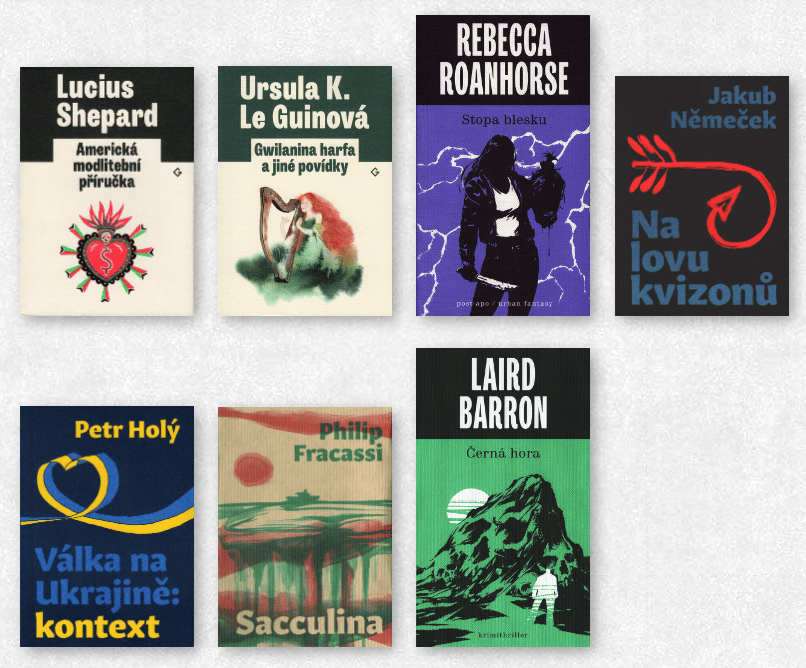
Only last year was the Pemmikan edition created, where I wanted to try "even smaller books," such snacks, but nutritious. That's why it's called that – pemmican is dried meat for the road. It is not limited by genre, rather by scope. It can be said that Pemmikan was really created so that I could publish something easily and quickly, instantly. A reflection of this is the very first book "War in Ukraine: Context," which deviates from my focus on fantasy, but reacts to an event in our reality that shook us all.
Well, and this year a fourth edition should be created, Horla, promised already two years ago, which was created because in the first edition (now called "G," because it didn't have a name at the beginning), too many horror stories started appearing. I understood that horror deserves its own series, again strictly uniform. In this case, the series will have two versions, a "mass" one for shops and a "collector's" one for purchase only from me. With this strategy, I want to try to solve my permanent financial problems. I won't write to you about Horla here; you'll probably hear about it this year.
Which title of yours is the best-selling, and which surprised you in terms of sales, either positively or negatively? And could you introduce a few of your titles/authors for those who haven't encountered them yet?
Typically for a beginner, I was surprised by "Flamingo at the End of Summer" by how little it sold. But this is probably common. I was disappointed by how little "Cities, Not Long After" sold at first, but it's better now. People like that book. Currently, "Trail of Lightning" is playing the role of the biggest punching bag.
The best-selling is Ursula K. Le Guin. "The Telling" has already sold out, and "Why Read Fantasy" as well as "Gwilan's Harp" are staples. And finally, Barron's "The Beautiful Thing That Awaits Us All" with embossing on the dust jacket didn't disappoint either; interest in it is still there and hopefully it will sell to the last piece. I think the artistic processing of the book, of which I am the happy author, has a pretty big share in that.
Introducing titles is quite difficult; I always feel like I'm leaving something out. Whoever wants to will find everything on the publisher's website, which is quite detailed for today's times. I would just say this much: Gnóm is currently straddling between "male" and "female" literature (although even this wasn't planned). The softer, female, and optimistic branch is currently represented by Ursula K. Le Guin and Pat Murphy, while the rough, male, and gloomy branch is represented by my horror authors.
Everything else (such as Lucius Shepard with his "American Prayer Book," which is simultaneously a social satire, thriller, urban fantasy, collection of poems, and a love novel) is located somewhere between these branches, or outside them.
"Your authors" are mostly known on an international scale, but the domestic reading public may not know them. How to get their names into wider awareness and how to draw more attention to your publishing brand? Is it even possible within the domestic book market, or do you have no choice but to bet on connoisseurs and enthusiasts?
I'm not complaining. I feel that in seven years of operation, I've brought more into awareness than others in thirty. But maybe I just reached a different target group.
It really depends a lot on the method of presentation. For example, the best horror I've read so far, I didn't publish. It's called "A Head Full of Ghosts" and it was written by Paul Tremblay, a buddy of Barron and Langan. King stated about that novel that he was actually scared, and he doesn't get scared just like that. It's even on the cover. What better advertisement to wish for than an explicit recommendation from King? The translation is very decent, the cover is mediocre, the paper is low quality. Published by Knižní klub, 2016, and the rating from 155 people on Databáze knih is 65%. It seems the book fell through the cracks. A second edition didn't happen. Where did the mistake happen? I don't know, but that book doesn't deserve it. So even a large publisher doesn't have to be successful in promoting a book.
And conversely, "betting on connoisseurs and enthusiasts" is perhaps a quite reliable path, because as is known, the best is a personal recommendation from friends.
Do obstacles occur for small publishers, for example in distribution? How do you calculate the final price of a book when it is known that distribution companies take at least 50%?
Well, logically I have to calculate so that I have some profit even from those "my" 50 percent. That at the same time gives me the opportunity to offer a discount if I sell directly. There are probably no big secrets or hurdles in this. We have to go into distribution because otherwise, if the book doesn't even flicker on the shelves (and on websites), no one knows about it. At least, if you are aiming for print runs higher than 1000 copies, like me. And I have those ambitions. Perhaps thanks to that, I don't see any major problems with distribution, but for people who do hundreds of copies, for them it must be different, because such a quantity is scattered in distribution in the style of "one book per shop," and I don't know what effect that has then.
What is a problem for everyone, however, are the so-called parasitic e-shops, i.e., companies that don't have a brick-and-mortar store (= don't have high costs), but take books at the distributor's price. Then they sell them with a profit of a few percent, so they have the lowest prices. By doing so, they are literally enriching themselves on someone else's work. It's cynical scumbaggery, nothing else. Capitalism without common decency is of course also capitalism, but the question is who wants to live in it then.
What titles can we look forward to from you, whether as a publisher or "just" a translator, in the future? Personally, I would be happy for more books by Barron, Fracassi, or Evenson…
This year, three books should be published that I translated for other publishers. All of them will be great, even if each for a different group of readers. But given that I only figure in it as a hired worker, I am reluctant to reveal anything without the prior consent of these publishers. In short, just look forward to it vaguely, well.
But actually, I can already reveal one of them, it's already publicly announced: Sofia Samatar, "A Stranger in Olondria." Host will publish it on May 5th. A beautiful thing. I will write about it then on the Gnóm FB.
And as for Gnóm!, right now it's the turn of the first book of the Horla edition, Brian Evenson: "A Song for the Unraveling of the World." It's another collection of short stories. It will be good. I will keep quiet about the next one, but that I have bought the rights to a novel by Fracassi, that's also not a secret.
author Roman Bílek
Roman Bílek
Autor článků na imago.cz
You might also like

Mysteries of the City of Kalus: An Interview with the Author of a Massive RPG Campaign
What is it like to write a massive RPG campaign? An interview with Sparkle about the Mysteries of the City of Kalus, the transition from classic to postmodern fantasy, and inspiration from real life. full article...
Interview 15. 12. 2025 Karel Krajča 5 min
Interview: Michal Dlouhý on his debut novel, The Divided City
An interview with Michal Dlouhý about his debut, The Divided City. How the book was created, what inspired him, and why the wizard loses his power. full article...
Interview 4. 11. 2025 Karel Krajča 5 min
The second Dračí Hlídka gamebook: An interview with the author
The Ztracené město Galadu gamebook is darker, more sophisticated, and more personal – and the author also reveals plans for its successor. full article...
Interview 30. 7. 2025 Karel Krajča 8 min