


Resident Evil: The History and Present of a Famous Game Series
The Resident Evil video game series is a survival horror legend. Check out the history, main entries, the story of Umbrella Corporation, and film adaptations. Why is it so popular?

What do you find in the article?
- A Bit of Brand History
- The Overall Story and Essence of Resident Evil
- Individual Series Entries
- Resident Evil (1996)
- Resident Evil 2 (1998)
- Resident Evil 3: Nemesis (1999)
- Resident Evil – Code: Veronica (2000)
- Resident Evil 0 (2002)
- Resident Evil 4 (2005)
- Resident Evil 5 (2009)
- Resident Evil 6 (2012)
- Resident Evil 7: Biohazard (2017)
- Resident Evil Village (2021)
- Resident Evil Requiem (2026)
- Other Adaptations – Mainly Movies
It all started in a test tube. It's hard to say whether the contents escaped due to carelessness or intent. Either way, the result was a catastrophe starring zombies, disgustingly mutated monsters, and one of the most famous video game series of our time - Resident Evil.
A Bit of Brand History
The series began in 1996 (as Biohazard in Japan) and helped popularize what we now call survival horror: tension, puzzles, environmental interaction, inventory management, and the constant feeling that you are not the hero, but the prey. Crucially, Resident Evil has undergone several fundamental transformations over the years—which is why it survived. Sometimes it leaned more into action, other times it returned to fear and dread.
In its early days, Resident Evil had two serious competitors: Silent Hill and Alone in the Dark. The Silent Hill brand is still alive today and remains successful, partly thanks to great remakes of the old titles. Alone in the Dark also attempted a reboot, but that didn't turn out very well. This trio of games defined the standalone survival horror category.
Thanks to remasters and remakes, games from the Resident Evil series remain relevant today. Capcom successfully keeps the brand modern and regularly shows the competition how it's done.
The Overall Story and Essence of Resident Evil
The central theme of the entire series is a simple yet highly effective premise: "Someone" tries to create the perfect biological weapon, and then "it" escapes from the lab into the world. That "someone" is most often the Umbrella Corporation—presenting itself as a giant pharmaceutical and research conglomerate, but in reality, an organization that has long tested viruses, parasites, and other bio-projects on humans and in the field. The first major disaster that kicks it all off is the incident around Raccoon City and the gradual revelation that this isn't an accident, but a system.

What causes zombie apocalypses and other horrors is usually some variant of a viral infection (the most famous being the T-virus)—but Resident Evil never gets stuck on just one "disease." Gradually, more mutations, new strains, parasites, and biological experiments appear. Once it's shown that life can be modified into a weapon, more and more people become interested: corporations, armies, terrorists, occultists, and individuals obsessed with power. And this escalation is the engine of the entire series—from a single isolated house to global bioterror, where it's no longer just about survival, but about who controls the "living production."
Individual Series Entries
Resident Evil (1996)
Setting & Story: A secluded mansion in the middle of the wilderness, where the investigation of "strange incidents" quickly grows into the discovery of experiments and bio-weapons. You are inside a house that is turning into a trap—and with every unlocked room, the feeling grows that something here doesn't belong in our world.
Gameplay: Classic "survival school." Exploration, puzzles, inventory management, backtracking through familiar corridors, and limited resources. The remake adds even more emphasis on atmosphere and tension.
Resident Evil 2 (1998)
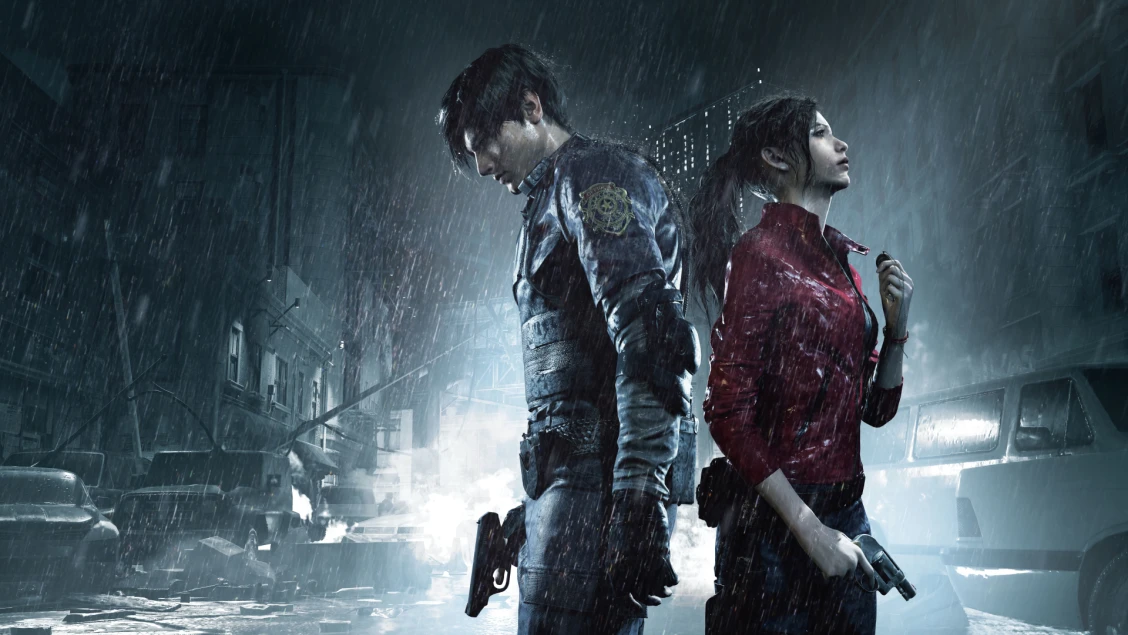
Setting & Story: Raccoon City at the moment of collapse. Two parallel storylines (Leon and Claire) revolve around the police station, escaping the city, and gradually piecing together the truth about what got in and why there's no turning back.
Gameplay: Still survival horror, but with a greater emphasis on pacing and story. A strongly "hub-based" environment (the station as the focal point), lots of backtracking, gradually opening shortcuts, and working with keys and puzzles.
Resident Evil 3: Nemesis (1999)
Setting & Story: Raccoon City becomes an escape route. Jill tries to get out, but someone (or something) has one goal: don't let any witnesses leave. Nemesis isn't just a boss here—it's a stressor that changes how you move around the map and how you make decisions.
Gameplay: Faster rhythm, more pressure, more "run and improvise." Typical is the pursuit and the feeling that the game can break your safe routines.


Resident Evil – Code: Veronica (2000)
Setting & Story: Outside Raccoon City, more "global Umbrella" and a more personal conflict surrounding family and power within the organization. Claire starts in captivity, and the plot gradually shifts into even larger and stranger settings; Chris also plays a significant role.
Gameplay: Old-school style with an emphasis on exploration, inventory, and planning. This entry can be tougher in how it punishes you for poor resource management.
Resident Evil 0 (2002)
Setting & Story: A prequel that explains what led to the events of the first game. It starts on a train and continues in abandoned facilities connected to Umbrella—rather than "one house," it's a series of isolated horror spaces.
Gameplay: The signature feature is working with two characters: switching roles, combining abilities, and slightly different inventory management (you often have to decide what to leave where). This entry just expands the story; it doesn't bring anything fundamentally new.
Resident Evil 4 (2005)
Setting & Story: Leon heads to a remote part of Spain to rescue the president's kidnapped daughter. Countryside, a cult, a parasitic infection, and a gradual transition from the village through larger "arenas" to even crazier places.
Gameplay: Revolutionary "over-the-shoulder" camera, more precise shooting, emphasis on action pressure in combat, and spatial awareness. It's more action-oriented, but still uncomfortably intense.
The fourth game was a revelation! New environment, new camera, guys with chainsaws, and a shift from classic zombies to mutants. The remaster was also beautifully done.
Resident Evil 5 (2009)
Setting & Story: Investigating bioterror in Kijuju (a fictional region of West Africa). Chris and Sheva gradually fight their way to the core of the next "evolutionary" step of bio-weapons and old ties in the background.
Gameplay: Significant co-op, more action combat, more work with a partner (and inventory between two characters). Tension here often stems from the pace and pressure in fights, not from quiet exploration.
The fifth game relied mainly on two-player co-op, but you could play it solo. Aside from the unusual African setting, however, it didn't bring anything fundamental.
Resident Evil 6 (2012)
Setting & Story: Global bioterror, more campaigns and characters that intertwine. It's the most "blockbuster" entry—it doesn't feel like one incident anymore, but a world falling apart on several fronts.
Gameplay: The most action-packed main entry of its era: set pieces, chases, hordes of enemies, several campaign styles depending on the character (from "more horror" to "total action").
Personally, I consider the sixth entry the weakest. A confusing story full of generic action didn't leave a big impression on me.
Resident Evil 7: Biohazard (2017)
Setting & Story: Ethan searches for his wife in a remote house on a plantation in Louisiana. What looks like a family horror slowly devolves into something much bigger—but it still stays on a tight and dirty personal level.
Gameplay: A fundamental return to fear thanks to the first-person perspective, cramped spaces, and a slower, nervous pace. This is where "I'm afraid to open the next door" starts working again.
The seventh game is a breakthrough title that also introduced a new game engine. It was a dense, scary experience further enhanced by the ability to play in VR (which made me sick immediately, though…).
Resident Evil Village (2021)
Setting & Story: Follows the seventh game, but moves you to a remote European village and its surroundings—with distinct "domains" and antagonists that give each part a different horror flavor (gothic, folklore, physicality, bizarre). The game introduces a brilliantly conceived gang of mutated vampires. And there are werewolves too!
Gameplay: A mix of survival and action: still first-person, still strong atmosphere, but more space, more combat, and a more "adventurous" structure.
Resident Evil Requiem (2026)
Setting & Story: (no spoilers) This is the ninth main entry, released on February 27, 2026, continuing the modern line of the series. A new heroine, Grace, appears on the scene—who is definitely no action hero—and the beloved Leon Kennedy returns as a seasoned pro who isn't easily rattled. The story itself returns to the events of the second game.
Gameplay: Requiem is an entry that tries to balance horror and action so that neither fear nor pace is lost. It alternates slower parts for Grace and action parts for Leon. While the authors are cooking with old ingredients, they've seasoned them with new elements and, most importantly, amazing-looking graphics. Requiem practically immediately climbed into the rankings of the best-rated games of recent years, and I have to say, quite deservedly. It's been a long time since I've been this scared and amazed by a game!
Other Adaptations – Mainly Movies
Resident Evil has long been more than just a game series. There are so many film and series attempts that they have essentially become parallel branches that often take the same concepts and settings but assemble them completely differently.
The most famous is the live-action film series from 2002–2016, which relies mainly on Milla Jovovich. Her Alice is the centerpiece of the entire film continuity—a character created specifically for the films, around whom the plot and action style revolve. These films are much more "bio-action blockbuster" than game survival horror: fast pace, big scenes, striking visuals, and a gradually escalating apocalypse. Game motifs and familiar names appear there more as ingredients in a new recipe. Paul W. S. Anderson's series has six parts. It started interestingly, but gradually it became a B-movie series, entertaining perhaps only for die-hard fans.
Then came an attempt to return closer to the source material in the form of Welcome to Raccoon City (2021). Here, there's more focus on familiar locations, characters, and events from the first games, and overall it feels like a "more fan-oriented" approach—though it's still true that a film must function differently than a game, so the result isn't a direct transcription, but rather its own version of the same myth.
Alongside live-action films, there is another branch that is often the most natural for game fans: CGI animation set in the same universe as the games. This includes, for example, the miniseries Infinite Darkness (2021) and the film Death Island (2023)—and generally, this direction relies on the fact that it can afford to play with game continuity, familiar heroes, and "bio-incidents" in a way that resembles game cutscenes stretched into a feature film.
And on top of all that, a live-action series (Netflix, 2022) was created that went its own way—more of an experiment than a "definitive" television Resident Evil.

Karel Krajča
Šéfredaktor, content creator a organizátor festivalu Fantastická Ostrava. Fanoušek fantastiky, videoher, deskových her a popkultury obecně. Příležitostný milovník malování figurek a craftení všeho druhu. Hudební závislák a amatérský znalec fyziky a matematiky.
You might also like

BlizzCon 2026: Diablo V, StarCraft shooter, and more news
Blizzard revealed their plans at BlizzCon 2026. Read the details about the surprising Diablo V, the new StarCraft shooter, and a special version of World of Warcraft. full article...
14. 9. 2026 Karel Krajča 5 min
Star Trek turns 60: The story of the sci-fi that changed the world
Star Trek celebrates 60 years since its first episode aired. Read how this sci-fi legend inspires real science, leads people to study, and shapes pop culture far beyond the genre. full article...
8. 9. 2026 Karel Krajča 7 min
One Piece TCG: A Guide to the Pirate Card Game
The One Piece TCG phenomenon has stormed the world of collectible card games. Read about the magic of its game system, how it compares to the competition, and who this pirate adventure is for. full article...
4. 9. 2026 Karel Krajča 7 min