



Ascension Card Game: A Guide to the World of Deckbuilding
Find out how the Ascension card game and the deckbuilding genre work. We’ll cover the rules, expansions, and the new Lord of the Rings edition. Get to know a genre legend!
I love card games. They are compact, feature polished mechanics, and are great for collecting and trading. Plus, it’s usually easy to find fellow enthusiasts to play with. However, I’ve started to struggle with large collectible games like Magic: The Gathering, Star Wars: Unlimited, or Pokémon TCG. I can't shake the feeling that if you want to play in tournaments and be competitive, you have to hunt for expensive rare cards and constantly tweak your decks. Soon, there are so many cards that you need a personal assistant just to manage them :).
Fortunately, there’s a solution: card games where you buy a base set and can start playing immediately. In this category, Ascension—the king of deckbuilding—reigns supreme.
When you look at modern card games today, you’ll encounter three magic acronyms: CCG/TCG (Collectible/Trading Card Games), LCG (Living Card Games), and our focus, deckbuilding. While they all use cards, each approaches the game from a completely different angle.
- CCG / TCG (Collectible/Trading Card Game): This includes classics like Magic: The Gathering, Pokémon, or newer hits like Disney Lorcana and Star Wars: Unlimited. You buy randomly assorted booster packs. You never know what you’ll find inside. Want the best card? You either buy more packs and hope for luck, or buy it from someone else at a high price. You build your deck at home and then take your finished creation to play against others.
- LCG (Living Card Game): A concept introduced by Fantasy Flight Games (e.g., Arkham Horror: The Card Game or Marvel Champions). It works similarly to TCGs in that you build your deck at home beforehand. The crucial difference is that there is no randomness. When you buy an expansion, you know exactly which cards are in it. Everyone has access to the same cards for the same price—eliminating the frantic spending on rare pieces.
- Deckbuilding (e.g., Ascension): This is a completely different league because one box is all you need. You don't buy any extra packs. All players start with the same conditions at the table and build their decks on the fly from a shared pool.
While in TCGs and LCGs you win (partially) at home by building a great deck from your collection, in deckbuilding, your success depends purely on your tactics, awareness, and ability to adapt to the situation during the game.
What is deckbuilding?
In deckbuilding games, the act of building the deck is the main gameplay element. You usually start with a small deck of weak, low-value cards. During your turns, you play these cards to gain resources, which you then use to buy better and stronger cards from a shared pool (often called the market) in the middle of the table.
The crucial moment comes when you draw all your cards—you simply take your discard pile, where your new, stronger catches are waiting, shuffle it, and create a new draw deck. Through this constant cycle, your deck gradually grows and becomes more powerful.
It’s a big difference from classic collectible card games (like Magic: The Gathering), where you carefully build your deck before the game even starts. In deckbuilding, the deck is created while you play. Your strategy must constantly adapt to the cards currently available in the shared pool.
Some of the most popular deckbuilding games include the fantasy battler Hero Realms (or its sci-fi version Star Realms), the thematic Star Wars: The Deckbuilding Game, the dynamic Shards of Infinity, the dungeon-crawler Clank!, the comic-book brawler Legendary, or the Czech-designed Lost Ruins of Arnak, which combines deckbuilding with worker placement.
While deckbuilding mechanics are common in board games today, I’m focusing purely on card games where deckbuilding is the core experience. And in that category, Ascension is at the absolute top.
The Birth of Ascension
When Ascension (originally subtitled Chronicle of the Godslayer) hit shelves in 2010, it wasn't designed by beginners. The game was created by a group of former professional Magic: The Gathering players: Justin Gary, Rob Dougherty, John Fiorillo, and Brian Kibler from StoneBlade Entertainment. They leveraged their experience from thousands of hours of tournament play to create a game that offers sophisticated tactical decision-making in a package accessible to everyone.
At the time, the genre was dominated by Dominion (2008), designed by Donald X. Vaccarino. However, it had one characteristic feature: a static market. At the start of the game, fixed piles of cards were laid out, and players bought from them the entire time. Ascension shook things up by introducing a major innovation: a constantly changing center row. There are always exactly six hero and monster cards on the table, which are replenished randomly from one large central deck.
This completely changes the game's dynamics. The random availability of cards almost entirely eliminates the possibility of relying on a single pre-learned, dominant strategy. The situation on the table is constantly evolving, and you can't just follow a pre-set plan. The game forces you to improvise, read the board, and react to what’s in front of you. This variable market mechanism became a standard that many other successful games have since adopted.
How do you actually play?
It’s good to know what the goal is. The objective of Ascension is to collect the most Honor points. You gain these primarily in two ways: by defeating monsters (taking physical tokens from a shared supply) and by buying cards that have their own point values. The game ends when the shared supply of honor tokens is exhausted. The player with the most points (summing up tokens and points on cards in their deck) wins.
Each player starts with an identical deck of ten weak cards. Eight of them give you Runes, and two give you Power. At the start of each turn, you draw exactly five cards from this deck.
During your turn, you play these cards and use two main resources:
- Runes: These act as currency. You use Runes to buy new heroes and constructs from the shared center pool of six cards. If you don't like anything in the market, standard basic heroes are always available.
- Power: This is your offensive potential. You use accumulated Power to defeat monsters in the center row, earning immediate rewards and those valuable honor tokens.
If there are no monsters in the center, you can always attack the ever-available Cultist card. This allows you to score points even when there’s nothing else to fight.
What’s great is that there are no action limits. You can play as many cards and make as many purchases or attacks as your resources allow. At the end of your turn, you move all played, purchased, and remaining cards from your hand to your discard pile and draw five new cards for your next turn. Once you run out of cards to draw, you simply shuffle your discard pile to create a new draw deck—and that’s exactly when your newly purchased, stronger cards enter the rotation.
I’ve experienced turns where the cards lined up so well that I could play dozens of them. When the right combo hits, things get crazy! Keeping track of everything on the table can be a challenge. Fortunately, Ascension has a great online version that handles the rules for you.
Gameplay and what’s in the box
The goal of Ascension is to collect the most Honor points. You gain these by defeating monsters (taking tokens from the shared supply) and buying cards with their own point values. The game ends when the shared supply of tokens is exhausted.
Each player starts with an identical deck of ten weak cards. On your turn, you draw five cards and use two main resources: Runes and Power. In the center market of six cards, which is constantly replenished, you’ll encounter three basic types:
- Heroes: You buy them with Runes; they go into your deck and provide one-time effects or extra resources when played.
- Constructs: You also buy these with Runes, but after playing them, you place them in front of you, where they remain permanently to provide long-term benefits.
- Monsters: You don't buy these; you defeat them with Power to gain immediate rewards and honor points.
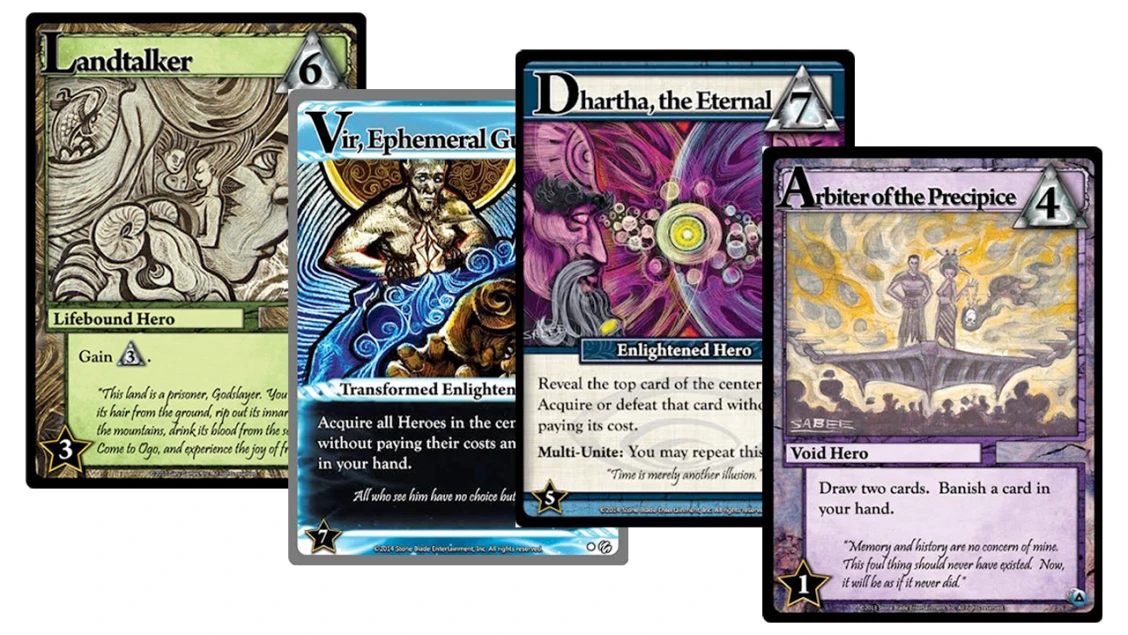
Purchased hero and construct cards belong to one of four factions, each offering a completely different playstyle:
- Enlightened: Act as deck accelerators, allowing you to draw more cards during your turn.
- Lifebound: Focus on rapid resource gain and trigger powerful combos if you play several in one turn.
- Void: Provide raw combat power and, most importantly, allow you to permanently remove weak starting cards from your deck.
- Mechana: This faction consists mainly of powerful constructs that have high honor point values for final scoring.
Due to the variable market, you usually can't rely on just one color. The key to victory is the ability to cleverly combine these types and factions based on what the random market serves up.
Base Ascension boxes are usually designed for 1 to 4 players. However, there is a brilliant way to increase the player count—because the expansions and sets are compatible, you can simply mix two different boxes together and play with up to 6 people. The game also includes a full-fledged solitaire mode from the start, so if you don't have any opponents, you can easily play against the game itself.
Expansions: When the base box isn't enough
Since you have a fixed pool of cards and don't need to hunt for more in boosters, you might wonder how quickly Ascension gets old. Ascension is known for the fact that you usually don't stop at one box. Over the years, many expansions have been released that you can play completely standalone or mix together as you like. The creators release them in blocks, with each new set introducing a unique gameplay mechanic.
During play, you might encounter events that affect everyone at the table (e.g., in the Storm of Souls set), a brand-new resource called Energy for unlocking hidden card abilities (Rise of Vigil), a special Dream deck (Dreamscape), or a day-and-night cycle that dynamically changes effects on the table (Gift of the Elements). Expansions are the perfect way to inject fresh strategic wind into the game once the base set starts to feel familiar after dozens of games.
There are many physical expansions (not counting various smaller promo packs); currently, there are 17 expansion sets on the market, with the last major expansion, Ascension: Legends, released in 2026. There are plenty of variants. You’ll soon find the ideal combinations that you enjoy the most. The game itself has no restrictions—you can mix all available cards and play, but I don't recommend it. There are too many cards, and their combinations don't work well. Based on experience, I recommend a maximum of three expansions.
The Lord of the Rings: Ascension – Into Middle-earth
After sixteen long years and seventeen expansions set in the original fantasy world of Vigil, StoneBlade Entertainment took the biggest step in its history. They acquired the rights to Tolkien’s work and, in the summer of 2026, launched a Gamefound campaign for the standalone game The Lord of the Rings: Ascension. It’s a major milestone for the studio and a dream come true for fans.
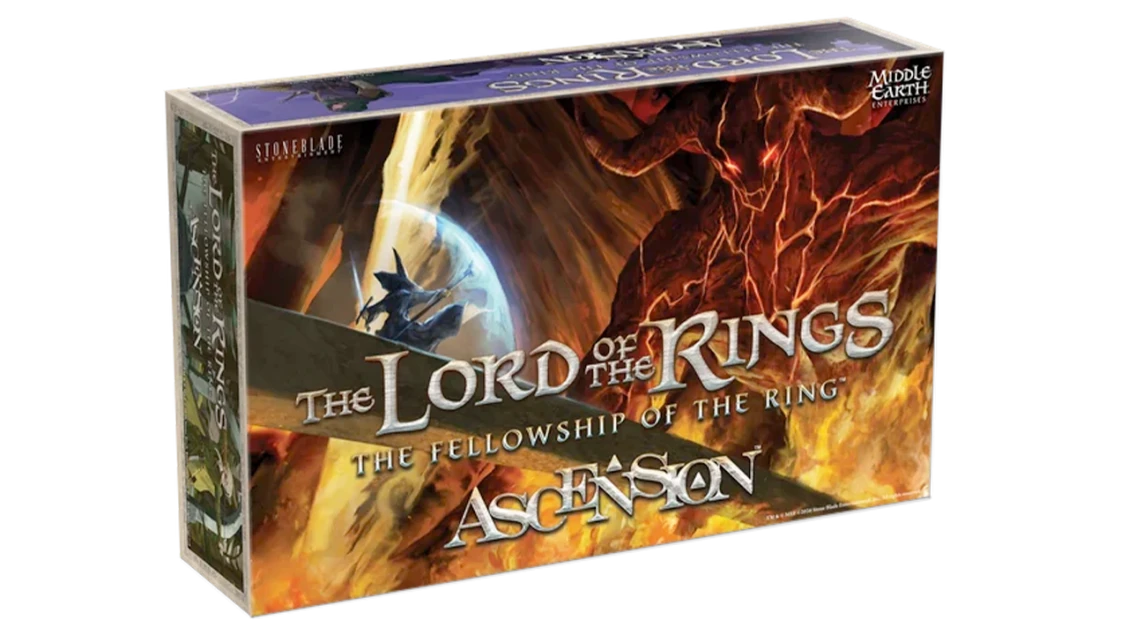
The studio is going all-in. They plan to release three standalone but fully interconnected sets. Each will be dedicated to one part of the iconic film and book trilogy—you’ll follow the story from The Fellowship of the Ring, through The Two Towers, to The Return of the King. Games take a pleasant 30 to 60 minutes, and you can play solo or with up to four people.
At its core, it’s still the good old, fast-paced Ascension, but the mechanics are completely overhauled for Middle-earth. Instead of fictional heroes, you’ll recruit members of the Free Peoples—Men, Elves, Dwarves, and Hobbits—into your deck. The main draw is the mechanic of the One Ring itself and its quiet but ever-present shadow from Mordor. Throughout the game, you’ll constantly balance on the edge—using the Ring’s immense power while fighting its corruption, which can easily destroy your deck.
You can still support The Lord of the Rings: Ascension in the campaign on Gamefound.
Whether you’re drawn to exploring the classic world of Vigil in the original boxes or the upcoming journey through Middle-earth, Ascension is a fantastic example of what a catchy card game should look like. It offers depth and tension without overwhelming you with complex rules or the need to spend thousands on random packs. If you’re just starting with deckbuilding or simply looking for a fast-paced game where victory depends on your ability to react to the situation on the table, this series is a sure bet. Just open a box and start building. Or you can start playing online. Versions for Steam, iOS, and Android are available.

Karel Krajča
editor-in-chief
Author profile and more articles
Editor-in-chief, content creator, and organizer of the Fantastická Ostrava festival. A fan of fantasy, video games, board games, and pop culture in general.
You might also like
TOP 6 board and card games for two
Discover the 6 best board games for two players that offer intense duels and great fun. A top selection from Karel—a passionate dueling game player. full article...
Tips and guides 12. 10. 2026 Karel Krajča 11 min
Magic: The Gathering 2027 Sets Revealed: Complete Overview
Find out which Magic: The Gathering sets are coming in 2027. We have three lore-based sets, an epic return to Kamigawa, and new fantasy crossovers ahead. full article...
27. 8. 2026 Karel Krajča 3 min
Pokémon Card Collecting: The Magic of Booster Boxes, Rarities, and PSA Grading
Want to know how to spot rare Pokémon cards and what determines a PSA 10? Check out these collecting tips from the guys at the Dvě vajca YouTube channel. full article...
4. 6. 2026 Dvě Vajca 6 min